

Ask ten people to explain seed phrase vs private key and you will get a shrug from most of them, because wallets tend to use the two terms as though they were interchangeable. They are related, and they are far from the same thing. One of them opens a single account. The other opens every account you will ever create from that wallet, which is why knowing the difference changes how you store each one and how you respond when somebody asks to see either.
What a private key is
A private key is a very large number that proves you control one address. When you send crypto, your wallet uses that number to produce a signature, and the network checks the signature against the matching public key without ever seeing the secret itself. Anyone who holds the number can spend whatever sits at that address, which is the whole of the security model in one sentence.
Most wallets show a private key as a long string of letters and digits, and some let you export one for a specific account. Its scope is narrow, and that cuts in two directions: leaking it costs you the coins at that one address, while backing it up protects only that address and nothing else in your wallet.
Where the words come from
The twelve or twenty-four words you were told to write down are a different layer of the system. Under the BIP-39 standard, your wallet starts with raw randomness, 128 bits for twelve words or 256 bits for twenty-four, adds a short checksum, and maps the result onto a fixed list of 2048 English words. Those words are then stretched into a 512-bit seed through a slow hashing function, which is the number your wallet builds everything else from.
From that seed, the BIP-32 standard derives a master key, and from the master key a tree of child keys spreads out in a defined order. Your first bitcoin address, your fifth ethereum account, the change addresses you never look at: all of them descend from the same words. Nothing is stored in the wallet in the sense of being written down somewhere, since each key is recomputed on demand from the seed and its position in that tree.
How the two compare, side by side
| Private key | Recovery words | |
|---|---|---|
| What it controls | One address | Every account derived from the wallet |
| Typical form | A long hexadecimal string | 12 or 24 words from a fixed list |
| Where it comes from | Derived from the seed | Generated from randomness at setup |
| If someone gets it | The coins at that address are gone | The entire wallet is gone, on every chain |
| If you lose it | Recoverable from the words | Nothing else can rebuild it |
The bottom row is the one worth sitting with. A private key is replaceable in the sense that your wallet can derive it again; the words sit above everything, and no support desk anywhere can regenerate them for you.
Seed phrase vs private key: which one do you back up?
The words, and the answer is that plain in almost every setup. Backing up a private key protects one address and quietly leaves the rest of your holdings undefended, which is a trap people fall into after exporting a key to move a token between apps and assuming the job is finished.
That leaves you with one string of words carrying the whole of your crypto life, and the usual advice is to write it on paper, or on steel if you want it to survive a fire. Steel is a sensible upgrade, since paper burns and blurs and gets thrown out by relatives clearing a drawer. It also leaves your security resting on a single object making it through everything the next twenty years might involve, including a burglary, a flood, a house move, and a stranger who has learned where you live.
We built TapSafe Recovery so that access is split instead of concentrated. The Recovery Tag holds 50%, your paired phone holds 50% encrypted into your own iCloud or Google Drive rather than sitting on the handset, and optional Recovery Contacts hold 25% each while learning nothing about your wallet. Because no single piece restores anything by itself, there is no one object whose loss ends the story and no complete answer for anyone to talk out of you. Your seed phrase stays available on the device as a last resort under BIP-39, so you are never locked to our hardware.
What happens when you import one into a new wallet
Importing a private key into another app gives you exactly one account, and the balance you expect either appears or it does not. Importing your words is where people get confused, because a wallet has to decide which branch of the derivation tree to look at, and different apps default to different paths under conventions such as BIP-44.
The practical effect is that your words can be entirely correct while a new wallet shows you a balance of zero. Nothing has been lost at that point. The app is looking at a different set of addresses derived from the same seed, and choosing the matching account type or derivation path brings your coins back into view. It is worth knowing this before it happens to you at eleven at night.
Why the words are what scammers ask for
Every wallet-drainer conversation converges on the same request, and the reason follows directly from the structure above. A private key would earn an attacker one address. The words hand over everything at once, across every chain, with no further work required, which is why fake support agents, counterfeit wallet apps and letters arriving in the post all steer toward the same twelve or twenty-four items.
No wallet company, ours included, will ever ask you for them. Anything that does is an attack, whatever logo sits at the top of the page.
The part you shouldn't have to manage alone
Understanding the difference between these two secrets is useful. Depending on the more powerful of them, written on something in a drawer, is the part that keeps costing people their savings.
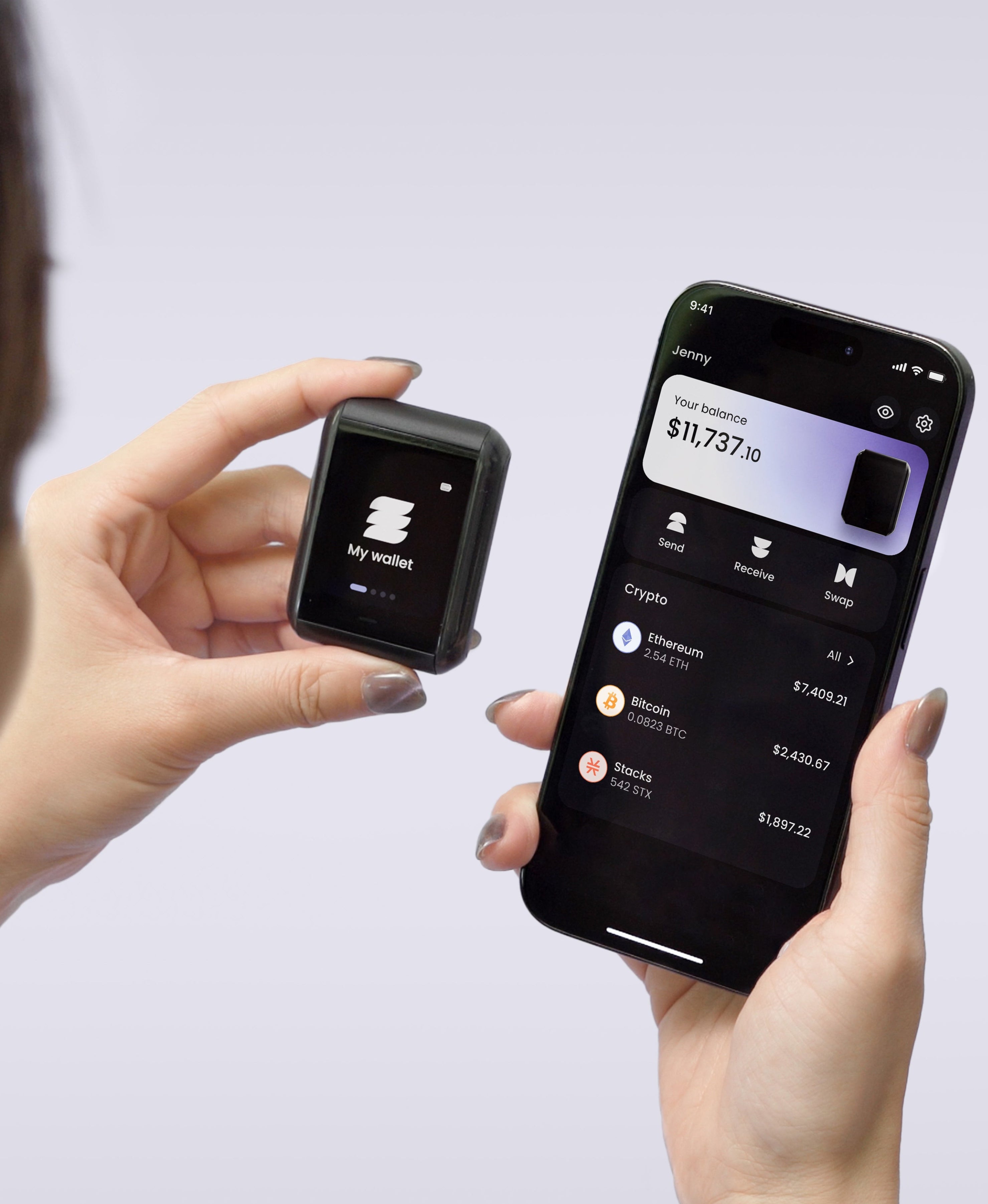
On a Ryder One, keys are generated inside an EAL6+ certified Infineon SLC38 secure element and never leave the chip, transactions render on a 1.6-inch AMOLED touchscreen so you can read what you are signing, and the firmware was independently audited by Halborn with the full report published. Communication runs over NFC alone, with no wired data path and no Bluetooth radio. Setup takes about 60 seconds, and the Starter Combo is 149 USD. Get your Ryder One.
Meta description: Seed phrase vs private key: one opens an address, the other opens your whole wallet. What each controls, which to back up, and why scammers want the words.


Share: