
Key Takeaways
Your private keys stay offline with both wallets. The difference is what happens when you need to recover.
- Ryder One backs up your wallet during setup using TapSafe Recovery. No seed phrase to write down, no PIN to remember, and no single backup that gives access to your wallet if found.
- Ledger gives you a seed phrase and the tools to manage it yourself. If you're comfortable with that responsibility and want access to the broadest ecosystem of chains and DeFi integrations, Ledger delivers.
- Ryder One is with everything included. Ledger devices range from $79 to $399, with an optional Ledger Recover subscription at $100+/year.
Choosing a hardware wallet comes down to one question more than any other: what happens when something goes wrong?
You may lose your device, forget where you stored your backup, or simply make a mistake under pressure. How a wallet handles that moment is what separates good security from a false sense of it.
This article walks through where they differ, where they overlap, and what those trade-offs actually mean in practice. We built Ryder One, so we're not neutral, but we've done our best to lay this out honestly, because the right wallet for you is the one that fits how you actually live, not the one with the best marketing.
High-Level Comparison
Ledger is the most established name in hardware wallets, with a broad ecosystem of chains, DeFi integrations, and multiple device options across price points. It follows the traditional 24-word seed phrase model that most crypto users already know.
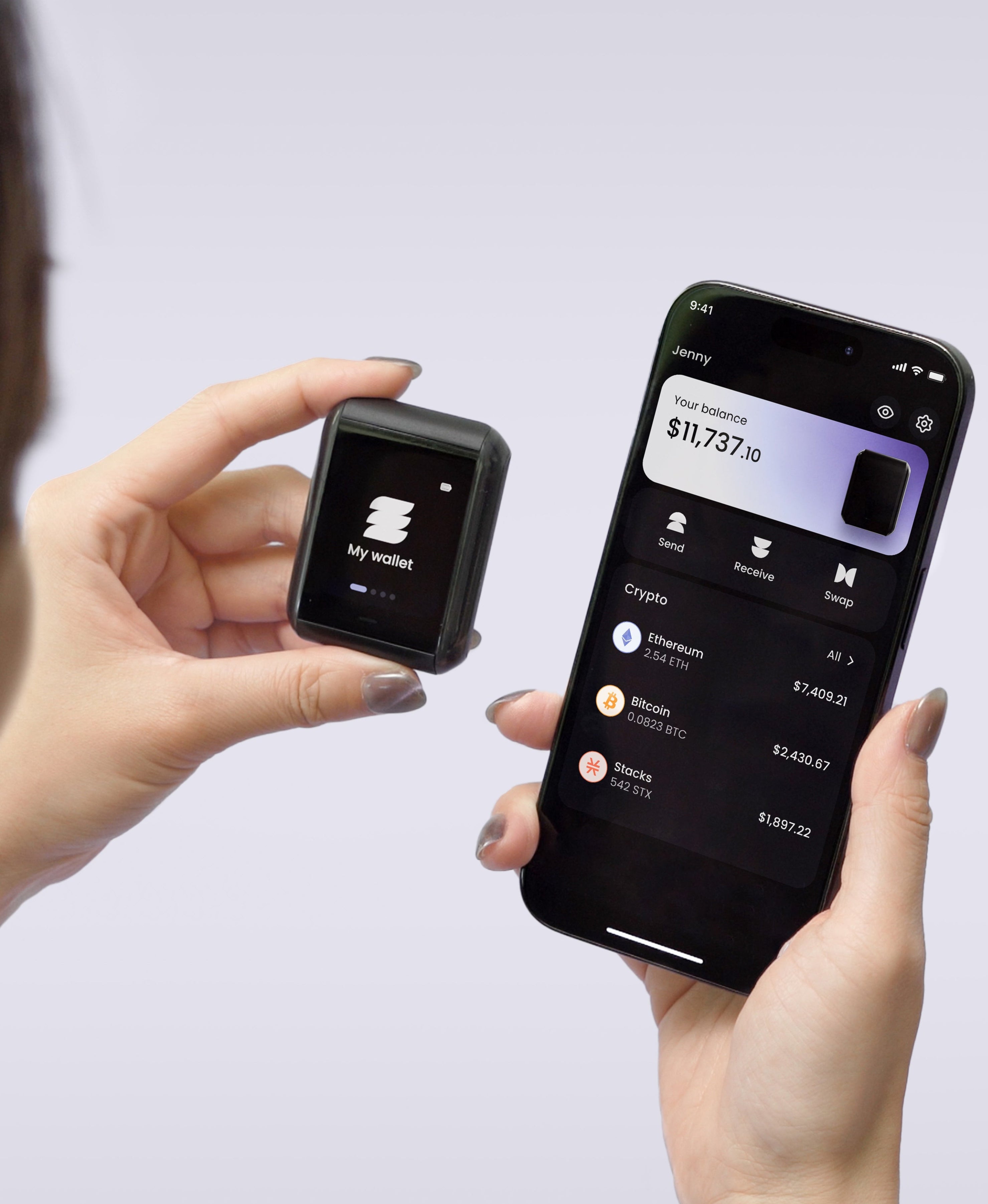
Ryder One is a portless, NFC-only hardware wallet that sets up in under a minute and includes TapSafe Recovery. It's built for people who don't want the stress of protecting a 24-word seed phrase for the rest of their lives while still being able to access it if they ever need to.
Both keep your private keys offline on a certified secure element. The differences are in how you set up, how you recover, and what trade-offs you're willing to make. Let's walk through them.
The Biggest Differences
Wallet Recovery
This is the part that matters most, but it's also where the two wallets diverge. Both Ryder One and Ledger use the BIP-39 standard, which means both generate a seed phrase that can be used to restore your wallet. The difference, though, is in what you actually have to do with that seed phrase, and what happens if something goes wrong with it.
Ledger Relies on the Seed Phrase & Your Safety Habits
With Ledger, the seed phrase is central to everything.
During setup, you write down 24 words on a piece of paper and store them somewhere safe. That piece of paper is your lifeline. Lose it and you lose access to your wallet.
Ledger has introduced additional options over time to address this, including the Ledger Recovery Key, an NFC card that stores your seed phrase like a spare key, and Ledger Recover, a paid subscription service that stores encrypted shards of your seed phrase with third-party custodians. Each option adds a layer of convenience, but also introduces new trade-offs around trust, privacy, and ongoing cost.
 Ledger's recovery method: writing down 24 words on paper and storing them safely
Ryder One Relies on TapSafe and Understands Human Error
Ryder One was designed around one insight: most people won't perfectly manage a paper backup for five or ten years. They'll forget where they put it, store it somewhere obvious, or make a mistake writing it down. With Ryder One, that burden is gone entirely.
During setup, your wallet is backed up with a simple tap. No writing, no PIN code, no choosing where to hide a piece of paper. Your recovery is spread across a Recovery Tag, your phone, and optionally Recovery Contacts. No single one holds enough information to access your wallet on its own, so there's no single point of failure and nothing worth stealing individually.
Your Recovery Tags should be stored in safe locations, but unlike a seed phrase, a tag on its own is useless to anyone who finds it. And if you ever need your seed phrase directly, it's always accessible on the device. You're just never forced to depend on it.
This recovery method is called TapSafe, built on a custom implementation of Shamir's Secret Sharing. Here is how TapSafe works in detail.
 Ryder One's recovery backup: a Recovery Tag
![]()
Ledger’s Recovery Key: an improvement, but still a risk of losing your crypto
Ledger's Recovery Key is a step in the right direction. Instead of writing down 24 words on paper, you tap your Ledger to an NFC card and your seed phrase is stored on it directly. It's easier to set up, and no one can access your funds from the Recovery Key card alone as it's protected by a PIN chosen during setup.
But it comes with its own problems: that PIN code is the big one.
If you get the PIN wrong three times, the card is permanently wiped. That might sound manageable today, but recovery isn't something you do every week. It's something you might not do for five or ten years. When that moment comes, it’s stressful to be standing there with only three attempts to recall a PIN that you had set a decade ago. To add to the stress, if you get it wrong, your backup is gone.
The Recovery Key card itself also isn't built to last. It's made of a thick paper-like/card material (not metal, not plastic). It's not designed to survive water damage or the kind of long-term wear you'd want from something protecting your life savings.
With Ryder One, none of this applies. The Recovery Tag doesn't need a PIN because it doesn’t hold enough information to access your wallet on its own. Nothing to mistype. Nothing to forget. And it is IP69K rated: the highest durability rating for water and dust. The enclosure is sealed using ultrasonic bonding, so there are no seams and no weak points. Put it in the washing machine and it will come out just fine!
 Ledger's Recovery Key is paper-based. Ryder's Recovery Tag is sealed polycarbonate: waterproof, dustproof, washing machine-proof.
Here’s a table that summarizes the key differences between recovery approaches:
|
Ryder Recovery Tag |
Seed phrase |
The Ledger Recovery Key |
| How to set up |
Tap Recovery Tag and phone |
Write down 24 words and store safely |
Tap Recovery Key during setup |
| If someone finds it |
Useless on its own |
Full access to your wallet |
3 wrong PINs and it's erased |
| Risk of mistakes |
Low |
Risk of mistype or loss |
Risk of forgetting PIN |
| Durability |
Resistant to dust and water |
Fragile |
No official rating |
| Time to back up |
~1 second |
10–15 minutes |
~1 second |
The Set Up
Ryder One setup takes around 60 seconds. You tap the device to your phone, the Ryder App walks you through wallet creation, and TapSafe Recovery is configured automatically with the included Recovery Tag. No desktop software, no writing, no extra purchases needed. Most people find it surprisingly fast the first time.
Ledger setup typically takes 15 to 30 minutes. You connect the device, install firmware, verify the device authenticity, create the wallet, write down and verify the seed phrase, and set a PIN. For users already comfortable with hardware wallets, this is a familiar process. For newcomers, it involves more steps and more opportunity for mistakes, particularly around the seed phrase transcription.
In daily use, both wallets ask you to physically confirm transactions on the device before anything is signed. The interaction model is different. Ryder One uses an NFC tap, Ledger uses a cable or Bluetooth connection, but the core security principle is the same.
Watch this side-by-side comparison of the Ledger and Ryder One setup. Ryder One's setup and backup is done at 1m36s. Ledger Gen5 takes until 9m27s.
Where They're the Same
The Secure Element
Both wallets use a certified secure element chip to store private keys and perform cryptographic operations in isolation from the rest of the system. Ledger's chips are EAL5+ or EAL6+ certified depending on the model. Ryder One uses an EAL6+ certified Infineon chip. Both wallets ensure private keys never leave the device and are never exposed to your phone or computer.
Transaction Verification
Both wallets require physical confirmation of every transaction on the device itself. The idea is simple but important: even if the device or app your phone is running has been compromised, the wallet's screen shows you exactly what you're signing before anything happens.
Ledger uses e-ink or touchscreen displays depending on the model. Ryder One uses a touch AMOLED display with a hardware-linked LED security signal connected directly to the secure element, giving you a physical indicator that the chip is actively processing your transaction. It's a small detail that adds a meaningful layer of security.
 Both Ledger and Ryder let you review and confirm every transaction directly on the device.
![]()
Where They Differ
Attack Surface
Security isn't only about the chip inside the device. It's also about every path that leads to it. Each connection point is a potential attack vector, and the two wallets take opposite approaches here.
Ryder One is portless and fully air-gapped. No USB, no Bluetooth, no Wi-Fi. Every interaction happens via NFC, which only activates within a few centimeters of a paired device. The thinking behind this is straightforward: fewer interfaces means fewer things to secure, monitor, and worry about.
Ledger supports USB cable connections for desktop workflows, and select models add Bluetooth for mobile use. This gives Ledger users more flexibility in how they connect and manage their wallet. It also means more interfaces are involved in normal use. Ledger has implemented security measures across each of these, and none of them make the device inherently unsafe. But the trade-off between connectivity and attack surface is a real one, and it's worth knowing which side of it you want to be on.
 Ryder One has a portless, sealed design and NFC-only connectivity. Ledger uses bluetooth and a USB-C connection.
Ecosystem and Third-Party Support
This is one area where Ledger has a genuine and significant advantage, and it's worth being straight about that.
Ledger Live supports a broad range of assets, DeFi protocols, staking integrations, and third-party wallet compatibility across a large number of blockchains. If you're actively managing a diverse portfolio, interacting with DeFi regularly, or working across multiple chains, Ledger's ecosystem maturity is a real advantage that Ryder One doesn't match yet.
Ryder One supports Bitcoin, Ethereum, Solana, Stacks, and major tokens across the chains most people use, with new assets added regularly. The focus has been on building a secure, well-tested experience for mainstream assets rather than maximizing chain count. For most holders that's sufficient, but for users with complex multi-chain setups, it's an honest limitation worth factoring in.
Daily Use
What’s in the Box?
Ledger boxes include the device, a cable, recovery phrase sheets, and a Recovery Key. The recovery phrase sheets are there because writing down your seed phrase is part of the setup process from day one. Setting up requires downloading Ledger Live. Optionally, Ledger Recover, the subscription-based seed phrase backup service, costs over $100 per year.
 Ledger includes a USB-C cable, the Recovery Key, 3 sheets and the Ledger device.
Ryder One includes the device, a Recovery Tag, a wireless charger and cable, and a travel pouch. The wireless charger works with your phone and other devices too, is a small but genuinely useful detail. TapSafe Recovery is included at no additional cost. Extra Recovery Tags are available for $29 for a pack of two if you want more redundancy.
 Ryder includes a wireless charger, a Recovery Tag, a travel pouch, and the Ryder One.
Usability Takeaways
Ryder One is faster to set up, requires no writing, and everything you need is in the box from day one. The NFC-tap workflow feels natural if you're already used to contactless payments. For most people, the whole process takes under a minute and feels closer to setting up a new app than a security device.
Ledger takes longer to get started and the seed phrase writing adds a step that's easy to rush or get wrong. Once it's running though, Ledger Live is a mature, feature-rich platform that gives you more control over a wider range of assets and workflows. If you're already comfortable with the setup process, the day-to-day experience is solid.
In daily use, both wallets do the same fundamental thing: they ask you to physically confirm every transaction on the device before anything is signed. The interaction model is different though. Ryder One uses an NFC tap while Ledger uses a cable or Bluetooth connection, but the overall security principle is the same.
Where the experience diverges is not in the routine moments, but in the ones that happen less often, like losing a device, recovering access, setting up on a new phone. Those are the moments where setup philosophy and recovery design become real.
 Ryder One uses NFC, familiar from everyday card payments. Ledger takes a more traditional approach. Both get the job done.
User Privacy
Both wallets can be purchased with varying levels of privacy and both accept cryptocurrency as payment. In terms of day-to-day usage, Ryder One's offline NFC-only architecture means fewer server connections during normal use. Ledger Live connects to Ledger's servers to display balance information.
It's also worth knowing that Ledger experienced a significant customer data breach in 2020 and again in 2026, which exposed the email addresses of over a million users through a third-party service provider. The funds in those wallets were never compromised, but the personal data has continued to be used for targeted phishing attacks in the years since. It doesn't make Ledger an unsafe choice, but it's a real part of the picture when you're thinking about privacy.
Device Durability
Hardware wallets aren't phones you replace every couple of years. They need to work when you need them, even if that's years from now. Ryder One is IP67 rated for water and dust resistance and designed to handle daily use over the long term. And even if the battery is completely dead, it works the moment you place it on any Qi-compatible wireless charger.
Ledger doesn't publish an IP rating for its devices. Some users in the community have reported Nano X screens or devices failing after a couple of years, which is worth keeping in mind if longevity matters to you.
 Ryder One is dustproof and waterproof rated IP67 meant to withstand years of usage.
Cost
Ryder One is priced at around and includes the Recovery Tag, wireless charger, and travel pouch. Ledger devices range from $79 to $399 depending on the model, which gives buyers more entry points at different price levels.
At face value Ledger looks more affordable. But the full picture depends on which recovery path you end up choosing, and those costs add up over time in ways that aren't always obvious at purchase.
Recovery Cost Trade Offs
The price of a hardware wallet isn't the full picture. The cost of your backup is where the real expenses show up.
With Ryder One, there are no ongoing costs. The Recovery Tag in the box is enough to get started. If you want more redundancy, extra Recovery Tags are $29 for a pack of two. No subscriptions, no renewals, no third party you need to keep paying to stay connected to your own wallet.
Ledger's standard seed phrase recovery is free, but Ledger itself acknowledges that paper isn't durable enough for long-term backup. Their higher-end wallets ($179 to $399) now include a Recovery Key in the box to address this. Their entry-level wallets ($79 to $159) don't, and Ledger's alternative is a metal seed phrase plate sold separately for up to $130. If you're buying a lower-priced Ledger, matching the durability that comes included with every Ryder One is an extra cost to consider.
Then there's Ledger Recover, a subscription service that stores encrypted pieces of your seed phrase with third-party custodians for over $100 per year. If you stop paying, your access to that backup is eventually revoked. Signing up also requires identity verification through a government-issued ID and facial recognition. Some users are comfortable with that. Others feel it cuts against the whole point of self-custody. Neither reaction is wrong, but it's a trade-off worth knowing about before you opt in.
When comparing wallets, it's worth running the numbers over three to five years, not just at the point of purchase. The gap between the two approaches tends to widen the longer you hold.
Final Verdict: Who Should Buy Which?
Choosing between Ryder One and Ledger comes down to how you actually use your wallet.
Choose Ledger if you want the broadest ecosystem of chains and DeFi integrations, prefer desktop workflows, need a larger screen, and are comfortable keeping a seed phrase safe for years. It's the most established name in the space, with the largest ecosystem to match.
Choose Ryder One if you want a wallet that's easy to recover in case of loss, without depending on a single paper backup. It's mobile-first with no cables or dongles, fully sealed for long-term durability, and everything you need comes in the box. No subscriptions, no add-on costs.
Here’s a table to make it easier for you to compare both devices:
|
Ryder One |
Ledger |
| Recovery system |
TapSafe (Recovery Tags + Recovery Contacts + Phone Backup) |
BIP-39 seed phrase (12 or 24 words) |
| Setup time |
~60 seconds |
15–30 minutes |
| What you must remember |
Recovery Tag locations |
Seed phrase location (+ PIN for Recovery Key) |
| What if someone finds your backup? |
No risk of accessing your wallet |
Direct access to your funds |
| Connectivity |
NFC only (air-gapped, portless) |
USB cable + Bluetooth (model dependent) |
| Secure element |
EAL6+ |
EAL5+ or EAL6+ (model dependent) |
| Display |
Touch AMOLED + hardware LED security signal |
E-ink or touchscreen (model dependent) |
| Mobile app |
Ryder App |
Ledger Live (desktop + mobile) |
| Ecosystem |
Growing, focused on major chains |
Extensive, broad DeFi and chain support |
| Third-party recovery |
None |
Ledger Recover (paid, identity-based) |
| IP rating |
IP67 |
No official rating |
| Price |
|
$79–$399+ |
| Recovery backup cost |
Free (1 tag included); extra tags $29 for 2 with no ongoing subscription |
Recovery Key ~$39.99; Ledger Recover ~$100+/year; subscription required |
| Open source firmware |
Yes, TapSafe is being open sourced |
Yes but restricted by chip supplier |
| Best for |
Hodlers, mobile-first users, simplicity seekers |
DeFi power users, multi-chain portfolios |
Ready to Make Your Choice?
Ryder One makes self-custody simple and secure. Set up in 60 seconds, no seed phrase handling required, and everything you need is in the box. Learn more about TapSafe Recovery and get your Ryder One today.



Share: