

Ask ten crypto holders to explain the difference between a private key and a seed phrase and you'll get four confident answers, three vague ones, and three people who assume they're two names for the same thing. The private key vs seed phrase question sounds like vocabulary, and it isn't. One of them unlocks a single address. The other unlocks every address you'll ever create on that wallet, on every chain it supports, forever. Knowing which is which changes how carefully you treat each one, and it changes what you do on the day something leaks.
Private key vs seed phrase, and what each one opens
A private key is a very large number. For Bitcoin and Ethereum it's 256 bits long, and its only job is to prove you control one specific address by signing transactions that spend from it. Anyone holding that number can move the coins at that address. Nobody holding it learns anything about your other addresses.
A seed phrase sits one level above that. Those twelve or twenty-four words encode a master secret, and from that master secret your wallet mathematically derives private keys in sequence: the first Bitcoin address, the second, your Ethereum accounts, your Solana accounts, and every future address you haven't generated yet. One phrase, an unlimited tree of keys beneath it.
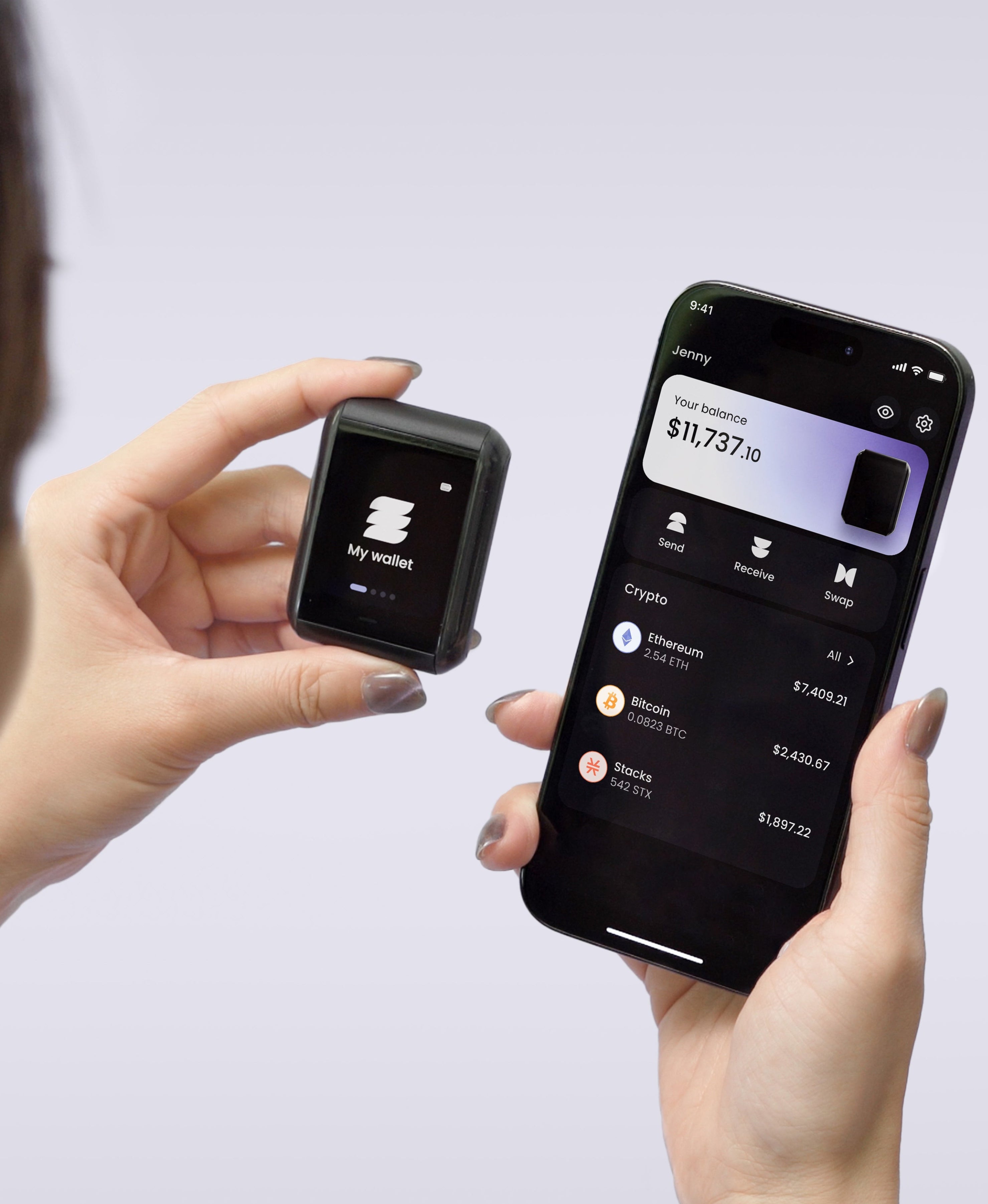
The asymmetry is the whole point. A leaked private key costs you the balance at one address. A leaked seed phrase costs you the wallet. This is the reason we built TapSafe Recovery into the Ryder One rather than handing people a card and wishing them luck, because a single written secret that controls everything is an uncomfortable thing to ask someone to protect on their own.
Where the words come from
The twelve words aren't a password someone at your wallet company chose for you, and they aren't a translation of your private key. They're an encoding of raw randomness, defined by a public standard called BIP-39.
Here's the sequence. Your wallet generates a random number, 128 bits of it for a twelve-word phrase and 256 bits for twenty-four. That number gets sliced into groups of eleven bits, and each group indexes into a fixed list of 2,048 English words, which is where "abandon ability able" and the rest come from. A checksum rides along at the end, so a phrase with a typo fails validation instead of silently opening an empty wallet.
From there a second standard, BIP-32, takes over and defines how the master seed produces child keys in a repeatable order. Repeatable is the operative word: type the same words into any BIP-39 wallet on earth and you get back the same keys in the same order, which is why your funds aren't hostage to the brand printed on the device. That portability is a feature worth understanding, and it's also why the phrase is so dangerous in the wrong hands.
The randomness underneath matters more than the words
Because the phrase is generated from a random number, the quality of that randomness sets the security of everything derived from it. A twelve-word phrase is meant to represent 128 bits of entropy, which is far beyond anything brute force can search.
Crypto got a live demonstration of what happens when that assumption breaks. On 30 July 2026, Coinkite published a security advisory confirming that a build error introduced in 2021 had caused some Coldcard devices to generate seeds using a software random number generator instead of the dedicated hardware one. Affected Mk4, Mk5 and Q seeds carried "about 72 bits of entropy rather than the expected 128 bits," and on Mk2 and Mk3 the estimated search space fell to roughly 40 bits, low enough to attack without ever touching the device. TRM Labs reported roughly 1,816 BTC drained from more than 5,200 addresses.
Nobody's private key was stolen in the usual sense. The words looked normal, the wallet worked normally, and the number underneath them was guessable. That's the clearest argument available for caring where your keys are generated: on the Ryder One they're created inside an EAL6+ certified Infineon SLC38 secure element and never leave the chip.
What the difference changes in practice
Three practical consequences follow from the gap between a key and a phrase.
The first is scope of damage. If you paste a private key into a compromised tool, you lose one address and can move everything else to safety. If you paste your seed phrase into the same tool, there is no "everything else" left to move, and speed stops helping you.
The second is what you can safely do with each. Exporting a single private key to sign something in a hot wallet is a contained risk you might accept. Typing your recovery words into any website, support agent's chat window, or phone app is the exact behaviour every drainer campaign is built to produce. No legitimate wallet, exchange, or support desk will ever ask for them.
The third is backup. Nobody needs to write down individual private keys, because the phrase regenerates all of them, which is exactly why the phrase becomes a single point of failure sitting in a drawer. Paper burns and fades. Steel plates survive fire and are the sensible upgrade, though your access still hinges on one object staying intact and staying private, so the shape of the problem hasn't changed. TapSafe splits the backup instead: your Recovery Tag holds 50%, your paired phone holds 50% encrypted into your own iCloud or Google Drive, and optional Recovery Contacts hold 25% each while seeing nothing about your wallet. No single item in that arrangement gives anyone access.
The short version
A private key signs for one address and is generated on demand by your wallet. A seed phrase is the root that every one of those keys grows from, which makes it the thing worth protecting properly. Both are derived from randomness you never see, and the Coldcard episode is a reminder that the machine producing that randomness deserves scrutiny.
If you take one habit from this: treat the phrase as the master record it is, never type it anywhere, and don't let its safety depend on one sheet of paper surviving the next twenty years. On the Ryder One the words stay reachable on-device as a last resort under the BIP-39 standard, so you're never locked to our hardware. Ordinary use just never asks you to lean on them.
Want a backup that isn't one object in a drawer? Get your Ryder One.
Meta description: Private key vs seed phrase explained: one signs for a single address, the other derives every key you own. What each controls, and how to back them up safely.


Share: