


# Polygon POL and AggLayer: What MATIC Became in 2026
In September 2024, one of the largest Ethereum scaling projects retired the ticker that had defined it since 2020. MATIC, the token that named the network and paid gas on Polygon PoS, gave way to POL under the Polygon 2.0 migration, swapping 1-to-1 across Ethereum mainnet and Polygon PoS and marking the shift from a single sidechain into a family of ZK-powered chains sharing one staking asset. By mid-2026 the migration is close to complete, and Polygon Labs has shipped the pieces that make the plan legible: zkEVM, the Chain Development Kit (CDK), and AggLayer between them.
Below we cover Polygon 2.0, the MATIC-to-POL migration, how zkEVM and CDK fit together, how AggLayer moves assets across chains, the ecosystem in 2026, and where POL fits inside a self-custody wallet like Ryder One.
What Polygon 2.0 is
Polygon began in 2017 as Matic Network, a plasma-based scaling attempt for Ethereum, and by 2021 had grown into Polygon PoS, a proof-of-stake sidechain offering dollar-cent fees and roughly two-second block times. Over the years that followed, Polygon Labs accumulated a stack of research and engineering around zero-knowledge proofs: Miden, Zero, Hermez, and the codebase that became Polygon zkEVM.
Polygon 2.0, announced in mid-2023, unified those pieces under one plan. The company reframed Polygon as a "network of ZK-powered chains" with three moving parts: an EVM-compatible zkEVM rollup, the Chain Development Kit that lets teams launch their own ZK chains, and AggLayer as the shared settlement layer. POL was designed as the single asset securing every chain in that family through re-staking, replacing MATIC across the ecosystem as gas, staking, and governance token in one.
MATIC to POL migration mechanics
The migration opened on 4 September 2024. Holders of MATIC on Ethereum call an upgrade contract to burn MATIC and mint POL at a 1-to-1 ratio, and Polygon PoS runs the swap as a chain upgrade so balances change without a user transaction. As of mid-2026, more than 98% of MATIC supply has migrated per Polygon's migration hub, and centralized exchanges have almost all completed the sweep for user balances.
The economic model changed alongside the ticker. MATIC had a fixed supply of 10 billion tokens; POL launched with roughly the same circulating count but introduced a 2% annual issuance schedule split between validator rewards and an ecosystem community treasury. Under the POL whitepaper, a single POL stake can secure multiple Polygon chains at once: a validator posts POL on Ethereum, opts into Polygon PoS, zkEVM, or a CDK chain, and earns fees from each network it validates. That re-staking design is what distinguishes the POL era from the older MATIC model, where rewards flowed from PoS alone.
zkEVM and the Chain Development Kit
Polygon zkEVM launched on mainnet in March 2023 as a Type 2 EVM-equivalent rollup. Every batch of transactions is proven with a zero-knowledge proof and posted to Ethereum, so users get Ethereum-level security while paying a fraction of L1 gas costs, and any Solidity contract deploys onto zkEVM without code changes.
The Chain Development Kit packages the zkEVM stack as an open-source template. Teams can spin up their own ZK rollup with custom gas tokens, custom data-availability layers, and their own governance, then plug into the shared prover network Polygon operates. Immutable, the gaming L2, signed onto CDK in 2024 and runs Immutable zkEVM as a CDK chain; Astar zkEVM and Palm Network followed, and by mid-2026 more than a dozen CDK chains are live per the Polygon ecosystem directory.
AggLayer explained
AggLayer is where the family of chains starts to feel like one network. When a user moves an asset from Polygon PoS to zkEVM, or from Immutable zkEVM to Katana, AggLayer collects ZK proofs from each source chain, verifies the cross-chain message on a shared bridge contract, and settles the destination side atomically. Because every message is backed by a validity proof rather than a multisig committee, the security model avoids the trust assumption behind most bridge exploits.
That design sits alongside a different school of cross-chain routing. Chainlink CCIP, covered in our CCIP breakdown, splits verification between two independent oracle networks and works across chains it does not operate; LayerZero uses a separate oracle and relayer pair. AggLayer's approach is narrower in scope and tighter in coupling: it moves assets between chains that share the AggLayer proof format, treating the group as one settlement zone. Polygon Labs describes AggLayer as unified liquidity across independent chains, so a user on any connected chain sees the whole family's liquidity pool without wrapped-token bridges. Version 2 shipped in 2025 with pessimistic proofs, which let each connected chain post a proof that its bridge state is safe even if other chains in the group behave incorrectly.
Polygon ecosystem in 2026
Polygon PoS has been the home for a run of mainstream brand experiments. Nike's .Swoosh sneaker drops, Reddit Community Points and Collectible Avatars, Adidas Originals digital collectibles, and Starbucks Odyssey (the loyalty program that wound down in early 2024) all ran on Polygon PoS at consumer scale, picking the chain for the same reason: sub-cent fees and enough throughput to onboard millions of accounts without meltdown.
The DeFi and RWA side has grown alongside the brand traffic. Aave, Uniswap, and Balancer have Polygon deployments; Franklin Templeton's tokenized money-market fund BENJI shipped a Polygon share class in 2023; Hamilton Lane and Ondo Finance both use Polygon rails for tokenized alternatives. According to DefiLlama's chain tracker, Polygon PoS holds roughly 1.1 billion USD in DeFi TVL as of mid-2026, with zkEVM at around 100 million USD. Katana, launched in 2025 as a Polygon-native DeFi chain built with CDK, borrows from Berachain and Solana playbooks with shared liquidity, a yield mechanism that routes sequencer fees to depositors, and AggLayer integration for cross-chain deposits; it crossed several hundred million dollars in TVL inside its first six months.
Self-custody read on POL
POL exists in two places at once, and the distinction matters for anyone holding the token. On Ethereum mainnet, POL is a standard ERC-20 deployed at a fixed contract address; on Polygon PoS, POL is the native gas token that pays for every transaction, the way ETH pays gas on Ethereum. The Ethereum contract is what centralized exchanges usually deposit and withdraw, while the Polygon PoS balance is what the network itself uses to price fees and pay validator rewards.
The practical read is that a POL holder needs to verify which chain their balance sits on before signing anything. Sending POL from an Ethereum address to a Polygon PoS address is a bridge operation, not a direct transfer, so it has to route through the Polygon Portal or an equivalent bridge; sending POL between two Polygon PoS addresses is a native transfer that pays gas in POL itself. Confusing the two lands funds on the wrong chain and usually requires an extra bridge round-trip to recover. Staking layers on top: the stake happens on Ethereum through the Polygon staking contracts, and re-staking to secure a CDK chain adds its own reward and slashing terms, so any wallet holding POL benefits from treating the two-chain identity as part of the base mental model.
Where Ryder One fits
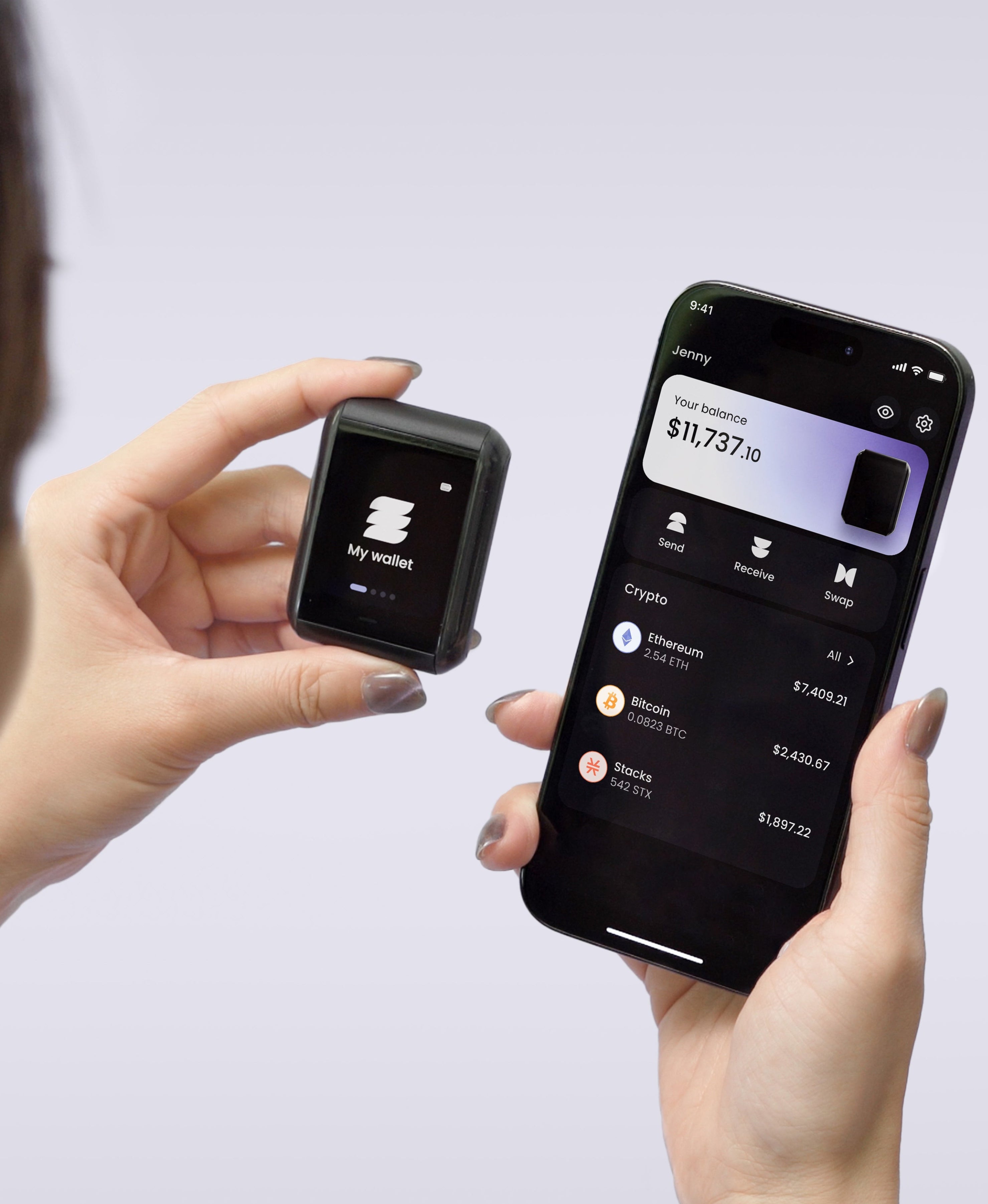
POL is an EVM-native asset on both Ethereum and Polygon PoS, so it works on Ryder One through the standard Ethereum-family signing path. Sending POL, bridging between Ethereum and Polygon PoS, staking, and interacting with any AggLayer-connected chain all render as transactions on the 1.6-inch AMOLED touchscreen, with destination address, amount, and contract call visible before the button press confirms.
Private keys stay inside an EAL6+ Infineon SLC38 secure element, independently audited by Halborn, and are generated on the chip so they never leave it. The physical confirm button wires directly into the secure element so no software path can sign without a deliberate press. Ryder One communicates over NFC only, with no USB data port, no Bluetooth radio, and no Wi-Fi, which removes the remote attack surface that browser and Bluetooth wallets carry when you route tokens between chains.
Backup follows a different approach than the paper-and-metal playbook. Paper seed phrases are exposed to fire, water, and misplacement, and metal seed plates upgrade the durability but leave the holder's security hinging on one object surviving everything. TapSafe Recovery removes that single point of failure by splitting the recovery secret across a Recovery Tag (IP69K rated), your paired phone (encrypted into iCloud or Google Drive rather than on the device itself), and up to two optional Recovery Contacts, none of whom ever see the wallet contents. The BIP-39 seed phrase stays accessible on-device as a last resort, so a Ryder One holder is never locked to our hardware. The device ships at $229 with the Recovery Tag, a Qi wireless charging pad, and a travel pouch in the box.
The bottom line
Polygon in 2026 is no longer the single L2 it started as. The rebrand from MATIC to POL, the zkEVM launch, the Chain Development Kit, and AggLayer together turn Polygon into a network of ZK chains sharing one staking asset and one settlement layer, with brand experiments on Polygon PoS and DeFi spreading across zkEVM, CDK chains, and Katana. For a self-custody holder, the mental model shifts from "MATIC on one chain" to "POL on Ethereum, POL on Polygon PoS, plus fees on any CDK chain the assets touch." A hardware wallet that shows the full transaction detail on screen, keeps keys off the internet, and backs everything up without depending on one object surviving is the pattern Ryder One was built around for every EVM asset it supports.
SEO
Target keyword: polygon crypto / pol token
SEO title: Polygon POL and AggLayer: What MATIC Became in 2026
Meta description: Polygon's MATIC-to-POL migration, zkEVM, CDK chains, and AggLayer explained — polygon crypto in 2026 and the self-custody read on POL.
Hero alt text: Polygon POL AggLayer 2026 — Ryder self-custody hardware wallet


Share: