

Chip certifications have turned into the headline number of the hardware wallet market, the way megapixels once were for cameras. A OneKey wallet leads with more of them than almost anything else you can buy, and the company backs that up by publishing its firmware for anyone to read. Both of those things are worth having. Neither of them answers the question that decides whether you still own your coins in ten years.
Where the OneKey wallet line stands in 2026
Two devices carry the range. The OneKey Classic 1S is 99 USD, thin enough to slide into a wallet slot beside your bank cards, and runs a 1.54-inch monochrome OLED at 128 by 64 pixels with four buttons, a 110 mAh battery, Bluetooth, and a cable connection to a computer. The OneKey Pro sits at 278 USD with a 3.5-inch colour touchscreen, a fingerprint reader built into the power button, and a camera that lets you sign transactions by passing QR codes back and forth instead of connecting at all. Both claim support for more than thirty thousand coins and tokens.
The Pro is where the chip count comes from. OneKey builds it around four secure elements certified to EAL6+, and describes that as the same grade of chip security found in passports and bank cards. The Classic 1S carries the certification on a single element.
What an EAL6+ rating covers
EAL6+ is a level under the Common Criteria standard, and what it certifies is how thoroughly a chip design was evaluated against someone attacking the silicon itself: probing it, glitching its voltage, reading power draw to infer what it is computing. A secure element at that grade is the part of the device that generates your private key and refuses to let it out, and it is the right foundation to insist on. Ryder One is built on an EAL6+ Infineon SLC38 for the same reason.
Four of them do not multiply the protection by four. Additional elements let a designer separate jobs, keeping the fingerprint template away from the signing key, for instance, so a weakness in one area does not spill into another. That is sensible engineering. It addresses an attacker who has your device on a bench, which is a scenario that matters, though it is rarely the one that empties a wallet.
Every radio is a door somebody has to close
Here is the trade-off the spec sheet does not frame as one. The OneKey Pro talks over Bluetooth, over NFC, over a cable, and through a camera reading QR codes. Each of those is a path into the device, and each path is code that has to be written correctly, maintained for years, and patched when somebody finds the flaw nobody caught.
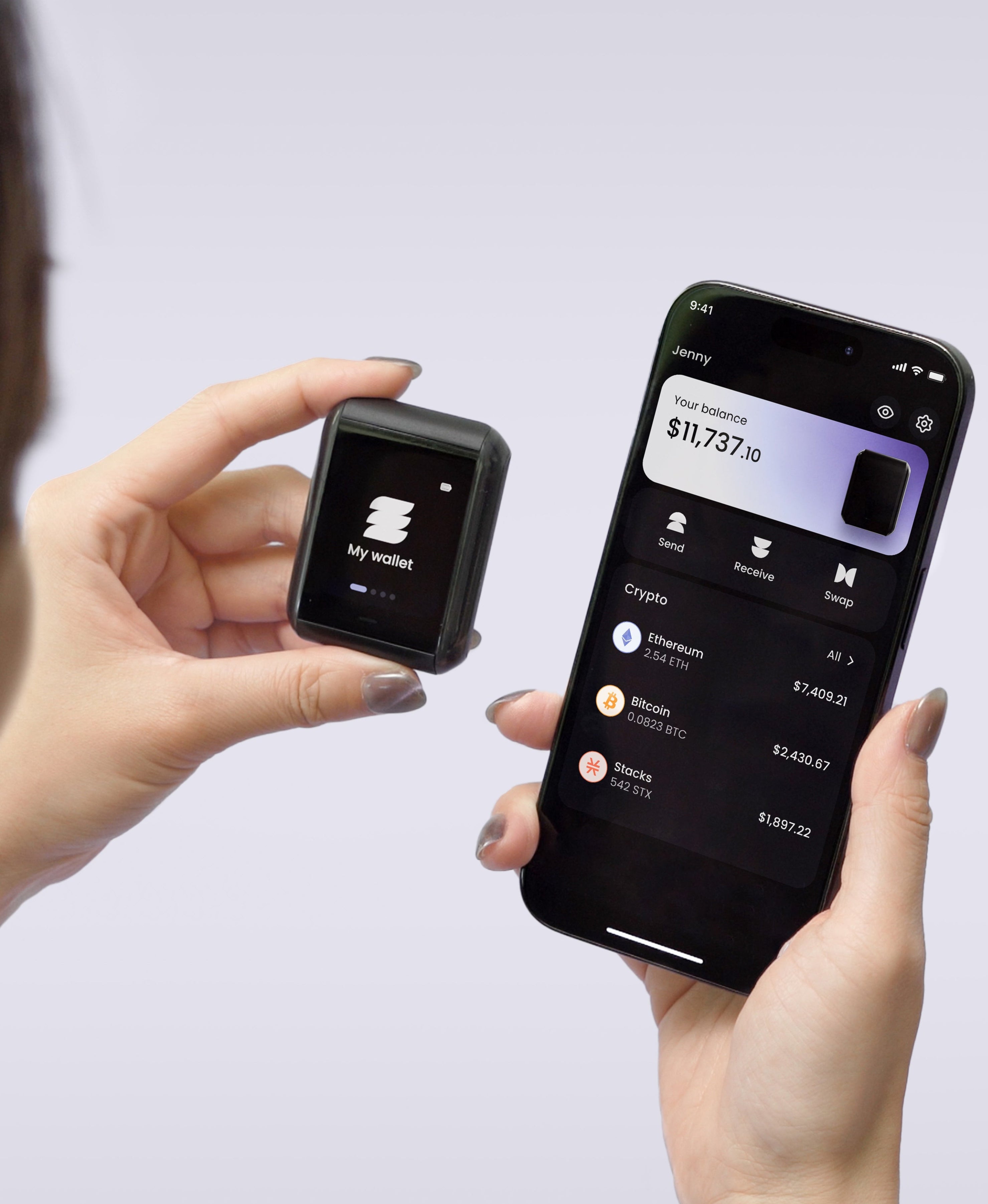
Ryder went the other way and gave Ryder One one channel: NFC, with no Bluetooth radio, no wireless network stack, and no data transfer over a cable. You tap the device against your phone the way you tap a bank card against a terminal. Fewer ways in means fewer things to get right, and it means a bug in somebody else's Bluetooth stack is not your problem. Air-gapped signing by camera, which the Pro does well, solves the same worry from the opposite direction by removing the connection entirely, at the cost of a slower routine every time you send anything.
Open firmware and what reading the code reaches
OneKey publishes its firmware and apps on GitHub under the GPL-3.0 licence, offers reproducible builds so an independent party can confirm that the binary on the device matches the published source, and commissions audits from the security firm SlowMist. Reproducible builds in particular are the part that deserves credit, since open code with an unverifiable binary proves very little about the thing in your hand.
What none of that reaches is the chip underneath. Secure elements ship under vendor agreements that keep their internals closed, so an open-firmware wallet with a certified element is open above the chip and shut below it, whoever makes it. The honest summary is that publishing the firmware raises the odds a mistake gets caught early, which is worth something without being a guarantee.
What is left holding your recovery
Strip away the chips and the radios and both OneKey devices land where nearly every hardware wallet lands. Setup produces a seed phrase, you write it down, and that piece of paper becomes the thing your holdings depend on. The four secure elements defend a device that a thief has to find and defeat; the words on the card can be photographed by anyone who opens the drawer, and no chip certification reaches them.
TapSafe Recovery takes that object out of the centre. Recovery on Ryder One divides through a custom implementation of Shamir's Secret Sharing: half of it lives on the Recovery Tag, an NFC tag rated IP69K that survives water, dust and temperature swings, and the other half lives as an encrypted share in your iCloud or Google Drive rather than on the phone itself. Neither piece opens anything alone, so losing the phone costs you nothing and finding the tag gets a burglar nowhere. Recovery Contacts can hold a quarter each without ever seeing your balances. Your seed phrase remains readable on the device under BIP-39 whenever you want it, so none of this locks you to our hardware.
Who each device suits
Anyone who wants to read the code, verify the build, and sign by camera will find the OneKey Pro a well-made answer at 278 USD, and the Classic 1S is a reasonable first device at 99 USD for someone who values portability over screen size. OneKey has earned its position by being more open than most of the field, and the comparison here is about design priorities rather than competence.
Anyone whose worry is the ten-year question, meaning what happens to their coins when a card gets lost, a house floods, or nobody in the family knows what the words in the drawer are for, is looking at a problem that a fourth secure element does not touch. Ryder One is 149 USD for the Starter Combo and 179 USD for the Super Safe Combo, with an EAL6+ Infineon secure element, NFC-only communication, and firmware audited by Halborn. Have a look at the device.
Meta description: A OneKey wallet ships four EAL6+ secure elements and open firmware. What that protects, why every extra radio is a trade-off, and what still rests on paper.


Share: