


# Monad Blockchain in 2026: The 10,000 TPS L1 Explained
For most of Ethereum's history, the tradeoff between speed and compatibility looked binary. You could stay inside the EVM and inherit its tools, its wallets, and its developer base, or you could go somewhere faster (Solana, Sui, Aptos) and rebuild the toolchain from scratch. Monad's pitch is that the tradeoff was a false choice, and the fix was engineering rather than a new virtual machine. The mainnet launch on November 24, 2025 turned the pitch into a live network.
In this piece we look at what Monad is under the hood, why parallel execution matters if you have been watching gas markets for years, how the mainnet is holding up after its first months of ecosystem growth, and what any of this changes for a self-custody holder who already runs a hardware wallet.
What Monad is, in plain terms
Monad is a layer-1 blockchain that runs the Ethereum Virtual Machine but rebuilds most of the plumbing underneath it. It was founded by Keone Hon, Eunice Giarta, and James Hunsaker, three engineers who came out of the high-frequency trading world at Jump Trading before spinning out Monad Labs. Paradigm led a $225 million round in April 2024, and a later public token sale on Coinbase pulled in another $269 million from more than 85,000 participants.
The design target is 10,000 transactions per second, block times of about 0.4 seconds, and finality inside a second. Every existing Solidity contract compiles and runs on Monad without changes. MetaMask, Rabby, Frame, and any EVM hardware wallet that already signs Ethereum transactions can sign Monad transactions the same way. The chain ID is different, the RPC endpoint is different, the key material is identical.
That last piece is the through-line for anyone who cares about custody: a new chain does not require a new signing model.
How parallel-EVM execution works
Ethereum executes transactions one at a time. That serial model is what makes Ethereum easy to reason about (every state change happens in a defined order) and what caps its throughput on a single machine. Monad keeps the ordering guarantee at the consensus layer, then executes the ordered block in parallel across CPU cores where the transactions do not touch the same state.
Three engineering choices make it work. Optimistic parallel execution is the first: independent transactions run at the same time on separate cores, and only conflicting pairs get re-run in serial. The result is bit-for-bit identical to what Ethereum would produce with a single thread, so contracts do not need to be rewritten to be safe.
The second piece is MonadDB, a custom database built for the workload. It stores the state trie natively, talks to NVMe drives with asynchronous I/O, and lets many state reads happen in flight at once. On Ethereum's default database (LevelDB or Pebble), reading state is often the slowest step, and it blocks the CPU while it waits. MonadDB removes that stall.
Consensus is the third leg: a pipelined variant of HotStuff. While validators vote on block N, execution workers are already replaying block N minus one, and storage is committing deltas from block N minus two. Each phase runs in parallel with the next, so a single logical block passes through several stages of the pipeline at any given moment. Together the three choices let a mid-range validator node keep up with a workload that would swamp a standard Ethereum execution client.
The mainnet launch and where the ecosystem sits
Monad ran a public testnet from February 19, 2025 through most of the year, then mainnet went live on November 24, 2025 alongside the MON token generation event. Within the first week, TVL crossed 150 million USD as Uniswap, Curve, and Morpho pushed live deployments to the network. That kind of blue-chip DeFi presence at launch is rare for a new L1, and it reflects how cheap the port is when the bytecode is identical.
Native builders came with it. Kuru runs a hybrid orderbook and AMM DEX designed for the throughput headroom Monad opens up, and it raised an 11.6 million USD round led by Paradigm before mainnet. Ambient ships a DEX that combines concentrated liquidity, ambient liquidity, and knock-out orders inside a single pool. Curvance is a modular money market with per-asset risk isolation and auto-compounding vaults. The ecosystem stretches beyond DeFi (a liquid staking layer, a growing set of consumer apps, and infrastructure tooling from Alchemy and QuickNode), and the shared trait among the projects is that they treat the throughput as a design assumption rather than a marketing line.
The MON token launched at 100 billion supply, with a 3.3% airdrop distributed to roughly 225,000 wallets that passed Sybil filtering. Fees on the network are paid in MON, and validators are staked in MON. As with every new chain, the token economics are worth watching over multiple cycles before extrapolating anything from the first month.
The self-custody read on an EVM-compatible chain
Here is what changes for a hardware wallet holder, and here is what does not. What does not change is the signing model. A Monad address is derived from the same secp256k1 key as an Ethereum address at the same derivation path. If you have the seed for your Ethereum account, you have the seed for the matching Monad account. The signature bytes that authorize a transfer on Ethereum authorize a transfer on Monad after a chain ID switch in the wallet UI. Every EVM hardware wallet already ships with that support: Ryder One, Ledger, Trezor, Keystone.
What does change is what the wallet has to show you on the screen before you press the button. A Monad transaction confirms in under a second, which is fine for the network, and the risk model at signing time is the same as any EVM chain. Approvals are still unbounded by default; contract calls still route through addresses that look like ordinary addresses; front ends still cache RPC responses and can misreport balances. The device screen is where the transaction shows in plain form before you approve it.
That is the reason a hardware wallet earns its keep on a fast chain more than a slow one. Speed removes the window where you can catch a bad signature by refreshing a block explorer. If the confirmation happens between two blinks, the on-device read is where mistakes get caught.
Where Ryder One fits
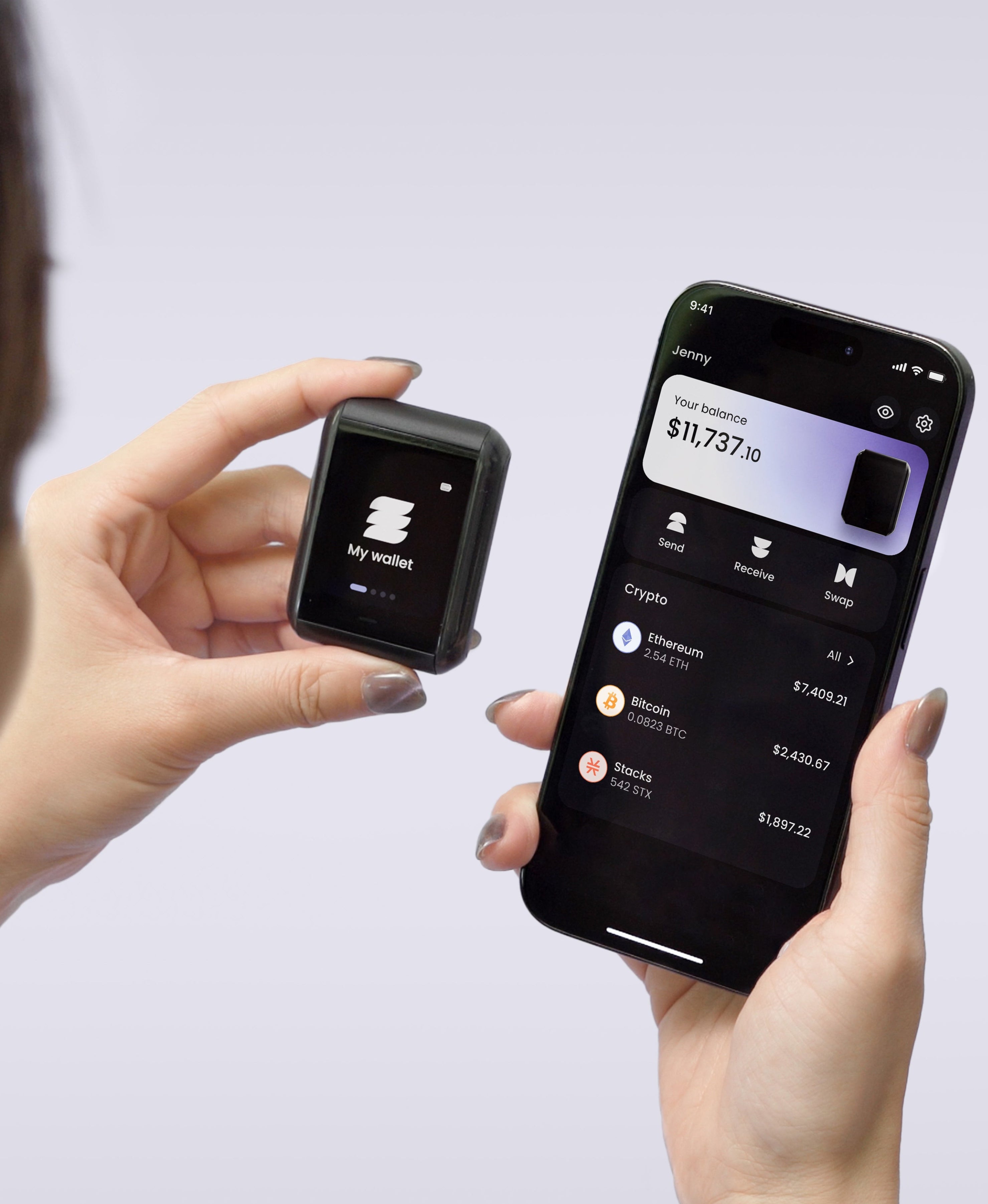
Ryder One is a compact hardware wallet built for EVM chains including Monad from day one. It has a 1.6-inch AMOLED touchscreen, an EAL6+ Infineon SLC38 secure element, and NFC-only communication. No USB, no Bluetooth, no Wi-Fi. Every Monad transaction (a swap on Kuru, a deposit into a Curvance vault, an LP position on Ambient) renders on the device screen with full readable detail before you tap the physical button to sign. The button wires directly to the secure element, so no software path can produce a signature without your input. Address verification runs on the device too, which defends against clipboard-swap attacks that show up wherever fees are cheap enough to make small-value phishing profitable.
Recovery uses TapSafe instead of a paper backup. The Recovery Tag holds 50 percent of the wallet share and is IP69K rated. A phone backup stored encrypted in your iCloud or Google Drive (never on the phone itself) holds the other 50 percent. Together they form a 2-of-2 that removes the single-object failure mode of a written seed phrase. Optional Recovery Contacts add 25 percent shares apiece, paired in person over NFC, and none of those contacts can see your balance or your keys. The BIP-39 seed phrase is available on-device as a last resort, so you are never locked to Ryder hardware. Ryder One ships at $229 with the Recovery Tag, a Qi wireless charger, and a pouch in the box.
The point is that a new chain does not require a new custody stack. What worked for ETH and ERC-20s covers your MON and every Monad-native token you end up holding.
The bottom line
Monad is the most credible attempt yet to run the EVM at Solana-class throughput without breaking the toolchain that took Ethereum a decade to build. Parallel execution is the technical piece; MonadDB and pipelined HotStuff are what let that parallelism turn into working block times on production hardware. The first months of mainnet have delivered blue-chip DeFi, native protocols with venture backing, and a token distribution to hundreds of thousands of users.
Whether MON keeps its price is a market question. Whether Monad keeps its performance under sustained congestion is an engineering question that only load will answer. For the self-custody read, though, the answer is settled: a chain that speaks EVM inherits every hardware wallet that already signs Ethereum. If you are moving assets onto Monad through Uniswap, Kuru, or the canonical bridge from Ethereum, put the signing key behind a device that shows you the transaction before you approve it. That is what the Ryder One was built for.
SEO
Target keyword: monad blockchain
SEO title: Monad Blockchain in 2026: The 10,000 TPS L1 Explained
Meta description: Monad is a parallel-EVM Layer 1 that hit 10,000 TPS on mainnet in November 2025. Here's how it works, the ecosystem so far, and the self-custody read.
Hero alt text: Monad blockchain parallel EVM 10000 TPS — Ryder self-custody hardware wallet


Share: