

Tangem built its reputation on a promise that is easy to like: tap a card against your phone, and your crypto lives offline without a cable, a charger, or a menu to learn. Then in July 2026, Ledger's in-house research team published a method for resetting the password on any Tangem card in circulation, and Tangem replied that the danger to ordinary owners sits somewhere near zero. Both of those positions hold up under scrutiny, which is why the question of whether Tangem wallet is safe deserves a fuller answer than either company gave it.
What Tangem is, and where its keys sit
Tangem ships its wallet as a plastic card with no cell of its own, drawing power from the NFC field of the handset that reads it. Your key is generated inside a certified chip on the card and never leaves, so the design belongs firmly in the cold wallet family rather than among browser extensions and phone apps.
Instead of a recovery phrase, Tangem sells cards in sets of two or three that carry the same key, and your backup is the spare card in a drawer somewhere. Owners can enable a seed phrase if they want one, though the default flow skips it. That choice removes the most common way people lose money in self-custody, and it introduces a different exposure: whoever holds a card and its password holds the wallet.
Is Tangem wallet safe after the Ledger Donjon laser attack?
On 10 July 2026, Ledger Donjon published its findings against the Samsung S3D232A secure element inside Tangem cards, a chip certified to EAL6+. The researchers aimed a single nanosecond laser pulse at a precise spot on the die while the card processed its SetPin instruction, flipping one conditional check that asks whether the card is in password-recovery state. With that check subverted, the card accepts a new password without the old one and without the backup card that the recovery flow is supposed to demand. From there the attacker signs whatever they like.
The barriers are steep and worth stating plainly. The method needs the card in hand, a laboratory costing roughly 250,000 USD in laser fault-injection and side-channel instrumentation, and the expertise to drive it; characterising the technique took a long stretch of work, after which each individual card takes around two hours. Ledger disclosed to Tangem on 10 February 2026, five months before going public.
Why "no firmware updates" cuts both ways
Tangem has always presented its cards as sealed objects, and the absence of any update mechanism was a selling point: nothing can be changed remotely, so nothing can be tampered with remotely. That argument is sound as far as it goes, and it rules out an entire category of supply-chain and malicious-update attacks that have troubled other vendors.
The same property is what makes this disclosure unusual. Because there is no path to load new code onto a card, the flawed check stays exactly where it is for the life of every unit already sold. A wallet with updatable firmware carries the risk that a bad update reaches it; a wallet without updatable firmware carries the certainty that a discovered flaw stays put. Neither arrangement is free, and buyers rarely see the trade written down before they choose.
Tangem's response, and the part of it that lands
Tangem told The Block that an attack requiring expensive laboratory equipment, possession of the card, and specialist skill leaves the risk to everyday users "virtually non-existent." The company also observed that Ledger Donjon, for all its independence as a research unit, sits inside one of its largest competitors.
Read the threat model as it stands and Tangem has a point about most owners. Nobody is running a quarter-million-dollar optics bench at your card because you hold a few thousand dollars of Bitcoin. The people who should think harder are those whose holdings would justify that budget, anyone whose card could sit unattended in a hotel safe or a shared home, and anyone who travels through places where a card can be taken and returned before it is missed. This class of attack needs physical access, so your exposure tracks how well you control the object.
The 2024 bug, for context
This is not the first time Tangem's engineering has drawn scrutiny. In late 2024 the company disclosed a bug that logged private keys, affecting fewer than 0.1% of users, and it handled the disclosure openly. One incident does not make a pattern, and a vendor that publishes its own bad news is behaving better than one that stays quiet. Taken together with the Donjon research, the record reads as a competent team shipping a design whose constraints are unusually unforgiving of mistakes.
Where your backup lives
Every wallet eventually reduces to the same question: what happens when the object in your hand is gone. Tangem answers with duplicate cards, which is a clean answer that skips the recovery phrase entirely, though it leaves you managing two or three copies of the same secret across separate locations, each one a complete key on its own.
TapSafe Recovery approaches it from the other direction by making sure no single item can restore your wallet alone. Access divides into shares: the Recovery Tag holds 50%, your paired phone holds 50% encrypted into your own iCloud or Google Drive rather than on the handset itself, and optional Recovery Contacts hold 25% each while learning nothing about your holdings. Because no piece works by itself, a stolen item is a dead end rather than a loss, and your seed phrase stays available on the device as a last resort under the BIP-39 standard, so you are never tied to our hardware.
So, is Tangem wallet safe enough for you?
For everyday amounts held by someone who keeps their cards close, Tangem remains a reasonable wallet, and its tap-to-sign flow gets more people off exchanges than most competing designs manage. The laser research does not change that for small balances, and treating it as proof that Tangem is broken would misread what the paper says.
For savings you would grieve over, the calculation shifts. You are holding a device whose known weakness cannot be corrected, whose backup model asks you to keep several complete keys in circulation, and whose defence rests on nobody ever getting a quiet couple of hours with one of them.
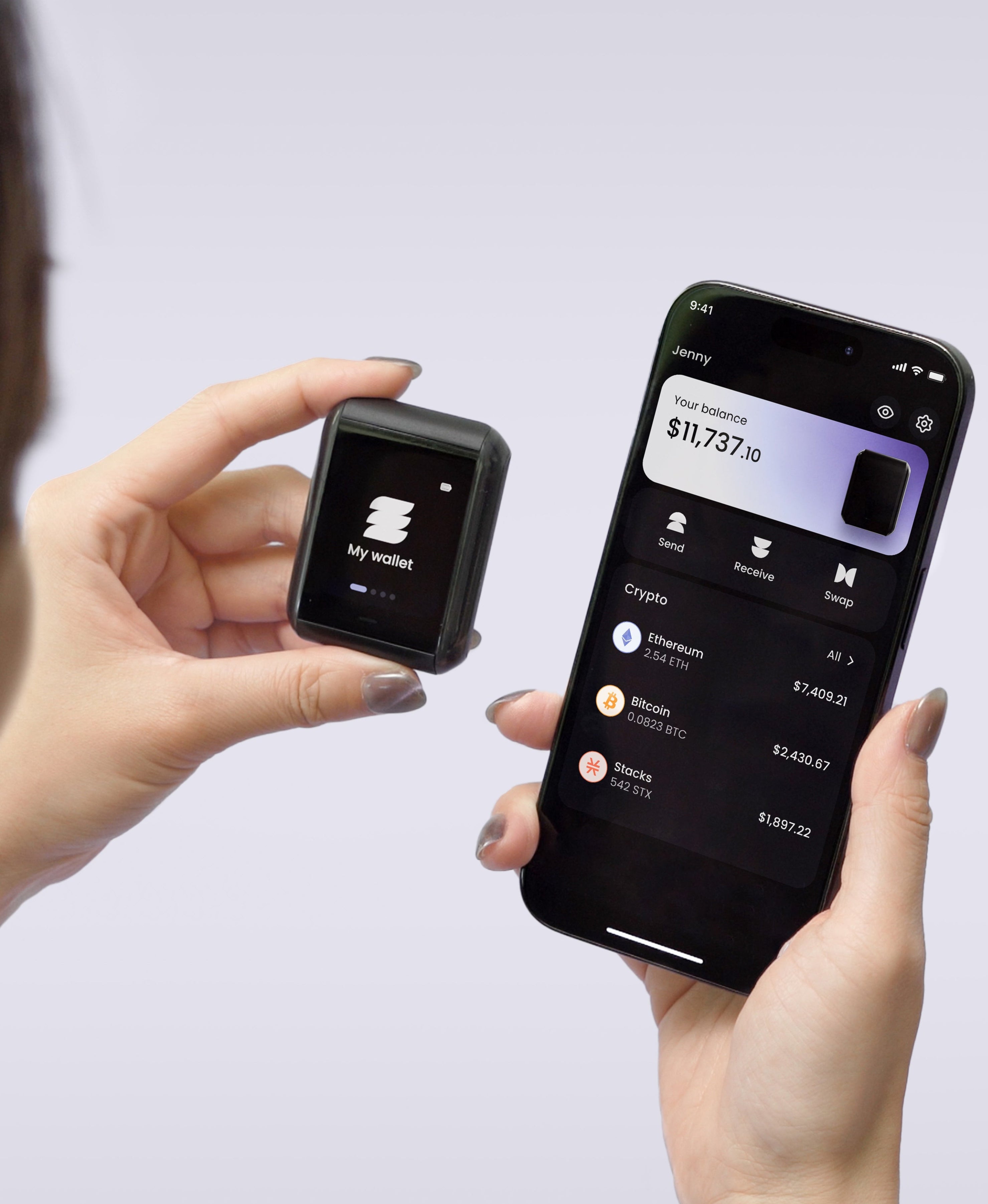
Ryder One takes the opposite bet on both counts. Keys are generated inside an EAL6+ certified Infineon SLC38 secure element and never leave it, RyderOS can be updated as threats evolve, and the firmware was independently audited by Halborn with the report published in full. Communication runs over NFC alone, with no wired data path and no Bluetooth radio. Setup takes about 60 seconds, and the Starter Combo is 149 USD. Get your Ryder One.
Meta description: Is Tangem wallet safe? Ledger's lab reset passwords on every Tangem card in circulation with a laser, and no card can be patched. What it means for your crypto.


Share: