

Rabby has a strong reputation among people who use DeFi every day, and it earned that reputation: the code is open, the extension has been through repeated outside review, and the transaction warnings catch things other wallets wave straight through. So when someone asks whether Rabby wallet is safe, the useful answer separates two questions that tend to get blurred together. One is whether the software does its job well. The other is whether a browser is a sensible place to keep the keys to your savings.
What Rabby is, and where its keys sit
Rabby is a browser extension and mobile wallet for Ethereum and other EVM chains, built by the team behind DeBank. It is non-custodial, so nobody at DeBank can move your coins, and the source sits on GitHub for anyone who wants to read it. Your keys live in an encrypted keyring on your own machine, unlocked with your password each time you sign something.
That design puts Rabby in the same category as MetaMask: a hot wallet, where the secret controlling your funds sits on a computer that also opens email, runs other extensions, and downloads files. Rabby's engineering is careful about this. The operating system underneath it remains a shared space, and anything with the run of that space can reach whatever the wallet has stored there.
Is Rabby wallet safe according to its audits?
Rabby publishes its audit reports inside the repository rather than describing them on a marketing page, which is the behaviour you want to see. Least Authority reviewed the mobile wallet in October 2024 and the browser extension that December, then returned for a second extension review in 2025. Repeat engagements with the same firm across successive versions tell you considerably more than one clean report from launch year.
It helps to be precise about what an audit covers. The exercise examines the code the developers wrote and shipped, under a defined scope, at a point in time. Nothing in it speaks to the copy of that code sitting in your browser right now, which is where this story turns.
The attack that goes after Rabby users by name
In August 2026, Socket's threat research team published an investigation into a wallet-theft operation it provisionally named the Offside Wallet Theft Factory, and the write-up rewards a full read if you use any browser wallet. Across 77 Firefox extension identities, 40 were confirmed malicious, and thirteen of those were modified builds of Rabby that pulled the serialized keyring out and shipped it to an attacker before local encryption ever ran. Mozilla's signing records place the campaign between 9 March and 3 August 2026, with several listings still live when researchers reported them.
The names carry the tell, and each one is built to survive a quick glance: RABB-Wallet Web3 & EVM, Rabb-Wallet CryptoPortfolio, Rabbit For Desktop. No flaw in Rabby was required anywhere in that chain. An attacker took working wallet code, added an exfiltration path, and let the add-on store handle distribution.
This pattern keeps recurring because it keeps paying. Koi Security traced more than 150 counterfeit wallet extensions on the same marketplace during 2025, impersonating MetaMask, TronLink and Rabby among others, with roughly one million dollars stolen; the operators uploaded harmless versions first, collected favourable reviews, then swapped in theft code once each listing looked trustworthy. In February 2024, a counterfeit Rabby app drained users from Apple's App Store while the team's own app was still in review.
What Rabby's transaction checks do well
Give the wallet its due here. Before you sign, Rabby simulates the transaction and shows you the balance changes it expects, flags contracts it reads as risky, and switches to whichever chain the site is asking for instead of leaving you to spot the mismatch. For anyone approving contracts all day, that is a meaningful reduction in the odds of handing away a token allowance by accident.
Those checks run inside the browser, on the same machine as everything else you do. When malware owns the machine, it can read what the wallet reads and paint whatever screen it likes, and a warning system living inside the compromised process is in no position to warn you about the compromise.
Pairing Rabby with a hardware wallet
Rabby supports hardware wallet signers, and this is the upgrade we would point most people toward before they consider switching software. The extension carries on doing what it does well, which is reading chains, building transactions, and warning you about a contract that looks wrong. Approval moves to a device with its own screen, where the private key never touches your operating system at any point.
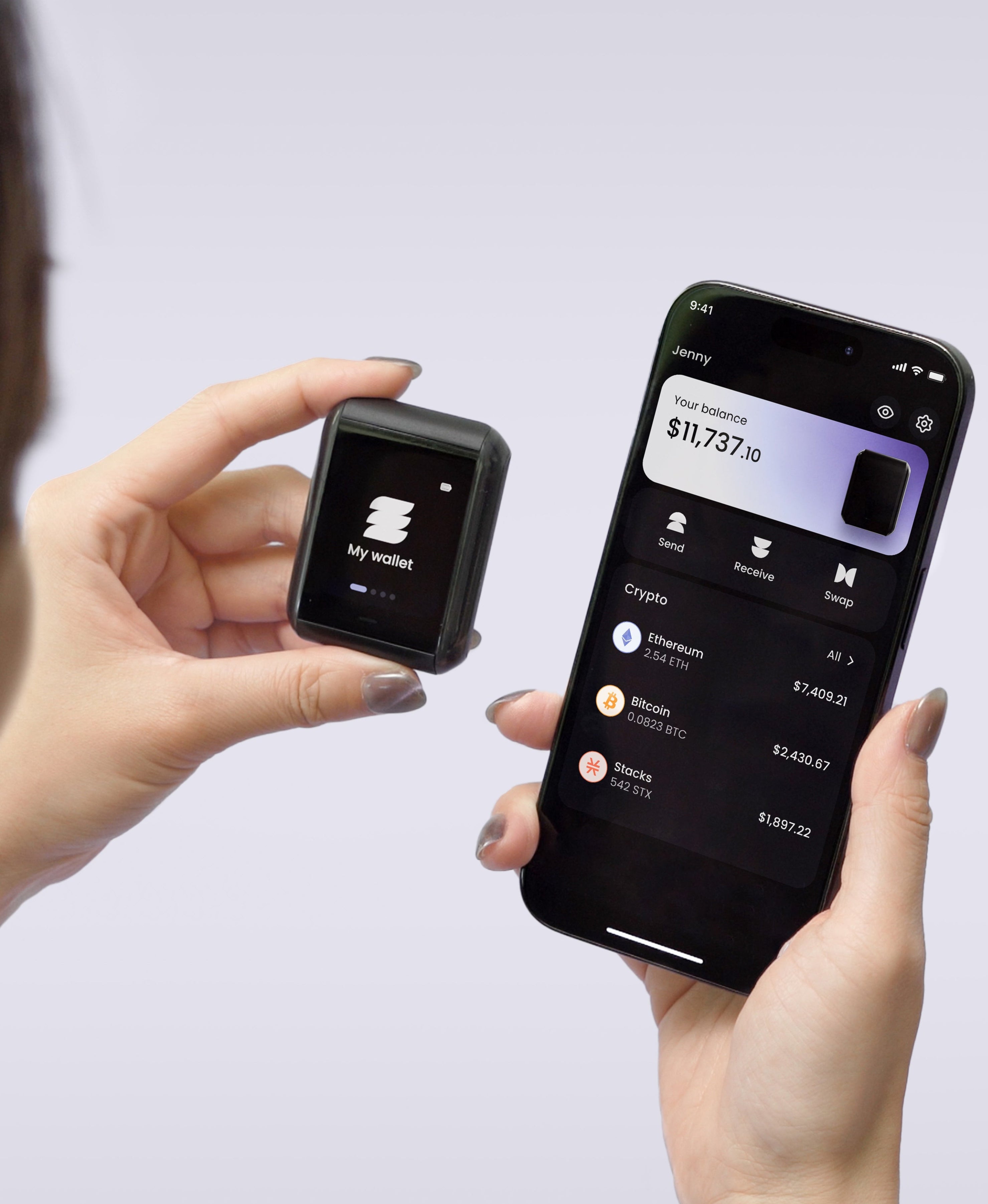
On Ryder One, each transaction renders on a 1.6-inch AMOLED touchscreen in readable detail before you approve it, and the button that triggers signing is wired directly to the secure element, so no software path can sign without a person pressing it. Check the hardware signers your wallet lists as supported before you buy, since that list differs between extensions and changes with releases.
Where your recovery lives
Whichever route you take, one thing holds across Rabby, MetaMask and most hardware wallets: recovery collapses into a single string of words that has to survive fire, theft, a house move, and a phone call from someone impersonating support. Every counterfeit extension in the Socket report was hunting for exactly that, either as stored key material or as words typed into a convincing box.
TapSafe Recovery exists to break that concentration apart. Access splits into pieces: the Recovery Tag carries 50%, your paired phone carries 50% encrypted into your own iCloud or Google Drive rather than sitting on the handset, and optional Recovery Contacts hold 25% each while learning nothing about your wallet. Because no single piece restores anything by itself, there is no complete secret for a caller to talk out of you. Your seed phrase stays available on the device as a last resort under the BIP-39 standard, so you are never locked to our hardware.
So, is Rabby wallet safe enough for you?
For active DeFi, modest balances, and the coins you move every week, Rabby sits among the better options available, and its warnings will save you from mistakes a plainer wallet would let through. For money you would be sick to lose, no browser extension clears that bar, because the protection ends exactly where the operating system begins.
Two habits cost nothing at all. Install from the official site rather than from a search result, and read the publisher name on the listing before you click add. After that, move your long-term holdings somewhere the browser has no way to reach.
Keys on a Ryder One are generated inside an EAL6+ certified Infineon SLC38 secure element and never leave it, the firmware was independently audited by Halborn with the report published in full, and communication runs over NFC alone, with no wired data path and no Bluetooth radio. Setup takes about 60 seconds, and the Starter Combo is 149 USD. Get your Ryder One.
Meta description: Is Rabby wallet safe? The code is open and audited, yet 13 counterfeit Rabby extensions stole keyrings in 2026. What that means for the crypto savings you hold.


Share: