

MetaMask is the front door to Ethereum for most people who use it, and it has held that position for years without ever losing customer funds from its own servers, because there are no customer funds on its servers to lose. So when someone asks whether MetaMask is safe, the software's track record turns out to be the easy half of the answer. The harder half is what happens in the space around it: the browser it runs in, the sites it connects to, and the signature it asks you to approve.
Where MetaMask keeps your keys
MetaMask is non-custodial, so nobody at Consensys can move your coins or freeze your account. Your Secret Recovery Phrase is encrypted with your password and stored on your own machine, and the extension decrypts it in memory each time you unlock and sign.
That arrangement makes MetaMask a hot wallet, which is a precise description rather than an insult. The secret controlling your money sits on a computer that also opens attachments, runs a dozen other extensions, and visits whatever a search result led you to. MetaMask defends its own storage well; what it cannot do is defend the operating system it borrows, because anything with the run of that machine can reach what the wallet has stored there.
Is MetaMask safe from the attacks built specifically against it?
Being the largest wallet means being the reference implementation for every drainer kit on the market. Approval drainers, address poisoning, and delegation abuse all get built and tested against MetaMask users first, then ported elsewhere once they work.
Late May 2026 gave a clean illustration. Victims received emails and push notifications claiming a 2026 system upgrade was required to keep their wallet working, with access supposedly ending on a stated date. The link led to a convincing lookalike domain, where clicking the verification button opened a WalletConnect modal asking for one signature, and that signature authorised a drainer contract to sweep every token the wallet held. On-chain investigator ZachXBT flagged the pattern on 28 May after spotting drain transactions across several EVM networks; more than 400 addresses were emptied, with losses averaging low five figures and the total passing 9 million USD by 30 May.
Impersonation on that scale is the shape of the category now, and it is not confined to one brand. MetaMask's own April 2026 security report documents a counterfeit Ledger Live app taking 9.5 million USD from more than 50 victims in a single week, reaching across Bitcoin, Ethereum, Tron, Solana and Ripple balances at once.
MetaMask's own security record
Two incidents belong on the record, and both were disclosed and fixed. In 2022, Halborn found that the recovery phrase could be written to the browser's disk cache in readable form because the input field was not marked as a password field, a flaw catalogued as CVE-2022-32969 and patched in extension version 10.11.3. The following year, a breach at a third-party support vendor exposed personal details belonging to roughly 7,000 people who had contacted support, without touching keys or funds.
Neither incident cost anyone their crypto, and the handling of both was open. Set against the volume of theft aimed at MetaMask users through phishing, they also make the point that the wallet's code has rarely been the weak link.
The signature is where the money moves
Almost every loss described above ran through a signature the owner approved. Token approvals let a contract spend your tokens on your behalf, which is what makes decentralised exchanges work, and an unlimited approval granted to a malicious contract is a standing licence to empty that token balance whenever the attacker chooses.
Two habits reduce this a great deal. Review what a prompt is asking before you approve it, treating any request that arrives through an email or a notification as hostile until proven otherwise, and periodically revoke old approvals you no longer use through MetaMask's own permissions view. Neither habit helps if the machine underneath you is compromised, because malware can render whatever screen it wants while sending something else to be signed.
Pairing MetaMask with a hardware wallet
The upgrade we point most people toward is not abandoning MetaMask. Keep it for reading chains, building transactions, and connecting to sites, then move the approval step onto a hardware wallet with its own screen and its own chip, where the private key never touches your operating system.
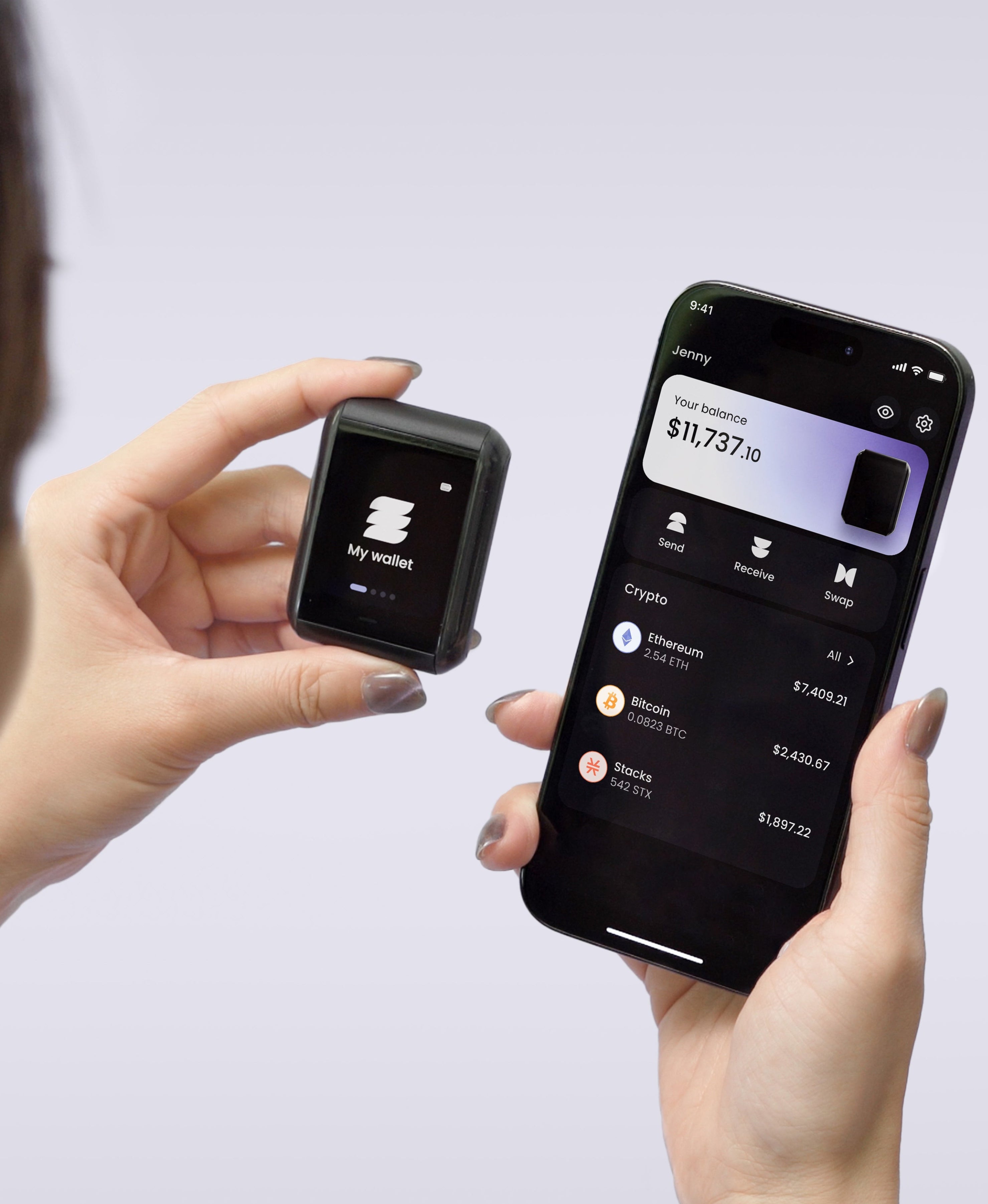
On Ryder One, each transaction renders on a 1.6-inch AMOLED touchscreen in readable detail before you approve it, and the button that triggers signing is wired directly to the secure element, so no software path can sign without a person pressing it. A drainer prompt that looks perfect in the browser still has to survive being displayed on hardware the browser does not control. Check the hardware signers your wallet lists as supported before you buy, since that list differs between extensions and changes with releases.
Where your recovery lives
Under every wallet in this article sits one string of words that restores everything, and MetaMask is candid that losing it means losing the account for good. That concentration is what the phishing industry exists to attack, whether by scraping it off a disk or coaxing it into a box that looks official.
TapSafe Recovery breaks the concentration up. Access splits into shares: the Recovery Tag carries 50%, your paired phone carries 50% encrypted into your own iCloud or Google Drive rather than sitting on the handset, and optional Recovery Contacts hold 25% each while learning nothing about your wallet. Since no single share restores anything alone, there is no complete secret for a caller to talk out of you, and your seed phrase remains available on the device as a last resort under the BIP-39 standard, so you are never locked to our hardware.
So, is MetaMask safe enough for you?
For the coins you trade weekly, for minting, for testing a new protocol, MetaMask is a capable wallet and the ecosystem is built around it. Keep balances there that you could absorb losing, and the convenience is worth what it costs you in exposure.
For savings you intend to hold through several cycles, no browser extension clears the bar, because its protection stops at the edge of an operating system it does not control. Move that money somewhere the browser has no route to, and leave MetaMask doing the job it does well.
Keys on a Ryder One are generated inside an EAL6+ certified Infineon SLC38 secure element and never leave it, the firmware was independently audited by Halborn with the report published in full, and communication runs over NFC alone, with no wired data path and no Bluetooth radio. Setup takes about 60 seconds, and the Starter Combo is 149 USD. Get your Ryder One.
Meta description: Is MetaMask safe? The code holds up; the browser around it is the risk. What the 2026 drainer campaigns exploited, and where to keep crypto you can't replace.


Share: