

If you are looking for how to recover crypto sent to the wrong address, the answer depends entirely on who controls the address the money landed on. There are a handful of situations where the coins come back. In most of the rest, they do not, and the sooner you know which case you are in, the less likely you are to lose a second amount to somebody promising a fix.
Why a confirmed transaction stays confirmed
A card payment can be reversed because a bank sits in the middle with the authority to claw it back. A blockchain has no such party. Once your transaction is included in a block and confirmed, the network treats it as settled history, and there is no administrator with a button that undoes it. The FTC puts this plainly when it warns that crypto payments typically do not come with the legal protections attached to traditional payment methods and generally cannot be reversed.
So the question is never whether the transaction can be cancelled. It is whether a human being who is willing to help you happens to hold the keys to wherever the coins went.
When you can still get it back
Four situations give you a workable path.
The transaction has not confirmed yet. On Bitcoin, a transaction that signalled replaceability under BIP-125 can be replaced by a new one paying a higher fee, which lets you redirect the funds before the original is mined. This window is minutes, sometimes seconds, and it only works from the wallet that created the transaction.
You sent to an exchange. Deposit addresses belong to the exchange, so a support ticket reaches somebody who can move the funds. This is the most common successful case, especially where a deposit arrived as the wrong asset or over an unsupported network. Expect proof of the transaction, expect a processing fee, and expect it to take weeks rather than days.
You sent to an address you control on a different chain. Because Ethereum and the networks compatible with it derive addresses the same way, the same private key opens the same address on all of them. Coins sent over the wrong EVM network are usually sitting there waiting for you to add that network to your wallet and look.
You know the person who owns the address. Then it is a conversation rather than a technical problem, and whether it ends well has nothing to do with cryptography.
When it is gone for good
Everything else, and the category is larger than people expect.
Most addresses on any chain have never been used by anybody, and a mistyped address that still passes its checksum is almost certainly one of them. The coins arrive at a destination whose key has never existed and never will. Nobody stole them and nobody can spend them. They will show as a balance on the chain for as long as the chain runs.
If the destination belongs to a stranger who has no reason to answer you, the outcome is the same in practice. If it belongs to the attacker who engineered the mistake, it will be moved within minutes. In none of these cases is there a process, a form, or an appeal, and accepting that early is what protects you from the next part.
The second scam, aimed at people who just lost money
A search for help after a loss puts you in front of firms advertising blockchain forensics and asset retrieval. Most are running the same fraud a second time on people already hurting. The FTC's guidance is that no legitimate operation asks for payment up front before returning anything, and the CFTC warns that these outfits commonly pose as government officials or court representatives, reach people through messaging apps such as Telegram and WhatsApp, and follow a first small payment with requests for more.
Treat any of the following as the end of the conversation: an unsolicited message offering to retrieve your funds, a request for your seed phrase or wallet file for any reason whatsoever, a fee payable in crypto or gift cards, or a guarantee of results. Report the loss to law enforcement and to the exchange involved if there was one, because those are the only parties with the authority to freeze anything.
How the wrong address got in there
Almost nobody types thirty-four characters by hand and fumbles one. The mistakes that cost money are engineered.
Clipboard malware watches for something shaped like a wallet address and swaps it for the attacker's while you paste. Address poisoning works on your habits instead of your machine: the attacker sends you a dust-sized payment from an address whose first and last few characters match one you use often, so that when you later copy a destination from your transaction history you copy theirs. Both attacks defeat the check most people perform, which is glancing at the beginning and end of the string on the screen where the paste happened.
The wrong-network sends come from somewhere else again, from interfaces that let you pick a network in one dropdown and paste an address in the next without connecting the two.
Checking the address on a screen that cannot be rewritten
Verification on the machine that might be compromised is not verification. If malware can rewrite what your clipboard holds, it can rewrite what your browser displays, which is why the address has to be confirmed somewhere the software on your computer cannot reach.
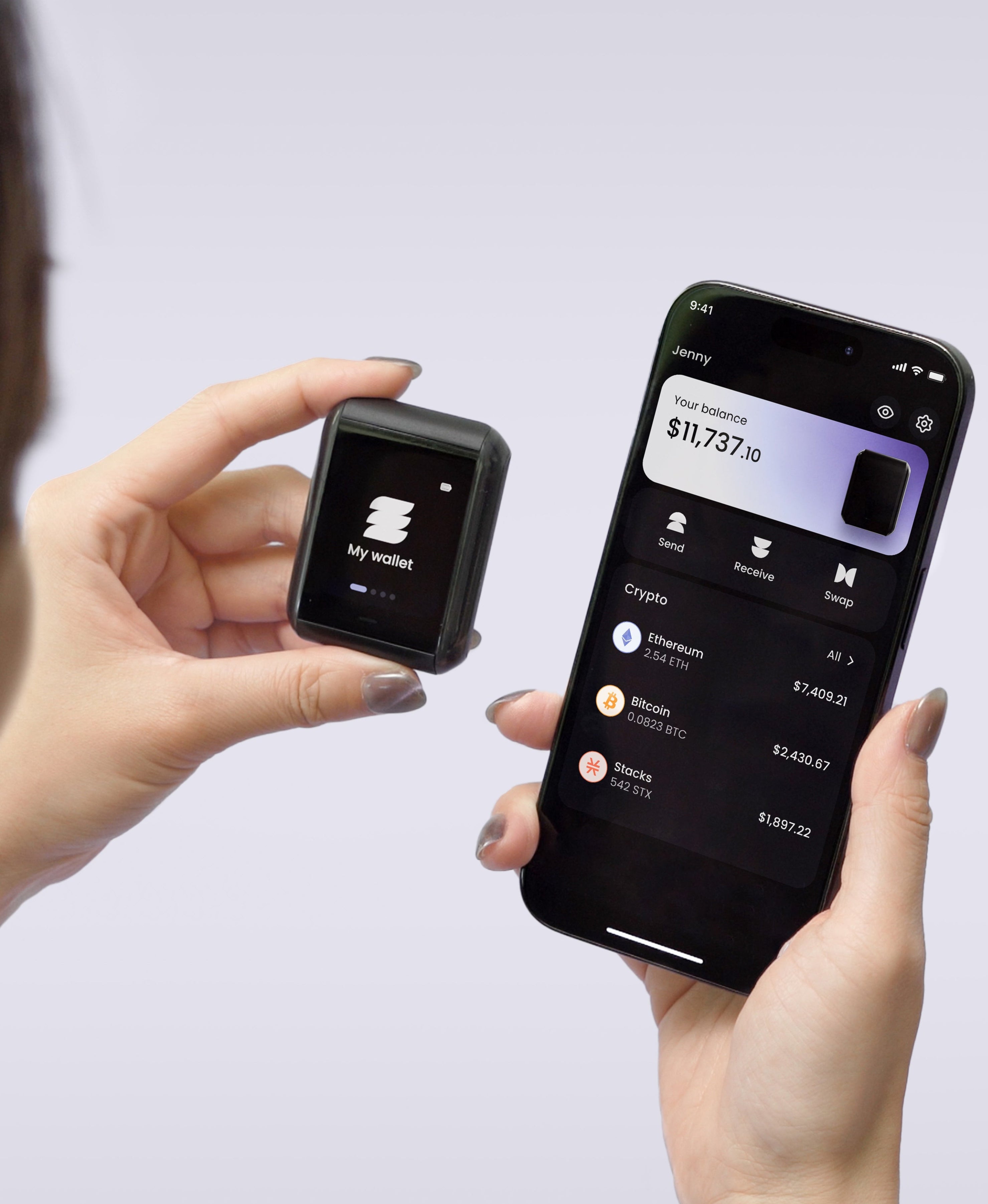
That is the job Ryder One does with its 1.6 inch AMOLED touchscreen. Receiving addresses are shown on the device itself for you to check, the full detail of a transaction is rendered on-device before you approve it rather than signed blind, and the button that authorises the signature is wired directly to the secure element, so no software path can approve anything without your finger. Frequently used destinations live in an on-device address book, and a fee alert warns you before confirming if network costs look wrong.
What this has to do with your backup
A sending mistake and a backup failure feel like separate topics, and they share a root: one object or one screen quietly holding the whole outcome. The address on a compromised display is one version of that. A single card in a drawer carrying your entire wallet is another.
Paper tears and burns. Steel plates fix the durability problem and are the sensible upgrade from paper, though they leave the shape of the risk in place, since you still have one item that grants full access to anyone who reads it and total loss to you if it vanishes. TapSafe Recovery splits that responsibility instead. The Recovery Tag carries half, your paired phone carries the other half encrypted in your own iCloud or Google Drive rather than on the handset, and the pair together restores the wallet while neither one reveals anything alone. Optional Recovery Contacts hold a quarter share each and see nothing about your balances. Your seed phrase remains available on the device as a last resort under the BIP-39 standard.
The short version
Coins sent to an exchange, to an address you control on another network, or to somebody you can call have a route home. Coins sent to an address nobody has ever held do not, and anyone who tells you otherwise for a fee is the second attack. The only reliable protection is confirming the destination on hardware that malware cannot repaint.
Ryder One is 149 USD for the Starter Combo. Keys are generated inside an EAL6+ certified Infineon SLC38 secure element and never leave the chip, the device communicates over NFC only with no Bluetooth, no Wi-Fi and no USB data path, and the firmware has been audited by Halborn with the report published in full. Setup takes around sixty seconds.
Meta description: Crypto sent to the wrong address comes back in four cases only. Which ones work, why the rest are final, and how recovery services exploit the loss.




Share: