

Hardware wallets all look similar from the marketing copy. Sleek device, secure element, supports many coins. The differences that determine whether the wallet is right for you sit one layer deeper, where the marketing rarely goes.
This piece runs through seven questions to ask before you buy a hardware wallet, with the kind of answers each question should produce. Apply them to any wallet on your shortlist (including Ryder One) before you commit.
1. What secure element chip does it use, and what’s the certification level?
The chip is the foundation. Every hardware wallet’s security claim rests on the chip being resistant to physical and side-channel attacks. The certification standard for that resistance is Common Criteria EAL (Evaluation Assurance Level), running from EAL5+ to EAL7+ for crypto-grade hardware.
Acceptable answers: a named chip from a recognized vendor (Infineon, STMicroelectronics, NXP) at EAL6+ or higher. Pause if: the vendor won’t name the chip, the certification level sits below EAL5+, or the vendor claims certification without linking to the certificate.
2. How does the device communicate with the host machine?
Three options: USB, Bluetooth, NFC. Each has different attack surface implications.
USB exposes the device to USB-stack attacks and any firmware-level malware on the host. Bluetooth widens the radio surface and creates wireless attack vectors. NFC requires physical proximity (a tap) and dramatically reduces remote attack potential.
Acceptable answers: any of the three, with full disclosure of what’s exposed and whether the device requires physical interaction to sign. Pause if: the vendor downplays the trade-offs or runs multiple radios that you can’t disable independently.
3. Where do you read transaction details before signing?
The drainer attacks that move the most money in 2026 depend on showing one address on the host’s screen while signing for a different one underneath. A hardware wallet with an on-device screen that displays the transaction details defeats this attack at signing time.
Acceptable answer: a screen on the device that shows you the receiving address, the amount, and any relevant metadata in readable form. Pause if: the wallet relies entirely on the host machine’s display, or the device’s screen is too small to read addresses on.
4. How do you confirm a signature?
The confirmation step matters. A wallet that signs based on a software command alone is vulnerable to remote attacks that take over the host. A wallet that requires a physical button press wired directly to the secure element forces an attacker into your physical presence.
Acceptable answer: a physical button on the device, wired so no software path can bypass it. Pause if: the wallet signs based on touchscreen-only confirmation without a hardware-anchored gesture, or the button is software-mediated.
5. What’s the recovery model?
Every hardware wallet has to answer the question of what happens when the device is lost, broken, or stolen. The legacy answer was a seed phrase written on paper. Modern wallets layer additional structure on top to survive more failure modes.
Acceptable answers vary by how much operational complexity you’re willing to take on. Seed phrase alone (paper or metal) works if you can keep the paper safe for decades. Split-share recovery distributes the backup across multiple parties or objects so no single failure takes the wallet down. Pause if: the wallet has no documented recovery flow, or the recovery depends on the vendor’s servers without an offline fallback.
6. Has the firmware been audited, and by whom?
Hardware wallet firmware is complex. An audit by a credible third-party security firm gives you a concrete reference for the device’s resistance to common attacks. Firms with strong reputations in this space include Halborn, Trail of Bits, Kudelski Security, and NCC Group.
Acceptable answer: a published audit from one of these firms (or an equivalent), with the report public and the audit recent (within the past 18 months). Pause if: the vendor cites an audit but won’t share it, or the audit is more than three years old without an update.
7. What chains and tokens does it support?
A wallet that supports only Bitcoin works for a Bitcoin-only holder. A wallet that supports Bitcoin, Ethereum, Solana, and major ERC-20/SPL tokens works for a multi-chain holder. Match the coin support to what’s in your portfolio rather than to the longest list.
Acceptable answer: clear support for every asset you currently hold, with a documented process for adding new chains as they emerge. Pause if: the wallet’s coin support depends on third-party apps the vendor doesn’t control, or the supported list hasn’t been updated in years.
How Ryder One answers these questions
Quick reference for the seven questions:
- Chip and certification: EAL6+ certified Infineon SLC38 secure element.
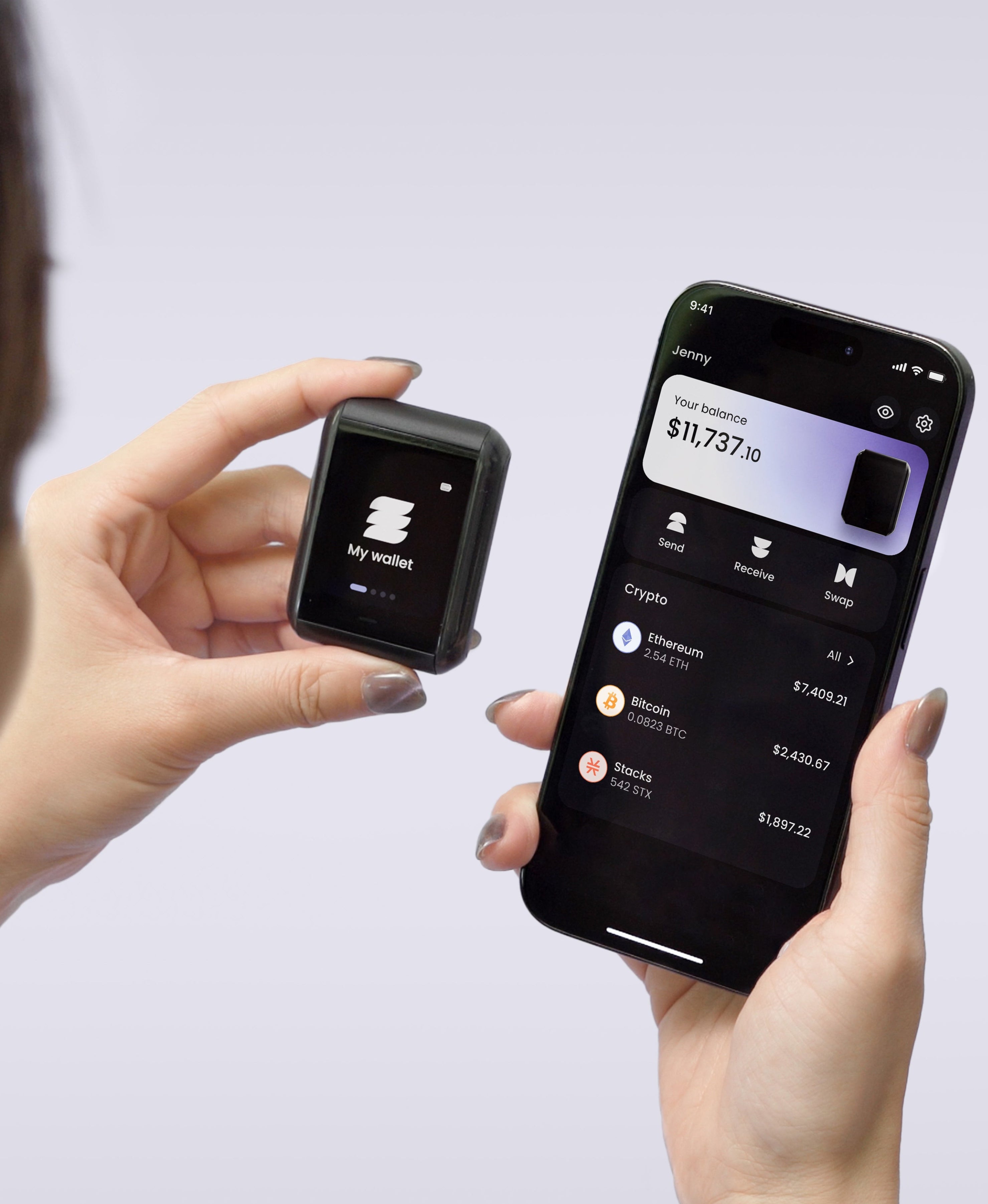
- Communication: NFC-only. No USB, no Bluetooth, no Wi-Fi.
- Transaction verification: 1.6-inch AMOLED touchscreen showing full transaction detail.
- Signature confirmation: Physical button wired directly to the secure element.
- Recovery: TapSafe Recovery splits the backup across a Recovery Tag, a phone backup, and optional Recovery Contacts. The seed phrase remains accessible on the device as a last resort.
- Audit: Firmware independently audited by Halborn, audit report public.
- Coin support: Bitcoin, Ethereum, Solana, and a growing list of top ERC-20 and SPL tokens.
Apply the same seven questions to every other wallet on your shortlist before you commit.
The bottom line
The marketing surface of hardware wallets looks more similar than the products are. The seven questions above force out the answers that determine whether the wallet does what you need at the moments that matter: when an attacker is trying to drain you, when the device gets lost, when the vendor changes a policy, when the firmware needs to update. Buy the wallet that answers these questions well for your specific case. Pass on any wallet that won’t answer them at all.
Score every wallet on these seven questions. Ryder One answers each one with EAL6+ certification, NFC-only interface, on-device verification, button-press signing, TapSafe Recovery, a public Halborn audit, and broad chain support. See the full spec.



Share: