


# HBAR Explained: Hedera and the Enterprise Blockchain Bet
Most L1 tokens sell a story about developer culture or retail traders. Hedera sells a public list of enterprise members with three-year term limits who together operate the mainnet nodes. That structure has made HBAR a favorite of institutional buyers who want governance they can name in a compliance memo, and it has drawn criticism from people who believe decentralization means anyone can run a validator.
In this piece we cover what Hedera and HBAR are, how hashgraph consensus differs from a chain of blocks, why the 31-member council matters, what the ecosystem looks like in mid-2026, and what any of this means for the keys behind your HBAR balance.
What HBAR and Hedera are, in plain terms
Hedera is a public distributed ledger that went live in September 2019 and has run continuously since. HBAR is the native token used to pay fees, secure the network through staking, and settle payments between accounts. According to CoinGecko, HBAR trades around $0.068 with a market cap near $2.98 billion in July 2026, and it sits inside the top 35 assets.
The supply schedule was set at genesis. Fifty billion HBAR were pre-minted in August 2018 and moved into the Hedera Treasury, and Messari's State of Hedera report puts circulating supply at about 42.4 billion, or roughly 84.8% of the fixed cap. New inflation is not part of the design; the treasury releases tokens on a scheduled path for ecosystem funding rather than open issuance.
Hedera exposes three service layers. The Hedera Token Service (HTS) lets teams mint fungible and non-fungible tokens as a native operation, so no smart contract deployment is needed to create a token. HCS provides a trusted timestamp and ordering layer for external applications, and the Hedera Smart Contract Service runs an optimized Besu build of the EVM so most Solidity contracts port over.
Hashgraph consensus, and why aBFT matters
Bitcoin and Ethereum use blockchains, which are ordered sequences of blocks that each reference the block before them. Hedera uses a hashgraph, which is a directed acyclic graph of gossip events. Every event a node produces contains a few transactions and two hashes pointing to the last two events the node knew about. As nodes gossip continuously, that graph grows in a way that captures the entire order of who told whom, and when.
Once the graph exists on every node, consensus becomes a calculation rather than an exchange of votes. This is the piece Hedera calls virtual voting: each node looks at the shared history and figures out what every other node would have voted, without sending any voting messages across the wire. The Hedera docs describe the full gossip-about-gossip protocol, and the short version is that events carry both payload and topology information at the same time.
The security bar the design targets is asynchronous Byzantine fault tolerance, or aBFT. In practice the network reaches consensus and continues operating even if up to one-third of nodes fail or act maliciously, and it does so without assumptions about network timing. Many chains claim BFT properties under partial-synchrony assumptions; hashgraph's proof does not need them.
The Council of 31 governance model
Hedera's governance is the piece most L1 designers avoid entirely. Rather than pushing consensus to a permissionless validator set, Hedera runs its mainnet through an invited Governing Council capped at 39 seats with 31 members active in mid-2026. Each member operates a mainnet node, votes on protocol changes and treasury decisions, and holds a term limited to three years with two consecutive terms maximum.
The roster reads like a compliance officer's dream. Google, IBM, LG Electronics, Dell, Boeing, Deutsche Telekom, and Standard Bank sat on the council through mid-2026, and FedEx joined earlier to help advance digital shipping infrastructure. McLaren Racing joined on the fan-engagement side, and Accenture was announced as the newest member on April 30, 2026. Term rotation is what keeps any one member from concentrating power inside the treasury.
Critics argue that a permissioned 31-member validator set is less censorship-resistant than a permissionless proof-of-stake chain, and they are correct about that specific metric. Advocates argue that identifiable, accountable, term-limited operators are what enterprises need before routing regulated activity through a public network. Where you land depends on whether your priority is neutrality or accountability.
Hedera in mid-2026: HTS, Guardian, and the DeFi read
The ecosystem in 2026 is quieter than the enterprise headlines suggest, and more active than the token price alone would predict. On the DeFi side, DefiLlama tracks Hedera's TVL at roughly $25 million, with SaucerSwap driving most of the AMM volume and USDC dominating the stablecoin float. TVL peaked around $113 million in Q3 2025 before pulling back with the broader mid-cap L1 cycle, so the picture is a chain with a working DeFi core without the size of an Arbitrum.
Where Hedera has real traction beyond DeFi is sustainability infrastructure. The Guardian framework is an open-source policy engine that digitizes carbon credit issuance on top of HTS, and in March 2026, Gold Standard and ATEC Global issued the first fully digitized cookstove carbon credits through a public MRV workflow anchored on Hedera. Earlier in the year, BCarbon migrated more than two million issued credits onto the network, and Verra partnered with Hedera to move parts of its global registry onto the ledger.
The EVM layer is quietly doing work too. Because Hedera runs an optimized Besu build, most Solidity code compiles and deploys, and a small set of DeFi teams have used that path to bring Ethereum tooling onto a chain with sub-cent fees and predictable finality. The tokens people hold on Hedera today are more likely to be HTS-native than ERC-20 clones bridged from another chain.
The self-custody read on HBAR
HBAR uses Ed25519 keys for its native accounts, which is a different signature scheme from the secp256k1 keys that Bitcoin and Ethereum share. Each Hedera account is identified by an account ID in the form shard.realm.number rather than by an address derived from the public key, and native tokens are held under the account rather than under contract logic. If you also use the EVM layer, secp256k1 signing sits on top, but your primary HBAR balance rests behind an Ed25519 key.
The custody implication follows from the key material. Any wallet that supports Ed25519 signing and understands Hedera's account model can hold HBAR, and a handful of hardware wallets have added HBAR support over the years. The discipline matches any other L1: keep the signing key on a device that stays offline between uses, verify every transaction on that device's screen before you approve, and back the seed up in a way that removes single-object failure modes.
Scams that target HBAR holders are the ordinary ones: phishing sites that ask for the seed phrase, fake airdrop pop-ups, address-substitution tricks in the clipboard, and social-engineering campaigns riding the enterprise brand names on the council roster. Your defense is a signing device that shows the destination, the amount, and the memo field before your finger touches the button.
Where Ryder One fits for L1 self-custody
Ryder One does not currently support HBAR in its coin list, so we won't tell you Ryder signs your HBAR transfers today. Ryder One supports Bitcoin, Ethereum, Solana, and a growing set of top ERC-20 and SPL tokens, which covers where most self-custody holders keep the bulk of their assets. If your portfolio includes HBAR alongside those chains, the standard advice is to run each asset on a wallet that supports it and to keep the security posture consistent across all of them.
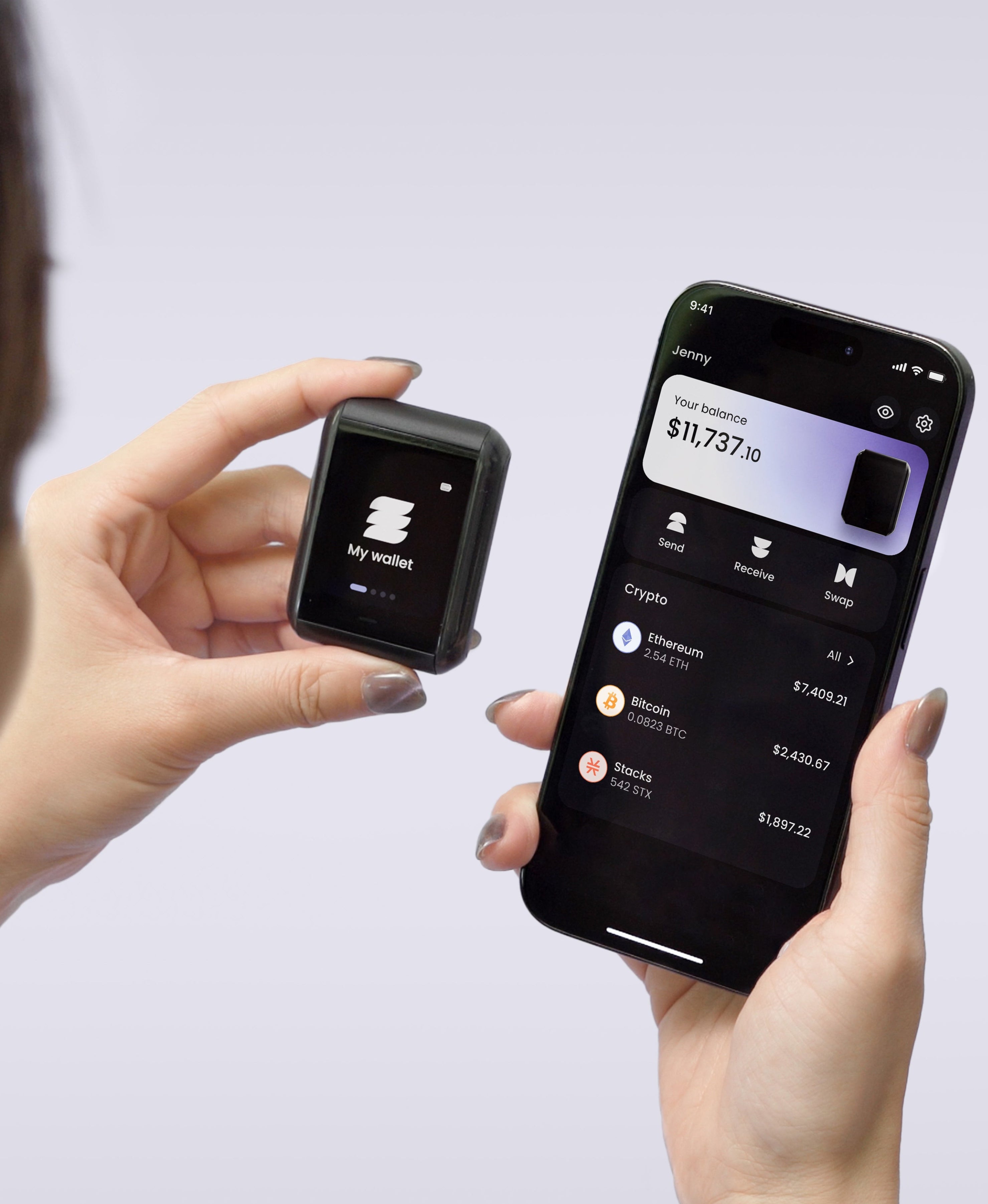
For BTC, ETH, and SOL, that posture is what Ryder One was built for. It has a 1.6-inch AMOLED touchscreen where every transaction renders in full before you approve it, an EAL6+ certified Infineon SLC38 secure element that generates and holds your keys, and NFC-only communication with no USB port, no Bluetooth radio, and no Wi-Fi surface a remote attacker can reach. The physical button is wired directly into the secure element, so no software path can produce a signature without your press.
Recovery uses TapSafe instead of a written seed phrase sitting in a drawer. The Recovery Tag holds 50 percent of your wallet share and is IP69K rated for water and dust; the paired phone holds the other 50 percent stored encrypted in your iCloud or Google Drive account, so losing the phone does not lose the backup. Optional Recovery Contacts add 25 percent shares apiece, paired in person over NFC. Ryder One ships at $229 with the Recovery Tag, a Qi wireless charger, and a pouch in the box, and the device itself is IP67 rated.
The bottom line
Hedera is an odd shape inside the L1 category: public, fast, aBFT-secure, and governed by a term-limited council of 31 named enterprises rather than a permissionless validator set. HBAR is the fuel for that network, with a fixed 50 billion supply and roughly 42 billion circulating in mid-2026. The ecosystem is small compared with the top DeFi chains, and it has visible traction in enterprise sustainability workflows.
For a self-custody holder, the read on HBAR is the same as the read on any L1: the token is only as protected as the key that signs its transactions. Wherever your keys live, put them behind a device that shows every transaction in full before you approve, and back them up so no single accident can take everything out. That is the discipline Ryder One was designed to make easy for the assets it supports today.
SEO
Target keyword: hbar crypto
SEO title: HBAR Explained: Hedera and the Enterprise Blockchain Bet
Meta description: HBAR is the token behind Hedera, an L1 governed by 31 enterprises including Google and IBM. Here's the network, tokenomics, and the self-custody read.
Hero alt text: HBAR Hedera enterprise blockchain — Ryder self-custody hardware wallet



Share: