


# Ethena USDe: How Synthetic Dollars Pay 15% Yield
Ethena USDe launched in February 2024 with an unusual claim: a dollar-pegged token that pays yield without ever touching a bank account. By mid-2026 the supply sits near $6 billion after peaking above $14 billion during the 2024 bull run, per DeFiLlama tracking data. The mechanism behind that peg is a synthetic basis trade in token form, and the risk profile for a self-custody holder looks nothing like USDC or USDT.
That distinction matters. USDe's peg holds because Ethena runs a delta-neutral hedge on centralized exchanges, and the yield holds because perpetual funding rates pay short positions when the market is long. When either leg breaks, the dollar you hold is exposed to a shape of risk fiat-backed stablecoins don't carry.
In this piece
- What Ethena USDe is
- How the delta-neutral hedge works
- sUSDe and the yield stack
- When the funding-rate math breaks
- Where Ryder One fits
- The bottom line
What Ethena USDe is
USDe is a "synthetic dollar" issued by Ethena Labs, first minted on Ethereum mainnet in February 2024. Users deposit ETH, BTC, USDC, USDT, or liquid staking tokens (like stETH) with the protocol and receive USDe at a 1-to-1 ratio. The peg is maintained through direct redemption for whitelisted market makers, plus arbitrage on the secondary market.
What sits behind the token is the interesting part. Ethena holds the deposited collateral as a long spot position, then opens an equal-notional short perpetual futures position on venues like Binance, Bybit, OKX, and Deribit. The long and the short cancel each other's price exposure, so the combined book sits close to dollar-flat regardless of where ETH or BTC trades. That combined position is what backs USDe.
Reserves live at off-exchange settlement providers: Copper, Ceffu, and Cobo. These custodians hold the collateral and mirror positions to the exchanges without depositing the assets directly, so a bankruptcy of a venue like FTX shouldn't wipe out Ethena's book the way it would if collateral sat on-exchange. Ethena publishes attestations showing which custodian holds what.
By mid-2026, USDe has settled into being the fourth or fifth largest stablecoin behind USDT, USDC, and Sky's USDS. Ethena also launched a sister token called USDtb in December 2024, which is backed 90% by BlackRock's BUIDL fund and doesn't use the basis trade at all. USDtb is the low-risk sibling for institutions that want an Ethena wrapper without funding-rate mechanics.
How the delta-neutral hedge works
Think about the trade in three legs. First leg: buy ETH on the spot market. Second leg: short the ETH perpetual future for the same notional size on a centralized exchange. Third leg: hold the short position and collect the funding rate that longs pay to shorts every eight hours.
Perpetual futures don't expire like traditional futures. Instead, exchanges use a funding mechanism to keep the perp price aligned with the spot price, so when more traders are long than short (the standard state during a bull market), longs pay shorts. When more are short than long (bear market squeezes, most of late 2022), shorts pay longs. The funding rate is the price of that imbalance, and Ethena's short leg is the position sitting on the receiving end when the market runs hot.
Because Ethena's spot position is fully hedged by the short perp, the combined book has near-zero directional exposure. If ETH rockets from $3,000 to $6,000, the spot leg gains 100% and the perp leg loses 100%. The dollar value of the collateral stays roughly flat. Meanwhile, the funding rate on the short leg accrues as yield, and that stream is where the 5% to 15% APY sits. Coin Metrics analysis shows funding rates averaged around 11% APY across 2023 to 2025, with peaks above 30% in bull-run months and lows dropping negative during risk-off periods.
The blend has changed over time. As of 2026, roughly 11% of USDe's backing sits in the delta-neutral perp trade, with the rest held in stablecoin reserves, tokenized Treasury products, and DeFi lending positions. Ethena added the diversified reserve stack to reduce the protocol's dependence on perpetual funding alone.
sUSDe and the yield stack
Holding raw USDe doesn't pay yield. To earn the funding-rate return, holders stake USDe into the sUSDe contract, where protocol revenue accrues daily and the sUSDe-to-USDe redemption rate rises over time. There's no rebase: a holder of 1,000 sUSDe still sees 1,000 sUSDe in their wallet, but 1,000 sUSDe redeems for progressively more USDe as the yield stack compounds.
Realized APY across 2024 and 2025 ranged roughly from 4% to 30%, with most periods clearing between 8% and 18%. As of Q2 2026, the 90-day trailing average sits near 12%, down from the 20-plus percent numbers seen in early 2024. The compression is what happens when funding markets cool from bull-run highs.
USDe supply has followed a similar arc. It climbed from launch to $10 billion in under 18 months, peaked around $14 billion during the late-2024 rally, and settled back to $6 billion after the 2025 unwinding. Even after that shakeout, USDe is one of the largest stablecoins on Ethereum by supply.
The yield engine sits on top of three sources: funding-rate income from the short perp legs, staking yield from stETH collateral, and interest from the T-bill and stablecoin reserve allocation. Ethena's insurance fund absorbs periods when funding rates flip negative, but the fund is finite. Long enough backwardation, and the yield goes to zero or below.
When the funding-rate math breaks
Every USDe holder is running a bet on where perpetual funding rates land over their holding period. The bet pays when the market runs net long and traders are willing to pay positive funding to hold long positions; it loses when the tape flips and shorts start paying longs instead.
March 2024 gave a preview. When ETH spiked past $4,000, USDe briefly traded around $0.995 on Ethereum secondary markets as arbitrageurs had trouble sourcing enough spot ETH to mint against demand. The peg recovered inside 24 hours, and Ethena's own redemption channel for market makers kept working the whole time. Small event, quick recovery.
The October 2025 event on Binance had more teeth. USDe traded as low as $0.65 on Binance's spot order book during a broader market flush, when concentrated liquidations and thin order-book depth on that specific venue caused a temporary breakdown. Ethena's peg on-chain and via primary redemption held, and the team disputed the framing as a peg failure. Even so, holders who tried to exit through that specific venue took a haircut of over 30% on paper before the price snapped back.
There's also a slower-burn failure mode. If perpetual funding rates flip negative across multiple exchanges for weeks, Ethena has to pay to hold the short position rather than collect. The insurance fund covers the shortfall until it doesn't. Extended backwardation is the tail risk the mechanism cannot design out.
Then there's the counterparty layer. USDe's collateral sits at off-exchange settlement providers, and the short legs sit at Binance, Bybit, OKX, and Deribit. A Binance freeze, a Ceffu operational failure, or a coordinated exchange outage would all touch the backing directly. USDC's reserve risk is a US bank going down. USDe's reserve risk is a centralized exchange going down. Different shape.
Where Ryder One fits
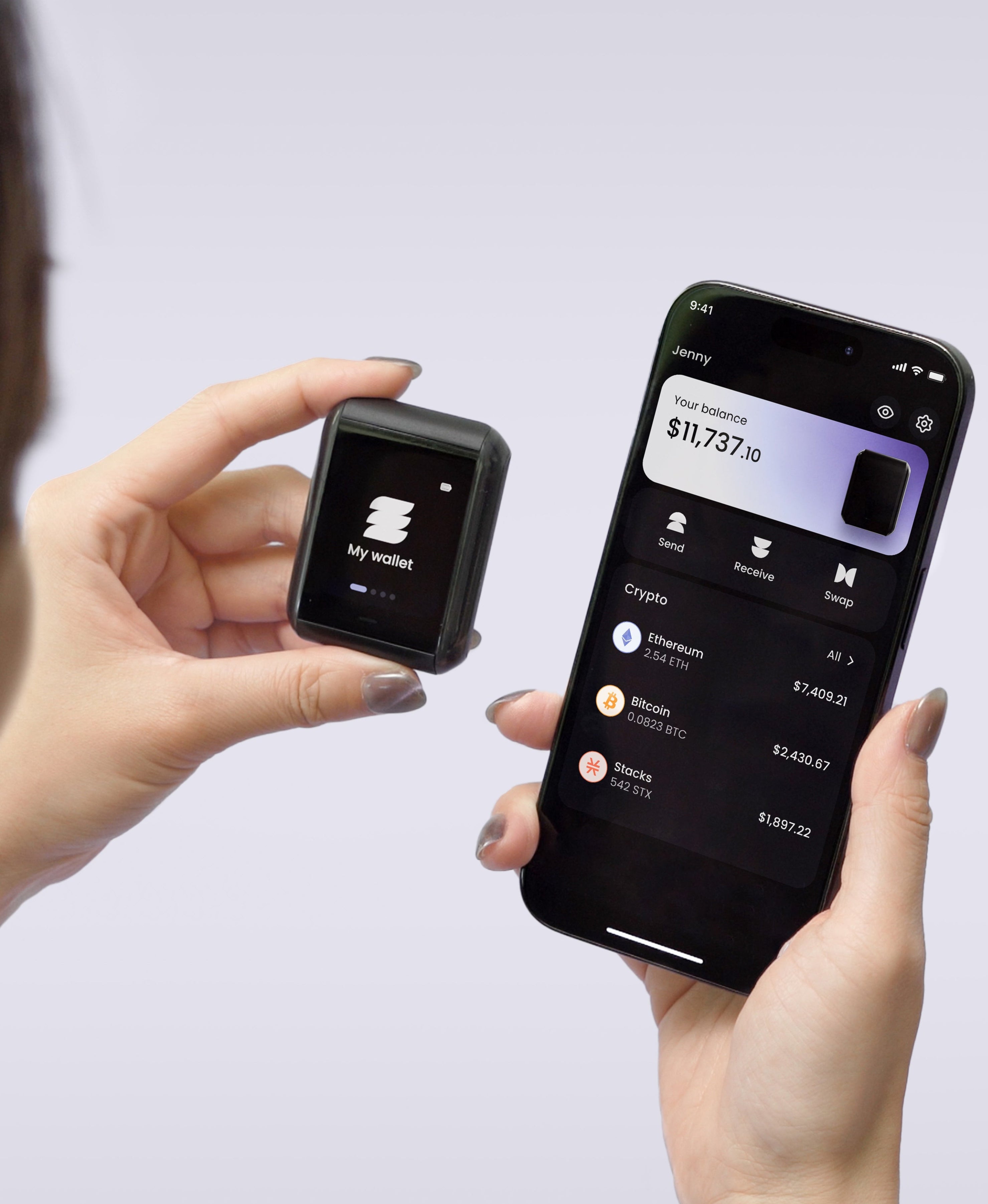
USDe is an ERC-20 on Ethereum, so it's a first-class asset on Ryder One, alongside the other ERC-20s the device supports. Sending, receiving, and staking flows all go through standard Ethereum transactions signed on the 1.6-inch AMOLED screen. Users who want to move USDe into sUSDe stake it through Ethena's contract, and the signing step happens on-device with full transaction detail displayed for review before the button press.
The self-custody read is the same one that applies to any regulated or algorithmic dollar. The token in the wallet is a claim on the issuer's balance sheet. In USDe's case, that balance sheet is a delta-neutral hedge portfolio sitting at Binance, Bybit, OKX, and their custody partners. Holding USDe means trusting Ethena Labs, trusting the exchanges running the perp shorts, and trusting the off-exchange custodians running the collateral. What a hardware wallet controls with certainty is the private key that authorizes moving the USDe balance itself.
For backup, the seed phrase is always available on-device as a last resort and meets the BIP-39 standard, so a Ryder One holder is never locked to Ryder hardware. TapSafe Recovery splits the wallet backup across a Recovery Tag (50%) and an encrypted phone backup (50%), with optional Recovery Contacts adding a distributed layer. A single lost object doesn't lock the holder out, and no single object gives an attacker full access alone.
For a token like USDe that lives on a chain where balance visibility is public, address hygiene matters. Ryder One verifies receiving addresses on-device and warns before sending to an unfamiliar counterparty, which is the defense against clipboard hijack attacks that swap out an address at the moment of copy-paste.
The bottom line
Ethena's USDe is a working experiment in what happens when a stablecoin's yield engine is a basis-trade hedge rather than a Treasury bill portfolio. The 5% to 15% APY on sUSDe is a return for holding perpetual-futures counterparty risk on Binance and Bybit, distributed through a delta-neutral hedge managed by Ethena Labs. That's a coherent trade, and holders who understand what they're getting paid for can size the position with eyes open.
What the trade isn't: a fiat-backed stablecoin. USDC and USDT are claims on cash and short-term Treasuries at named banks. USDe, by contrast, is a claim on a hedge portfolio at centralized exchanges. The two look the same on a wallet balance screen and behave differently under stress. Choose accordingly, and if the size of the position matters, keep the private key on hardware that verifies every transfer on-screen.
Take the next step
Whether the stablecoin in the wallet is USDe, USDC, USDT, or something else, the layer holders control with certainty is the key that signs the transfer. Ryder One keeps that key offline in an EAL6+ secure element, verifies every transaction on a 1.6-inch AMOLED screen, and replaces the fragile paper seed-phrase habit with TapSafe Recovery. $229, and 60 seconds to set up.
SEO
- Target keyword: ethena usde
- SEO title: Ethena USDe: How Synthetic Dollars Pay 15% Yield (48 chars)
- Meta description: Ethena USDe pays 5-15% APY through a delta-neutral basis trade with $6B+ in supply. Here's how the mechanism works and the self-custody read for holders. (152 chars)



Share: