


# Dogecoin (DOGE) in 2026: What the Memecoin Does Now
Every "this coin is a joke" pick from the 2013 altcoin boom died years ago except one. Dogecoin was drawn up in an afternoon by two software engineers who wanted to laugh at Bitcoin culture, and twelve-plus years later the Shiba Inu ticker still trades in the top ten by market cap. That staying power caught almost everyone off guard, including the two people who made it.
Below we cover what Dogecoin is at the protocol level, how merge-mining with Litecoin keeps the chain secure, the uncapped supply and its inflation curve, Musk's involvement across X, SpaceX, and Tesla, merchant use in 2026, and where DOGE fits inside a self-custody wallet like Ryder One.
What Dogecoin is
Dogecoin was created by Billy Markus and Jackson Palmer in December 2013 as a Litecoin fork with a Shiba Inu mascot and Comic Sans branding. Neither founder expected the coin to survive, and both have since stepped back from active development. What began as a satire of the 2013 altcoin boom became a payments-focused chain with a working peer-to-peer network, a wallet ecosystem, and an open-source client that still ships releases through github.com/dogecoin/dogecoin.
The chain uses the same UTXO model as Bitcoin and Litecoin, so every DOGE balance is the sum of unspent transaction outputs sitting at your address. Transactions confirm about once a minute, roughly ten times faster than Bitcoin blocks. There are no smart contracts on Dogecoin core, no application layer to speak of, and no native DeFi ecosystem on the chain. It's a payments coin with a mascot and a culture attached, and that narrow scope is part of why the codebase has stayed maintainable across a decade of price cycles.
How DOGE proof-of-work and merge-mining with Litecoin work
Dogecoin uses Scrypt as its proof-of-work algorithm, the same choice Litecoin made in 2011 to resist the ASIC hardware that Bitcoin miners had already scaled to industrial size. Since September 2014, Dogecoin has been merge-mined with Litecoin, which means every Scrypt miner producing Litecoin blocks can produce Dogecoin blocks at the same time without extra compute. The change was pushed through as a soft fork, and it fixed a scary problem: Dogecoin's independent hashrate was small enough by 2013 that a 51% attack would have been affordable for a well-funded adversary.
Merge-mining piggybacks DOGE on Litecoin's security budget. When a miner finds a Litecoin block, the same work counts as a Dogecoin block if the difficulty target is met, so a Litecoin-scale hashrate defends Dogecoin without asking miners to split their attention or hardware. The tradeoff is that Dogecoin's fate is bound to Litecoin's miner base; if Litecoin's Scrypt hashrate collapses, Dogecoin loses its shield with it. That risk has stayed theoretical because Scrypt ASICs remain profitable and Litecoin's own hashrate has climbed steadily since the merge-mining launch.
Supply and tokenomics: no cap, decreasing inflation
Bitcoin caps supply at 21 million coins; Dogecoin does not cap supply at all. The block reward has sat at 10,000 DOGE per block since March 2014, which works out to about 5 billion new DOGE minted each year at the current one-minute block cadence. At the time of writing, roughly 150 billion DOGE circulate against that steady 5 billion annual issuance, so headline inflation runs near 3.3% and drops as a percentage each year because the numerator stays fixed while the base grows.
That model was defended by Markus as a payments-first choice: coins are meant to spend, not to hoard, so an infinite emission curve keeps fees low and blocks full of transaction activity rather than speculation. The critique is the mirror image. Without a cap, DOGE cannot make the scarcity argument Bitcoin makes, and long-term holders are structurally diluted by every new block reward. Whether you view that as a feature or a flaw depends on whether you see DOGE as a currency or as digital gold, and the design answer has been the same since 2014.
Musk, X Payments, DOGE-1, and 2024 to 2026 milestones
Elon Musk has been the loudest public voice on Dogecoin since 2019, and his companies have shipped several DOGE-adjacent products since then. Tesla began accepting DOGE for select merchandise in January 2022, keeping the ticker on a company checkout even as Bitcoin was dropped as a car payment method. SpaceX signed the DOGE-1 mission with Geometric Energy Corporation as a fully DOGE-funded satellite launch, and after several delays it finally rode a Falcon 9 to lunar orbit in 2024.
X, the platform formerly known as Twitter, opened its payments rails in phases through 2024 and 2025, and DOGE was named across public statements from the company as one of the assets under consideration for the wallet layer. The 2024 US election added a political nod when the incoming administration created a Department of Government Efficiency (informally styled DOGE) that Musk co-led into 2025, a naming choice that pushed the ticker into political news cycles well after the vote. Every one of these events shows up as a spike on the DOGE price chart, and the chain kept running through all of them without a consensus-level incident.
Real merchant adoption in 2026
DOGE payments in 2026 look different from the 2021 hype cycle. Newegg has accepted DOGE at checkout since 2021 through a BitPay integration, and the option is still live on the electronics retailer. Twitch reinstated crypto tipping with DOGE among the supported assets, and several Shopify merchants take DOGE via third-party payment processors such as BitPay and Coinbase Commerce. Payment processors handle the price volatility by converting DOGE to fiat at checkout, so the merchant sees dollars while the customer spends coin.
That is the shape of DOGE utility today: a payments-native asset that a small but steady set of merchants accept, backed by processors that shield sellers from price swings. The volumes are far below stablecoin rails or credit card networks, and DOGE remains a niche checkout option rather than mainstream commerce infrastructure. What the merchant list demonstrates is that the coin does what its founders said it should, which is settle small transactions on a public chain at fees usually under a cent per transfer.
Self-custody read on DOGE
Dogecoin's cryptographic setup is close enough to Bitcoin's that most Bitcoin self-custody habits transfer directly. Addresses derive from secp256k1 keys the same way Bitcoin addresses do, and the UTXO model means every DOGE balance is a set of unspent outputs at your address. Wallet software signs a transaction locally, broadcasts it to the network, and the merge-mined Scrypt miners confirm it into a block about once a minute.
The threat surface looks familiar too. Phishing sites impersonate wallet download pages, clipboard-hijack malware swaps a copied DOGE address for an attacker's address at paste time, and exchange custody carries the same counterparty risk any custodial account carries. A hardware wallet keeps your DOGE keys off any internet-connected device and forces a signing step that a remote attacker cannot spoof, which is why moving long-term balances out of an exchange into self-custody is the standard defensive posture for DOGE holders who plan to keep the coin around.
Where Ryder One fits
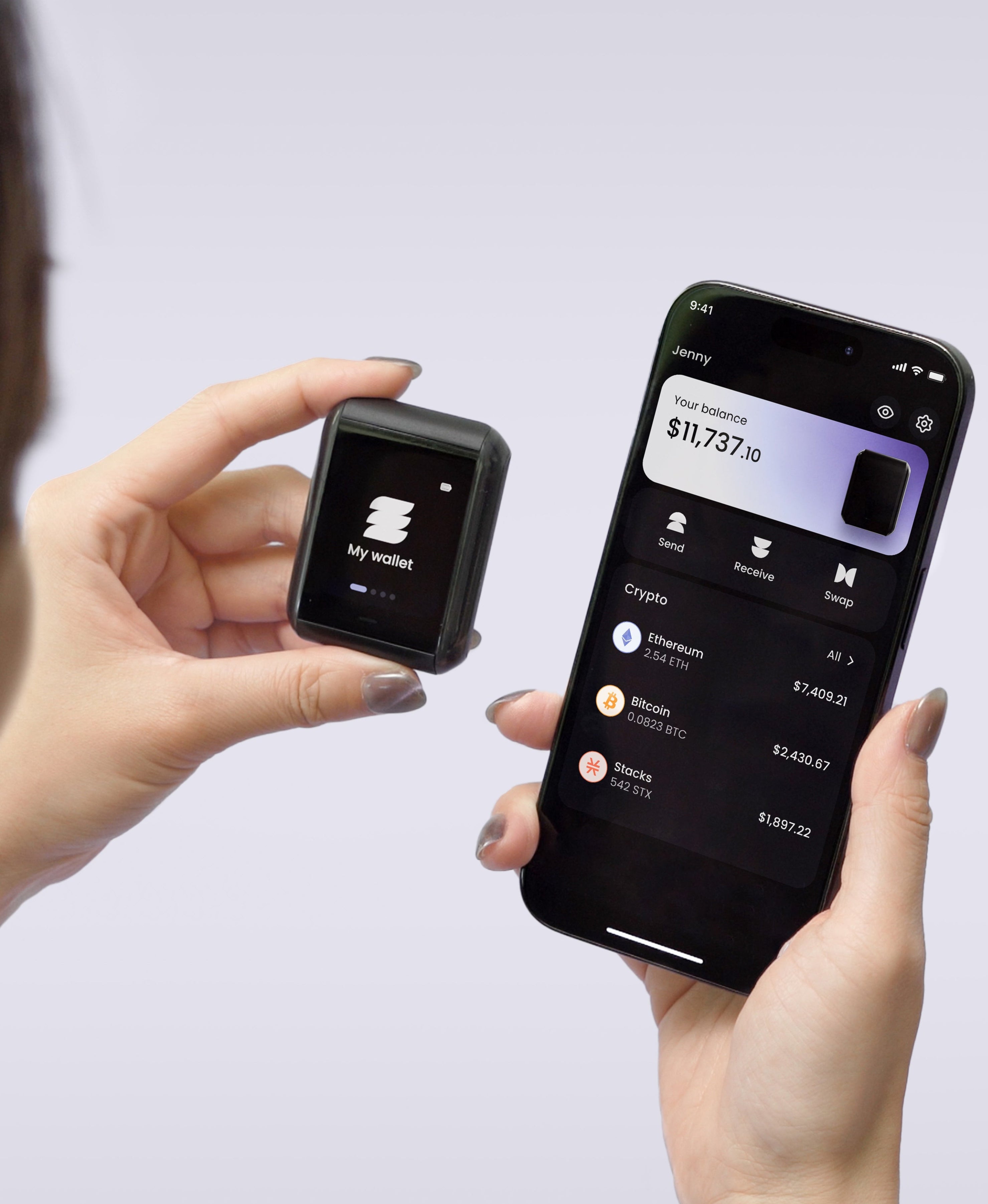
DOGE is not on the current Ryder One coin list, which sits at Bitcoin, Ethereum, Solana, and a growing set of top ERC-20 and SPL tokens. If you hold DOGE today, the practical move is to keep it either on a reputable exchange or in a DOGE-native software wallet while you keep your BTC, ETH, and Solana balances behind hardware. For every asset Ryder One does support, the guardrails are the same: an EAL6+ Infineon SLC38 secure element that generates keys on the chip and never releases them, a 1.6-inch AMOLED touchscreen that shows every transaction detail before you sign, and NFC-only communication with no USB port, no Bluetooth, and no Wi-Fi to expose a remote attack surface.
Backup takes a different path from the paper-and-metal playbook. Paper seed phrases burn, tear, or get misplaced, and metal plates hold up under fire while still leaving your entire recovery on one object surviving everything. TapSafe Recovery splits the secret across a Recovery Tag rated to IP69K, your paired phone (backed up encrypted to iCloud or Google Drive rather than to the device itself), and up to two optional Recovery Contacts who each hold a share without ever seeing wallet content. The BIP-39 seed phrase stays on-device as a last resort, so a Ryder One holder is never locked to our hardware. The device ships at $229 with the Recovery Tag, a Qi wireless charging pad, and a travel pouch in the box.
The bottom line
Dogecoin's story is the punchline that outlived the joke. Twelve years after Markus and Palmer put a Shiba Inu on a Litecoin fork, DOGE trades in the top ten by market cap, moves millions of dollars in daily volume, and clears merchant checkouts at Newegg, Twitch, and a Shopify tail. The chain runs on Scrypt proof-of-work merge-mined with Litecoin, mints 10,000 DOGE per block with no cap, and stays maintained by a small open-source team that still ships releases through the original repository. If you hold DOGE, treat it as a payments-and-culture asset with predictable inflation and use the same self-custody discipline you apply to any UTXO chain. For the assets Ryder One supports today, the wallet is built to keep keys inside a certified chip, show every signing detail on screen, and back everything up without depending on any single object surviving.
SEO
Target keyword: dogecoin / doge crypto
SEO title: Dogecoin (DOGE) in 2026: What the Memecoin Does Now
Meta description: Dogecoin turns twelve in 2026 with Litecoin merge-mining, uncapped supply, X and Tesla payments hooks, and merchant checkouts at Newegg and Twitch.
Hero alt text: Dogecoin DOGE memecoin 2026 — Ryder self-custody hardware wallet


Share: