

People ask whether you pay taxes on crypto before withdrawal because the wording on an exchange makes it sound like withdrawing is the moment something happens. It reads like a bank, where money leaving an account is an event. Moving your coins from an exchange to a wallet you control is not a sale, and under US rules it does not by itself create a tax bill. This matters beyond bookkeeping, because the fear of triggering something is one of the quieter reasons people leave coins on a platform longer than they meant to.
What follows is general information rather than tax advice, and anyone with a complicated position should talk to a professional who can see the whole picture.
What the IRS treats as a taxable event
Digital assets are treated as property for federal tax purposes, so the tax question turns on disposal. You dispose of crypto when you sell it for dollars, trade it for another token, or spend it on something. Each of those closes a position and produces a gain or a loss measured against what you paid.
Moving coins between two wallets you own closes nothing. The asset is the same asset, the owner is the same person, and no gain has been produced because nothing was exchanged for anything. The IRS confirms this from the reporting side: its guidance on Form 1099-DA states that you will not receive one for transfers of digital assets between your own wallets where there is no sale or exchange.
Two wrinkles are worth knowing. Network fees paid in crypto are technically a disposal of the coins spent on the fee, which on a single transfer is usually a small number but is not always nothing. And if you withdraw and sell in the same session, the sale is the taxable part, while the withdrawal that preceded it remains untaxed.
Why the question comes up at all
The confusion has a structural source. Custodial platforms are the ones that send you forms, so the platform is where tax feels like it lives, and a screen full of compliance language at the moment you withdraw invites the conclusion that withdrawal is what the paperwork is about.
The reporting regime has grown around that impression rather than against it. Brokers began issuing Form 1099-DA for the 2025 tax year covering gross proceeds from sales and exchanges, and from 1 January 2026 cost basis is reported as well for assets bought and sold on the same platform. None of that machinery is triggered by you taking custody of your own coins.
One practical caution sits underneath this. Your cost basis has to travel with you, because the exchange that knew what you paid stops tracking the asset once it leaves, and the obligation to report accurately when you eventually sell does not leave with it. Export your transaction history before you move, and keep it somewhere you will find it in three years.
What moving to self-custody does change
It changes who can stop you, and it changes who is responsible for your records.
An exchange balance is a claim against a company, and companies fail, restructure and wind down on schedules you do not set. Coins in a wallet you hold answer to your keys and nothing else. That is the trade being made, and the tax treatment of making it is neutral, which is the useful thing to know before you decide.
The record-keeping shift is the part people underestimate. Nobody sends you a summary at the end of the year for a wallet you control, so the acquisition dates and prices you will need at sale time are yours to keep. Portfolio tools can help, though handing one an extended public key discloses every address in that account, so an account you use for part of your holdings is a better thing to connect than your main one.
Where your backup fits into all of this
Taking custody means the backup becomes the thing standing between you and loss, which is a larger change than anything on your tax return.
A seed phrase written on the card that came in the box leaves your whole position resting on one piece of paper getting through fires, floods and house moves. Metal plates are the standard upgrade and they answer the durability question well, though the shape of the risk survives: one object grants full access to whoever reads it, and losing it loses everything.
TapSafe Recovery splits the backup so no single item carries it. The Recovery Tag holds half, your paired phone holds the other half encrypted in your own iCloud or Google Drive rather than on the handset, and the two together restore the wallet. Neither half reveals anything alone. Optional Recovery Contacts hold a quarter share each while seeing nothing about your balances, which is useful if you want somebody able to help without handing them your coins. Your seed phrase stays available on the device as a last resort under the BIP-39 standard.
The short answer
Withdrawing crypto to your own wallet does not create a taxable event under current US rules. Selling, swapping and spending do, whether they happen on an exchange or from a wallet in your pocket, and the records that prove what you paid are worth more once no platform is keeping them for you.
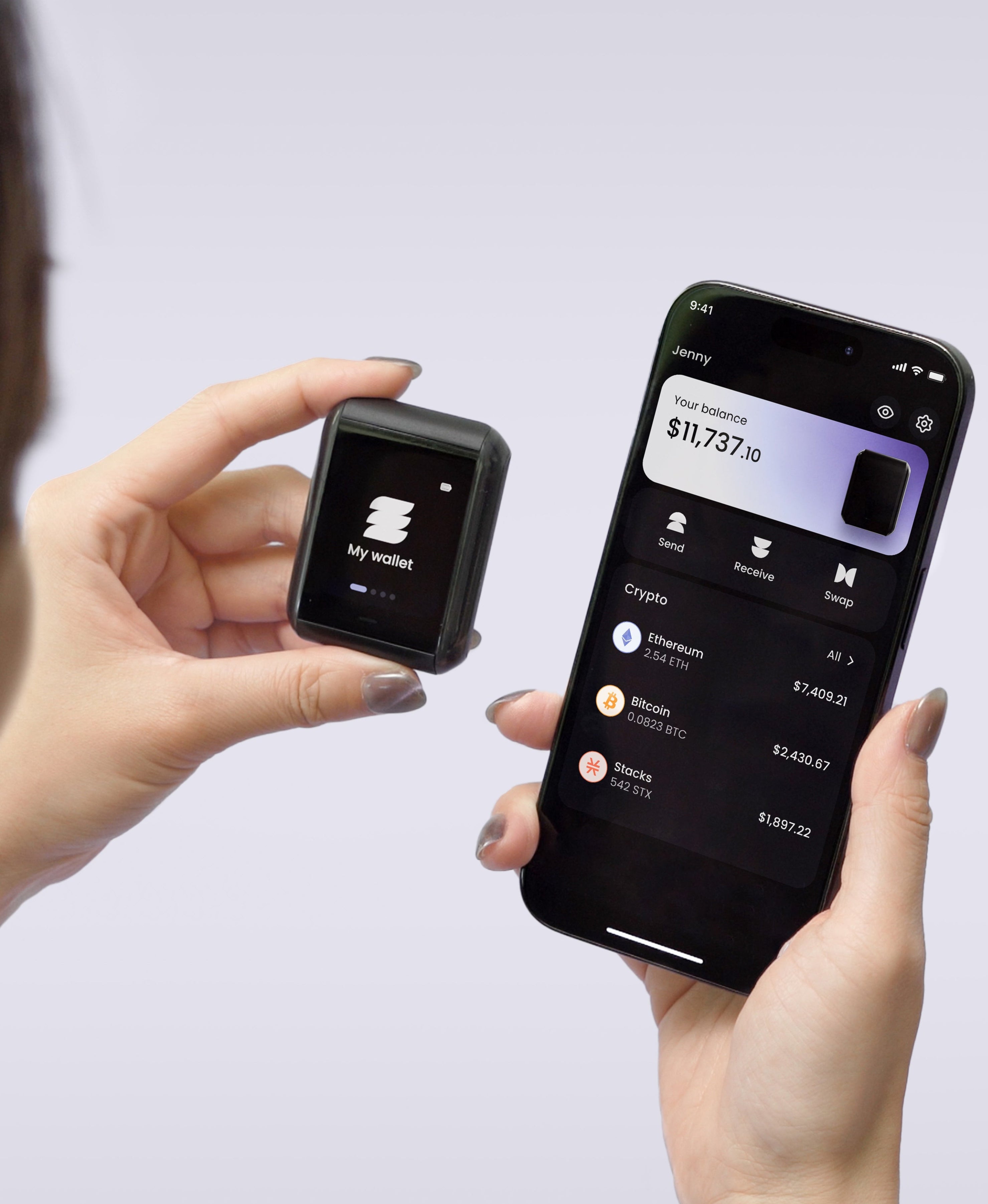
Ryder One is 149 USD for the Starter Combo. Private keys are generated inside an EAL6+ Infineon SLC38 secure element and never leave the chip, the device talks over NFC only with no Bluetooth, USB data path or Wi-Fi, and every transaction appears in readable detail on the 1.6 inch AMOLED touchscreen before you approve it. The firmware has been audited by Halborn with the report published in full, and setup takes about sixty seconds.


Share: