

Searching for how to add a Coinbase beneficiary is a sensible thing to do once your balance stops being pocket money. Every brokerage and bank you have dealt with offers the option, usually as a form that takes two minutes, and the expectation that a crypto platform works the same way is reasonable. It does not. Coinbase has no beneficiary designation, no transfer-on-death registration, and the process your family would face instead runs through a court.
What happens to a Coinbase account when the holder dies
There is no field to fill in, so nothing is arranged in advance. What exists is a claims process after the fact.
Coinbase's own guidance for claiming a deceased person's account asks the executor or administrator to come forward with a death certificate together with legal authority documents: a will, letters testamentary, letters of administration, an affidavit for collection, or a small estate affidavit depending on the state and the size of the estate. Those documents come from a probate court, which means your family cannot start with Coinbase. They have to start with a lawyer and a filing, and the timeline is measured in months rather than days.
For an ordinary estate that is inconvenient rather than ruinous, and it is worth saying plainly that the money is not lost. It sits where it is while the paperwork catches up. The cost is time, legal fees, and a family dealing with a court process in the worst month of their lives.
The workaround estate lawyers reach for is a trust. Coinbase will let an account be titled in the name of a revocable living trust, and once it is, the assets pass under the trust's terms rather than through probate. That works, it is well-trodden, and it involves setting up and funding a trust, which is a substantial piece of work with real costs attached.
The part the search term hides
Here is the harder question underneath the one people are asking. A beneficiary designation solves the legal problem of who is entitled to the coins, and it does nothing whatsoever about the practical problem of whether anybody is able to reach them once you are gone.
On a custodial platform those two problems are the same problem, because the company holds the keys and hands over the balance once the entitlement is proven. Move to a wallet you control and they separate completely. Your will can name whoever you like, and if nobody can find or use your backup, the instruction describes coins that no longer reach anybody. Estate lawyers see this repeatedly: a clear legal claim on assets that are cryptographically out of reach.
That is the trade self-custody makes. You remove the company from the equation, and you take on the job the company was quietly doing, which is making sure somebody other than you can get in.
Building what the beneficiary form would have given you
The naive version is to write your recovery words down and tell someone where they are, which hands that person full access to your coins today rather than after your death. The other naive version is to tell nobody, which is the situation the whole exercise exists to avoid. Most advice lands on splitting words between locations or people, and that improvises a scheme without the maths to make it safe.
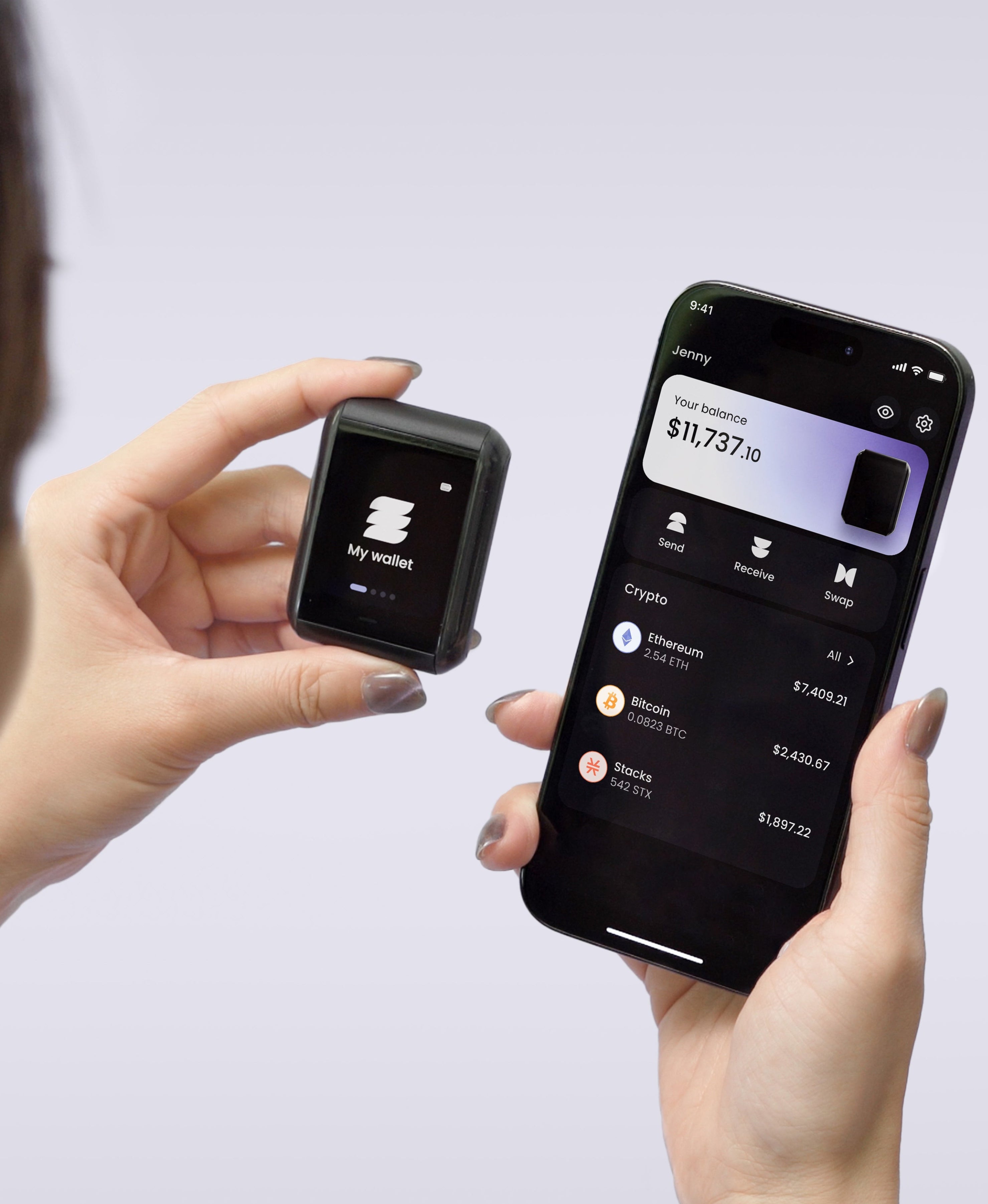
TapSafe Recovery handles this structurally. Your backup is split so that no single item carries it: the Recovery Tag holds half, your paired phone holds the other half encrypted in your own iCloud or Google Drive rather than on the handset, and the two together restore the wallet. Optional Recovery Contacts each hold a quarter share, set up in person over NFC and synced to that person's own cloud account, and a contact can hold their share for years without seeing your balances or being able to act alone. The scheme is built on a custom implementation of Shamir's Secret Sharing rather than on splitting a seed phrase in half and hoping.
What that buys you for estate purposes is the ability to distribute recovery ahead of time without distributing access. Somebody you trust can be part of the answer while you are alive without being a risk to you, which is precisely the property a beneficiary form provides and a written-down phrase destroys.
Your seed phrase remains available on the device as a last resort under the BIP-39 standard, so a wallet restored by your executor is not locked to our hardware.
What to write down, and where
Your will should describe what exists and who gets it, without containing anything that grants access. Wills become public records in probate, and recovery words in a filed document are recovery words anyone can read.
A separate letter of instruction is the place for the operational detail: that a hardware wallet exists, where the Recovery Tag is kept, which phone is paired, who holds Recovery Contact shares, and what the executor should do first. Keep it with your other estate papers, update it when your setup changes, and say nothing in it that would let a finder move funds on their own.
Tell at least one person that the wallet exists. The most common way crypto disappears from an estate is that nobody knew to look for it.
What to take from this
You cannot name a Coinbase beneficiary, and the alternative on a custodial platform is probate or a trust. In self-custody the legal question and the access question come apart, and the access question is the one that decides whether your family ends up with anything.
Ryder One is 149 USD for the Starter Combo, which includes a Recovery Tag; the Super Safe Combo at 179 USD ships with three. Keys are generated inside an EAL6+ Infineon SLC38 secure element and never leave the chip, the device communicates over NFC only, and the firmware has been audited by Halborn with the report published in full. Setup takes about sixty seconds, and the recovery scheme is designed so the people who matter to you can be part of it without ever holding your coins.


Share: