

Choosing a crypto wallet for business starts from a different place than choosing one for yourself. The question stops being how to keep a secret and becomes how to share control of one: who can move money, what happens when that person leaves, how an accountant reconciles it at year end, and who is answerable if a payment goes to the wrong address. None of that is solved by picking a wallet with good reviews.
What a business wallet has to do that a personal one doesn't
A personal wallet answers to one person who can hold the whole picture in their head. A company wallet answers to a bookkeeper, an auditor, a co-founder who was on holiday when the transfer went out, and eventually to whoever takes over the role. That means the setup has to produce a record, survive a departure, and make it clear to more than one person how money moves.
The common starting arrangement fails all three. One founder installs a wallet app on a personal phone, the company's coins go into it, and the backup words end up in a drawer at that founder's house. From the company's point of view the treasury now depends on one individual's phone, one individual's memory, and one individual's continued goodwill, which is an arrangement no board would accept for a bank account.
Custody: who holds the keys, and who can be told to move them
There are three shapes to choose between, and the trade-off is control against convenience. An account at a trading platform is the least work and the most exposure, because the coins are a claim against that platform and the platform can freeze, delay or fail. A single hardware wallet held by the company gives you the coins outright and puts the whole question of who holds the device into your own policy. A multi-signature setup requires several approvals before anything moves and suits larger balances, at the cost of more moving parts and more that can go wrong when somebody is unreachable.
Most small companies are better served by the middle option with clear rules around it than by a multi-signature arrangement nobody on the team can operate. Write down who has the device, who has the secondary material, where each lives, and what happens on the day the person holding one of them resigns. That document is worth more than the hardware.
The accounting changed for financial years starting after 2024
If your company reports under US GAAP, the rules moved recently. Under ASU 2023-08 the Financial Accounting Standards Board requires qualifying crypto assets to be measured at fair value with changes running through net income, and Grant Thornton notes the amendments take effect for fiscal years beginning after 15 December 2024, with early adoption allowed. Holdings also have to be presented separately from other intangible assets on the balance sheet.
The practical consequence for a wallet choice is that your records need to be clean. Keep company holdings in addresses used only by the company, never mixed with anybody's personal coins, and give your accountant read-only visibility into those addresses rather than access to anything that can sign. Watch-only access is enough to produce a balance at any date, and it grants no ability to spend.
Paying and getting paid without losing a transfer
Business payments are where the money tends to go missing, and the attack is unglamorous. Malware watches the clipboard and swaps a pasted destination for the attacker's own, or an invoice arrives from a supplier's compromised mailbox with a changed address in it, and the transfer is gone the moment it confirms because there is nobody to call and reverse it.
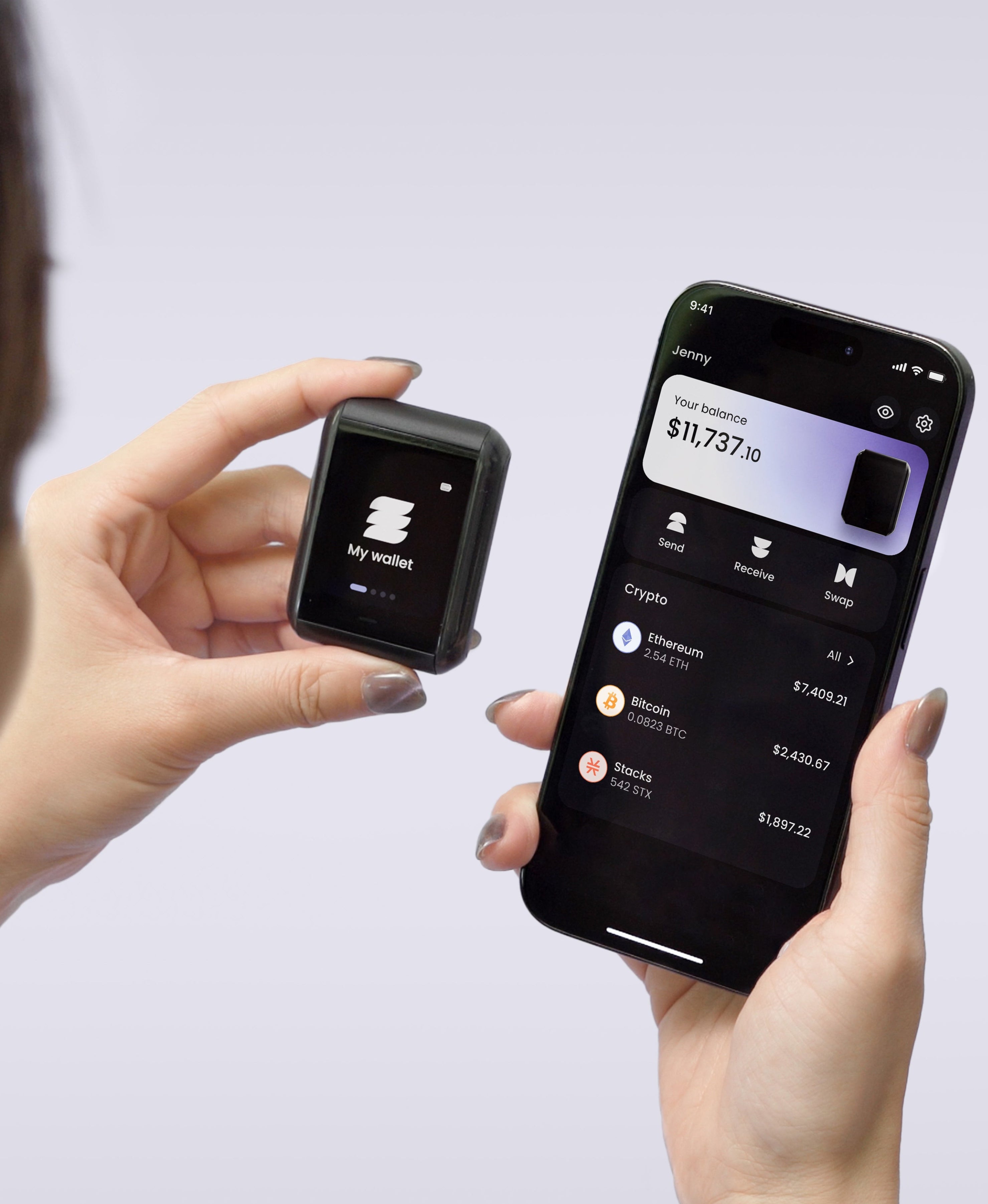
Two habits close most of that gap. Confirm any new destination address through a channel separate from the one it arrived on, meaning a phone call to a number you already had rather than a reply to the email. And check the destination on the signing device itself, where the screen shows what the device is being asked to sign rather than what a compromised computer is displaying. Ryder One verifies receive addresses on the device and keeps an on-device address book for destinations you use often, so a supplier you pay monthly can be checked against an entry you confirmed once.
What your backup plan has to cover with more than one person involved
Here is where company arrangements come apart. A backup one person can use alone means that person can take the treasury, and a backup nobody can reach without that person means the company is locked out the moment they are unavailable. Paper in a drawer fails on both counts. Steel plates survive fire and flooding and are the sensible upgrade from paper, but the same object still grants everything to whoever opens the safe and costs everything if it is lost, so the governance problem is untouched.
TapSafe Recovery splits that instead of duplicating it. Half of what a recovery needs lives on the Recovery Tag and half on the paired phone, encrypted in the owner's iCloud or Google Drive rather than on the handset, so no single item and no single person can rebuild the wallet alone. Optional Recovery Contacts hold a quarter share each and can see nothing about balances or addresses, which maps neatly onto a co-founder or an outside director who should be able to help in a crisis without being able to spend on a Tuesday. The seed phrase remains available on the device as a last resort under the BIP-39 standard, so the company is never tied to one supplier's hardware.
Choosing the setup
Start from the amount and the number of people. A company holding an amount it could absorb losing, with one or two people involved, wants a dedicated hardware wallet, a written policy and separate addresses for clean books. A company holding an amount that would end it wants multiple approvals and probably professional advice. Either way, the decision to record is who can move money and who can restore access, because those two questions are what an auditor, a co-founder and a successor will each need answered.
Ryder One is 149 USD for the Starter Combo, and the Super Safe Combo is 179 USD. Keys are generated inside an EAL6+ certified Infineon SLC38 secure element and never leave the chip, the device communicates over NFC only with no Bluetooth, no Wi-Fi and no wired data path, and every transaction is shown in readable detail on the 1.6-inch AMOLED touchscreen before approval. The firmware has been audited by Halborn with the full report published, and setup takes about sixty seconds.
Meta description: A crypto wallet for business has to survive a departure, satisfy an auditor and stop a redirected payment. How to choose custody, records and recovery.




Share: