

The money moving into crypto banking in 2026 hasn't gone to exchanges. It's gone to companies building accounts: businesses that look like a bank on the front end and settle on stablecoin rails underneath. A crypto neobank is the label the category picked up, and in 2026 it stopped being a pitch deck idea. Two names worth knowing are Flex and Dakota, and understanding what they do well is the fastest way to see what they don't do at all.
What a crypto neobank is
Take an ordinary business account: balances, payments, a card, some treasury tooling. Now replace the correspondent banking underneath it with stablecoins, so a payment from a supplier in Manila to a buyer in Ohio settles in minutes at a published cost rather than travelling through three intermediaries over four days. The customer experience stays familiar. The plumbing changes completely, and the plumbing is where the savings live.
That's the model. None of these companies are asking you to learn about blockchains, which is exactly why the category is growing.
Flex and Dakota, and what the funding tells you
Flex raised $70 million in a Series B1 round led by Halo Fund, reported by Forbes on 14 July 2026. The product it launched alongside the raise, Flex Global, offers multi-currency accounts in 32 currencies across 170 countries, aimed at mid-market business owners turning over between $3 million and $200 million a year in sectors like construction, wholesale, and import-export. Forbes put Flex's throughput at $10 billion in annualised payment volume with more than $1 billion of that running on stablecoin rails.
Dakota went a different direction. After launching an enterprise stablecoin offering in January 2026, it applied for a de novo national trust bank charter from the Office of the Comptroller of the Currency, reported by American Banker on 3 August 2026. The application says the trust bank would offer "fiduciary digital asset custody services, issue U.S. dollar-denominated stablecoins and provide related services such as transaction settlement." Dakota's fiat banking currently runs through partner banks, with FDIC coverage arriving via U.S. bank partners.
Read those two together and the shape of the category comes through. One company is scaling payment volume; the other is applying to become the regulated entity that holds the assets. Both are betting that businesses want stablecoin speed wrapped in something that behaves like a bank.
The question the marketing doesn't answer
An account is a claim on a company. That sentence is dull enough to skim past, and it's the entire lesson of the last four years.
When a balance sits in a crypto neobank, you hold a database entry saying the provider owes you funds. The provider holds the assets, or a partner does, and your ability to withdraw depends on that arrangement working on the day you need it. This isn't a knock on Flex or Dakota specifically, and it isn't a prediction that either will fail. It's a description of what an account is, and it applies identically to every company in the category.
The reason it deserves attention is that crypto has run this experiment already. FTX collapsed in 2022 with roughly 8 billion dollars of customer funds missing, and Binance paid a 4.3 billion dollar settlement to the Department of Justice in 2023. In both cases customers had balances on a screen and discovered what those balances were worth as a legal claim.
FDIC coverage is worth being precise about too, because it gets cited loosely in this market. It protects fiat deposits at an insured bank if that bank fails. It doesn't cover crypto assets, and it doesn't cover the failure of a non-bank company that happens to partner with one, which the FDIC has stated directly.
The split that makes sense
None of this argues for avoiding crypto neobanks. Moving money across borders in minutes is a measurable improvement over what businesses had before, and for operating cash, an account with good tooling beats a hardware wallet every time. You can't run payroll from cold storage.
The distinction worth drawing is between money that moves and money that sits. Flow belongs in an account, where speed and reconciliation matter more than sovereignty. Savings belong somewhere the provider's balance sheet has no bearing on your access, because the whole point of holding crypto is that it doesn't require anyone's permission.
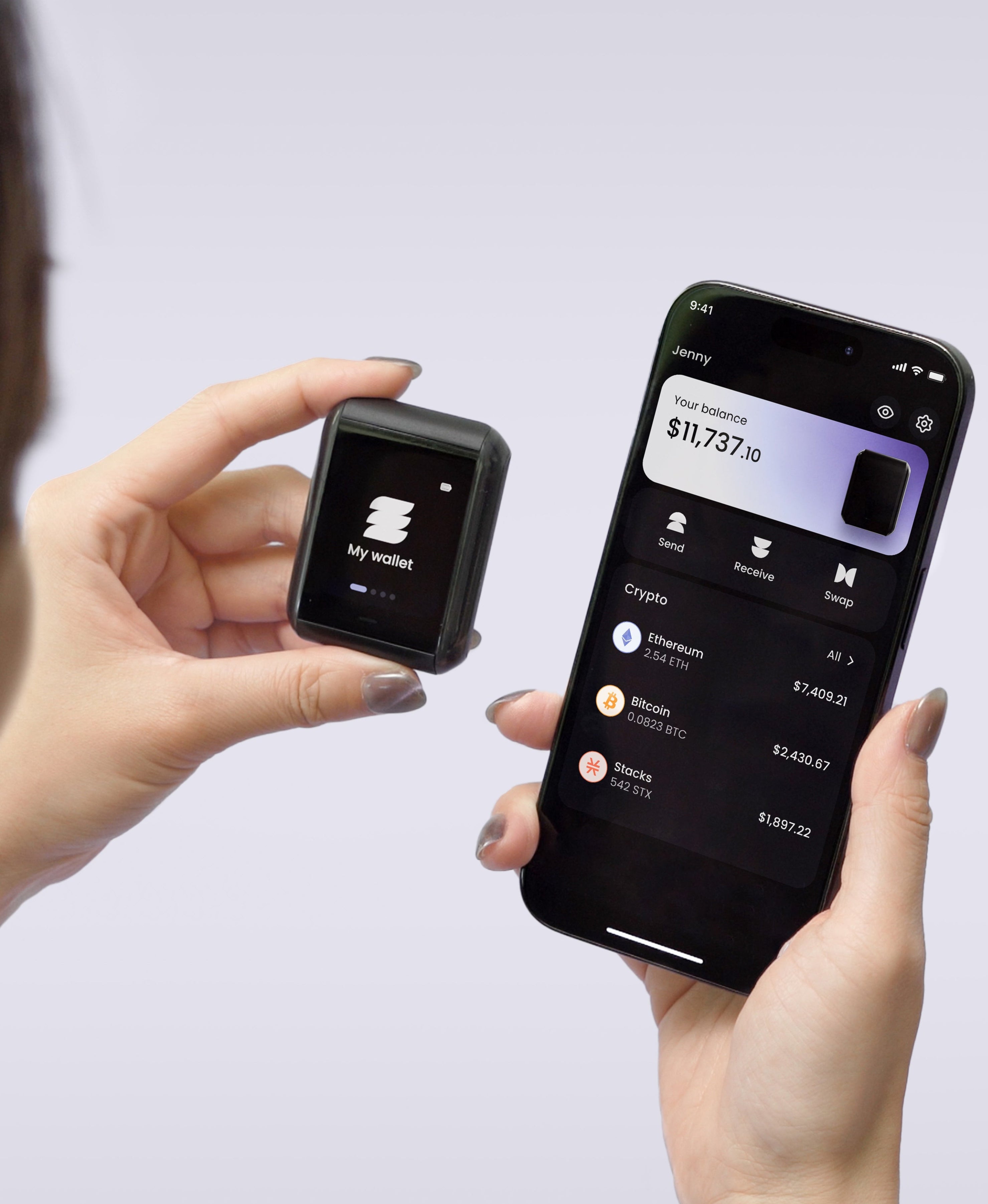
Where you keep the second category is a decision about backup as much as storage. Coins in self-custody are only as safe as your ability to recover them, and the standard answer of twelve words on a card puts your access on one object that has to stay private and intact for decades. TapSafe Recovery splits it instead: a Recovery Tag holds 50%, your paired phone holds 50% encrypted into your own iCloud or Google Drive, and optional Recovery Contacts hold 25% each while seeing nothing about your wallet. No single item recovers anything on its own.
On the Ryder One, keys are generated inside an EAL6+ certified Infineon SLC38 secure element and never leave the chip, and the firmware was independently audited by Halborn with the report published in full. Setup runs three taps and finishes in under a minute, which is roughly the time it takes to open a neobank account, for a fundamentally different relationship with your money.
What to watch next
Dakota's charter application is the one to follow. If the OCC grants it, a crypto neobank becomes a regulated custodian rather than a company routing around banks, and the rest of the category will feel pressure to follow. That's better for customers on almost every measure, and it still doesn't change what an account is.
The businesses getting this right treat the two categories separately: operating funds where they can move, reserves where nobody else can touch them. Whichever provider ends up winning the category, that division holds.
Want reserves nobody else can freeze? Get your Ryder One.
Meta description: What a crypto neobank is, why Flex and Dakota raised big in 2026, and the custody question behind every stablecoin business account: who holds your balance.


Share: