

Search for your Coinbase Wallet recovery phrase and you land in a confusing place. The app got renamed, the company that made it can't help you retrieve the words, and a surprising number of the results offering to recover them for you are run by people who would like to empty the wallet instead. All three of those facts have the same root cause, and understanding it makes the rest of this much easier to reason about.
What the Coinbase Wallet recovery phrase is
Your Coinbase Wallet recovery phrase is twelve words, generated on your device when the wallet is created, that encode the master key every address in that wallet descends from. The words follow the BIP-39 standard, which is why a wallet created in one app can be restored in a different one from the same twelve words.
That's the whole design, and it's the part people underestimate. The phrase isn't a password protecting an account somewhere; anyone holding those twelve words can rebuild your wallet on their own device without touching yours, and they don't need your phone, your email, or your permission. A seed phrase is the wallet, expressed in a form a human can write down.
Everything difficult about this design follows from putting complete access into one recitable string, which is the assumption our own TapSafe Recovery was built to break, and we'll come back to how further down.
Coinbase Wallet and your Coinbase account are not the same product
This is the confusion that costs people money, so it's worth being precise about it.
A Coinbase exchange account is custodial. Coinbase holds the coins, you hold a login, and if you lose access there's a support process, an identity check, and a path back in. Someone at the company can help you because someone at the company has the keys.
Coinbase Wallet, by contrast, is self-custody. The keys are generated on your device and the company never sees them, which means there is no reset, no support ticket, and no verification process that restores access. Coinbase states plainly that it will never ask for your recovery phrase and cannot move funds on your behalf. What reads like a limitation is the point of the product: nobody can freeze it, and nobody can be talked into handing it over on your behalf.
The rename adds a layer of confusion on top. Coinbase rebranded Coinbase Wallet as the Base App in July 2025, folding it into a broader app with a social feed and mini-apps, while keeping the same self-custody model underneath. If you're hunting for a "Coinbase Wallet" that no longer appears under that name, this is why. The twelve words you wrote down when you first set it up still work.
Where the phrase lives
The recovery phrase is stored on the device where the wallet was created, revealed through the app's own backup settings after you authenticate. Coinbase also offers an encrypted cloud backup and passkey options, which change how you get back in without changing what the twelve words control.
Two things follow from that. If you still have the device and can unlock the app, you can view and record the phrase right now, and doing so before you need it is the entire game. If you don't have the device and never wrote the words down anywhere, no amount of contacting Coinbase changes the outcome, because the company does not hold a copy to give you.
Anyone who tells you otherwise is selling something. A whole industry of "wallet recovery services" advertises against exactly this search, and the ones that ask for your phrase to "verify ownership" are theft with a landing page.
Nobody is allowed to ask for it
The rule has no exceptions worth carving out. No exchange, no wallet company, no support agent, no browser extension, and no hardware manufacturer, ourselves included, will ever have a reason to see your recovery phrase.
Attackers know the rule too, which is why the modern approach is to build a screen that looks like the software you already trust and let you type the words in yourself. Rapid7 Labs documented a fraud pipeline in research published on 17 August 2026 that ran counterfeit builds of Trezor Suite, Ledger Live, and Exodus: the fake application waited quietly, killed the legitimate app when it opened, replaced it with a convincing copy asking for the recovery phrase, and forwarded the words to a Telegram bot. Around 885,000 phone numbers were staged for the calls that softened victims up first.
None of that defeats cryptography. It defeats the assumption that the window in front of you is what it claims to be, which is why the safest habit is to treat any prompt for your twelve words as an attack regardless of what logo sits above it.
What a better arrangement for backup looks like
Writing the phrase on paper is where most people stop, and it leaves you with one object that has to stay both secret and intact for as long as you hold crypto. Fire, flood, a house move, a helpful relative tidying a drawer: every one of those is a way to lose the wallet without anyone attacking you at all. Stamping the words into steel is the standard upgrade, and it solves the durability half of the problem while leaving the other half exactly where it was, because a plate someone finds is a wallet someone drains.
We built TapSafe Recovery because both failure modes trace back to the same structure, which is that everything depends on one item surviving everything. TapSafe splits access instead: your Recovery Tag carries 50%, your paired phone carries 50% encrypted into your own iCloud or Google Drive rather than sitting on the handset, and optional Recovery Contacts hold 25% each while learning nothing about your wallet. No single piece opens anything alone, so no single piece has to be defended perfectly.
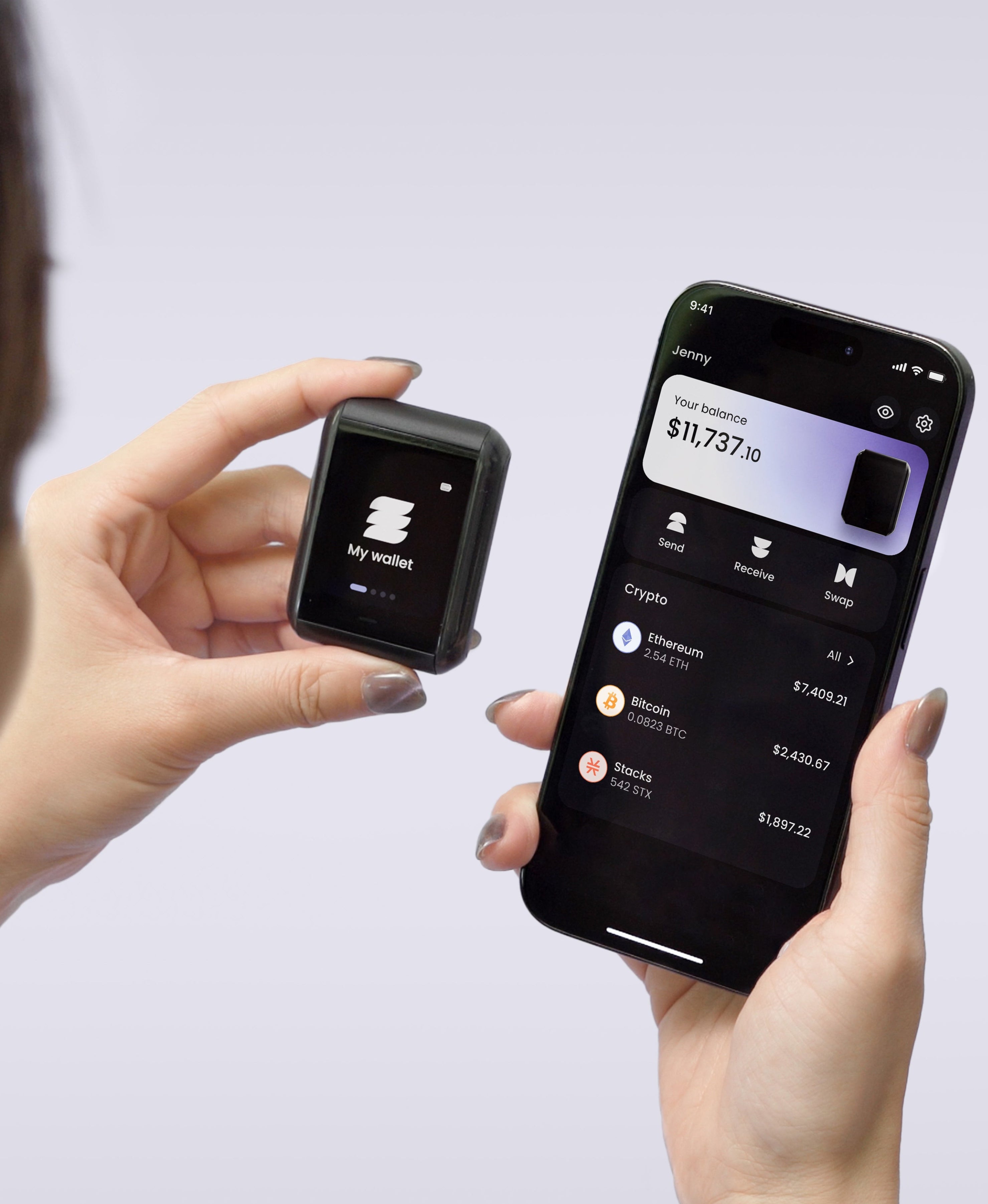
On the Ryder One, keys are generated inside an EAL6+ certified Infineon SLC38 secure element and never leave the chip, the firmware was independently audited by Halborn with the report public, and every transaction shows in readable detail on the 1.6-inch screen before you approve it. Communication runs over NFC only. Your seed phrase stays available on the device as a last resort and meets the BIP-39 standard, so you're never locked to our hardware, and importing an existing twelve or twenty-four word phrase from Coinbase Wallet or anywhere else takes a few minutes.
If you're moving funds off an app wallet
An app wallet on an internet-connected phone is a reasonable place for spending money and a poor place for savings, in the same way a pocket is fine for cash and wrong for a deed. The keys sit on a device that browses the web, installs software, and receives messages from strangers.
Moving to hardware means the signing happens somewhere that does none of those things. Start by recording your existing phrase properly, then either import it into a hardware wallet or generate fresh keys on the device and send the funds across in one transaction.
Write down the twelve words before you need them, and give your access somewhere better to live. Get your Ryder One.
Meta description: Your Coinbase Wallet recovery phrase is 12 words that control the wallet. Where it lives, why Coinbase can't restore it, and who is never allowed to ask.


Share: