


Roughly 42,000 Americans search "coinbase text scam" every month, and the volume keeps rising. The text message reads something like: "Your Coinbase withdrawal of $4,920 is pending. If this wasn't you, cancel here: [shortlink]." It's not pending. There is no withdrawal. The link leads to a phishing site cloned from Coinbase's real login page, designed to harvest the password, the 2FA code, and (if the attacker gets that far) the seed phrase of any wallet you've imported.
The Coinbase text scam is one of the highest-volume phishing campaigns of 2026, targeting both Coinbase customers and anyone with a US phone number who's ever Googled crypto. It's also one of the cleanest examples of why custody arrangements that depend on a username, password, and SMS code are fragile in ways that self-custody is not.
This piece walks through how the Coinbase text scam works in practice, what the attackers actually do once they get a victim onto the phishing page, why hardware-wallet self-custody breaks the attack chain entirely, and the specific habits that stop the scam from working on you.
What the message looks like
The recurring patterns in the 2026 wave:
- The number. A specific, plausible withdrawal amount ($4,920, $2,840, $7,500). High enough to scare, not so high it reads as fake.
- The urgency. "Pending — cancel within 30 minutes" or "If this wasn't you, secure your account immediately."
- The link. A shortlink (bit.ly, tinyurl, sometimes a custom branded short domain) that redirects to a Coinbase look-alike URL. Examples seen in 2026: `coinbase-secure[.]com`, `coinbasehelp[.]co`, `coinbase-support-team[.]net`.
- The number it comes from. Usually a short code or a US mobile number that's been burned through SMS-spoofing services. Sometimes spoofed to display "Coinbase" in your text app.
The legitimate Coinbase domain is `coinbase.com`. Anything with a hyphen, an extra word, or a non-.com TLD is a phishing domain.
What happens if you click
The phishing page mirrors Coinbase's real login flow with high fidelity. The first step asks for your email and password. The second step asks for a 2FA code (SMS, authenticator, or both). The third step — and this is where the recent wave gets dangerous — asks you to "verify your wallet" by entering your 12 or 24-word seed phrase.
A legitimate Coinbase customer wouldn't have a seed phrase on file (the exchange holds the keys). But many users have a Coinbase Wallet app (the non-custodial product) on their phone, and the phishing prompt is designed to harvest those keys.
Once the seed phrase is submitted, the attacker has full control of every wallet derived from that phrase: Bitcoin, Ethereum, Solana, anything. The drainage usually happens within minutes — sometimes seconds.
For users who don't enter a seed phrase but do enter their Coinbase password + 2FA code, the attacker gets account access. Depending on Coinbase's risk signals, they may be able to initiate withdrawals to their own addresses. Coinbase's fraud team will flag obvious attempts, but timing matters — a withdrawal initiated and confirmed within a few minutes can land before the flag.
Why the scam works
Three structural reasons.
Custodial accounts have a single shared failure point. A username, password, and 2FA code is enough to control any custodial account. Once the attacker has all three, the account is theirs. Self-custody requires the physical device and the PIN, both of which a remote attacker can't reach.
The text feels like a legitimate Coinbase alert. Coinbase does send legitimate withdrawal confirmations, security alerts, and 2FA codes via SMS. Users who've seen those messages before don't immediately treat a new one as suspicious.
The recovery flow is genuinely urgent. If a real withdrawal were pending, you would want to cancel it within minutes. The scam exploits the gap between "this might be real" and "I should verify on the official app instead of clicking this link."
How to disarm the scam in under 30 seconds
A four-step check stops almost every variant:
- Don't click the link. Open the Coinbase app from your home screen (or type `coinbase.com` directly in your browser). If there's a real pending withdrawal, it'll show in your account.
- Check the URL bar before entering credentials. Legitimate Coinbase login is at `coinbase.com`. If the bar shows anything else, leave.
- Never enter a seed phrase on a website. Coinbase's customer support will never ask for it. No legitimate service will.
- Report the text. Forward to 7726 (SPAM) on most US carriers; Coinbase's security team accepts phishing reports.
If you've already clicked and entered credentials: change your Coinbase password immediately, revoke all active sessions, and rotate any wallet seed phrase you may have entered. The clock matters.
Where self-custody breaks the attack
A hardware wallet doesn't have a username, password, or login URL. The private key is on the device, every transaction requires a physical button press, and there's no website to phish.
If your Bitcoin is on a Ledger, Trezor, or Ryder One, the Coinbase text scam can't touch it. The attacker would need physical access to your device and your PIN, both at the same time. Remote phishing can't bridge that gap.
Custodial accounts (Coinbase, Binance, Kraken) remain vulnerable structurally. The exchange holds the keys, and any path that compromises your access compromises the funds. The argument for self-custody isn't ideological; it's that the attack surface is smaller and shaped differently.
Where Ryder One fits
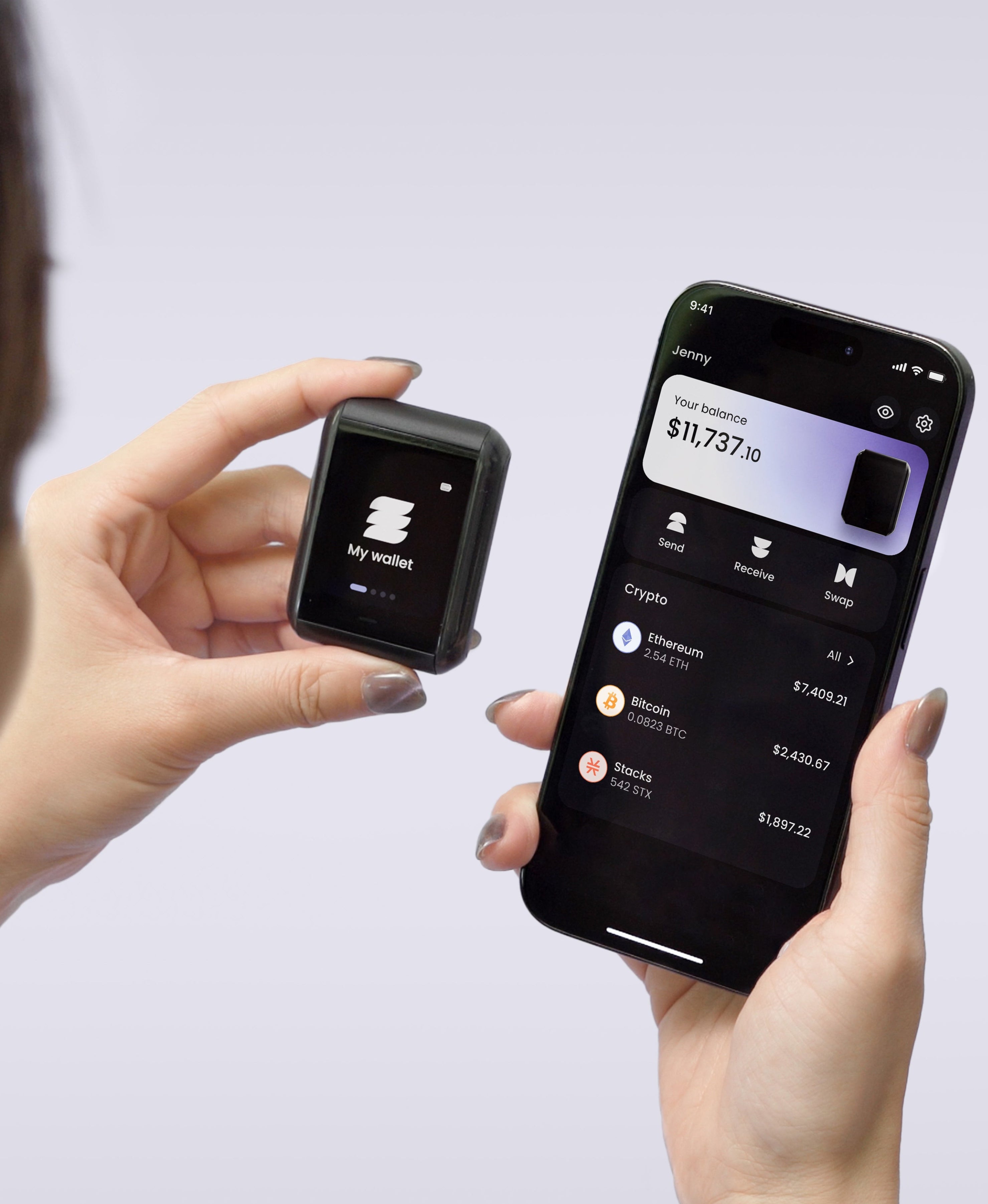
Ryder One holds the private key offline on an EAL6+ Infineon SLC38 secure element. Every transaction is verified on the device's 1.6-inch AMOLED touchscreen and signed with a physical button press. There's no login flow, no SMS code, no password to phish. TapSafe Recovery splits the backup across hardware and people you trust: 50% on a Recovery Tag, 50% in your phone's iCloud or Google Drive backup, optional 25% per Recovery Contact.
For holders moving long-term positions out of custodial accounts in response to the Coinbase scam wave, the migration is well-defined: withdraw from Coinbase to a Ryder One receive address, verify the address on the device, sign once, and the funds sit at an address only you control.
The bottom line
The Coinbase text scam is one of the most-searched crypto phishing campaigns of 2026, and the volume reflects how many people are receiving these texts every day. The mechanism — fake withdrawal alert, shortlink to clone login, harvest credentials and seed phrase — works because custodial accounts have a single shared failure point that's accessible remotely. The structural answer is self-custody: a hardware wallet holds the key offline, and no text message can reach it.
Move your Bitcoin off the exchange. Past the reach of any text scam. Ryder One holds your keys offline on an EAL6+ secure element, with TapSafe Recovery as the backup. No login, no SMS code, no phishing surface. See how it works.
SEO
- Target keyword: coinbase text scam
- SEO title: Coinbase Text Scam: The "Withdrawal Code" Lure Explained (54 chars)
- Meta description: The "Coinbase withdrawal pending" text is a phishing scam. Here's how the lure works, what attackers do with your password and seed phrase, and how to stop it. (160 chars)


Share: