


# Chainlink Beyond CCIP: Data Feeds, Staking, and Oracles
Most people who use DeFi have never called a Chainlink contract by name, and most crypto holders who own LINK couldn't list every service the token pays for. That's a fair read of what Chainlink has become in 2026: the invisible plumbing under tokenized assets, perps venues, stablecoin reserves, and blockchain games. According to DefiLlama's oracle dashboard, Chainlink secures the vast majority of oracle-dependent DeFi value, with cumulative Total Value Enabled over 20 trillion USD since launch.
In this piece, we map the wider Chainlink crypto stack: what LINK is, how Data Feeds and Data Streams price on-chain assets, the services on top (Proof of Reserve, VRF, Functions), what Staking v0.2 does, the 2026 direction with CRE and ACE, and where Ryder One fits.
What Chainlink and LINK are
Chainlink is a decentralized oracle network that connects blockchains, which can only see their own state, to information from the outside world: asset prices, mutual fund NAVs, bank reserves, random numbers, API responses, and events on other chains. When a lending contract on Aave needs the current price of ETH before triggering a liquidation, it reads a value that independent Chainlink node operators have aggregated, signed, and posted on-chain, so no single node or upstream source can move the answer.
LINK is the ERC-20 token that fuels the system. Node operators earn LINK for correct reports, applications pay LINK for oracle services, and stakers lock LINK as economic collateral behind the answers their pool secures. It's a working token first and a speculation vehicle second, with demand tied to the total dollar value routed through Chainlink's services rather than to any single narrative.
Data Feeds and Data Streams
Data Feeds are Chainlink's flagship product and the piece almost every large DeFi protocol touches. Each feed is a Decentralized Oracle Network of independent nodes that pull prices from major exchanges, aggregate them off-chain, sign the result with a threshold signature, and push the update on-chain when the price moves outside a set deviation band or a heartbeat interval passes. As the Chainlink Data Feeds docs describe, this push model sits under lending markets like Aave, Compound, and Sky along with stablecoin protocols and liquid-staking wrappers across dozens of chains.
The push model works well for slow-moving positions but is a poor fit for perps venues that need block-by-block prices with sub-second latency. Chainlink Data Streams closes that gap by delivering pull-based reports off-chain over a low-latency API, verifiable on-chain when the consuming contract needs them. GMX v2, Aevo, and other high-throughput perps venues use Data Streams to price positions closer to the exchange tick, then verify the report on-chain when a user opens, closes, or gets liquidated, which keeps gas costs down and stale-oracle exploits off the table.
Proof of Reserve, VRF, and Functions
Beyond price data, Chainlink runs a catalog of specialized services. Proof of Reserve is an on-chain attestation that reads reserves held off-chain (bank accounts, custodians, treasury holdings, or tokens locked on another chain) and publishes them where a smart contract can verify them. Circle uses Chainlink Proof of Reserve inside its cross-chain USDC pipeline, checking source-chain reserves before a destination-chain contract mints new supply. TrueUSD, WBTC, and several tokenized commodity issuers publish reserve reports through the same rails, which is why some stablecoin audit pages show a live number instead of a quarterly PDF.
Chainlink VRF, the Verifiable Random Function, generates cryptographically provable random numbers on-chain for NFT drops picking trait outcomes, blockchain games running loot tables, and prediction markets sampling event outcomes. The proof accompanies the number so anyone can verify the draw.
Chainlink Functions is the general-purpose piece: a smart contract calls an arbitrary Web2 API through a decentralized pool of nodes, each fetching the endpoint independently before the aggregated response returns on-chain.
Staking v0.2 and the LINK economic model
The economic security question for any oracle network is the same one every consensus system faces: what stops a node operator from lying? Chainlink's answer is Staking, first shipped in December 2022 and upgraded to Staking v0.2 in November 2023. Under v0.2, LINK holders lock tokens behind a specific set of Data Feed oracle reports, earn rewards when the pool's answers land inside expected tolerances, and share slashing losses when a node operator misreports.
Staking v0.2 introduced a dynamic pool size (currently 45 million LINK), unbonding periods (28 days plus a 7-day claim window), a distinction between Community Stake and Node Operator Stake, and slashing tied to alertable events on specific ETH/USD-class feeds. The design lets the security budget of the oracle network scale with the value it secures: as more capital moves through Data Feeds, the pool absorbs more stake and misreports become more expensive to attempt.
For a LINK holder, staking stays optional. The default is LINK sitting in a wallet as a plain ERC-20 with no lockup, and choosing to stake means accepting yield, slashing exposure, and the 28-day unbonding wait together.
Chainlink Runtime Environment and the 2026 direction
Chainlink's roadmap through 2026 is aimed at consolidating the stack. The Chainlink Runtime Environment (CRE), introduced in mid-2025, is a developer platform that lets a single workflow compose Data Feeds, CCIP messages, Functions calls, Proof of Reserve checks, and VRF draws into one on-chain pipeline instead of stitching each service together by hand across chains.
The other headline program is the Automated Compliance Engine (ACE), announced with a group of large financial institutions. ACE embeds identity, sanctions, and jurisdictional rules into token transfers so a regulated issuer can move tokenized funds across chains without hand-running each transaction through a compliance desk. Together with CCIP and Proof of Reserve, ACE is Chainlink's pitch for the infrastructure a bank needs before it puts a fund on-chain, and part of why LINK trades against institutional integration expectations rather than DeFi volumes alone.
Self-custody read on LINK
LINK is a standard ERC-20 on Ethereum, with wrapped or bridged versions on Base, Arbitrum, Optimism, Polygon, BNB Chain, Avalanche, and other networks. The custody question is the same as for any Ethereum-native token: you either hold it inside a wallet whose private key you own, or you leave it with an exchange or custodian and accept counterparty risk. The 2022 collapse of FTX, which held roughly 8 billion USD in customer funds at the time of failure, is the standing reminder of what that risk looks like.
If you stake, there's one wrinkle to know: staked LINK isn't liquid during the unbonding period. The staked balance can't move to a different address, sell, or route to another chain until the 28-day timer plus the 7-day claim window has elapsed, which is a scheduling constraint rather than a security risk on its own. Liquid-staking wrappers exist for LINK and carry the usual smart-contract exposure of any such token, with trade-offs similar to liquid-staked ETH. The practical setup is direct: hold LINK offline in a hardware wallet and sign every staking, unstaking, or approval transaction on-device.
Where Ryder One fits
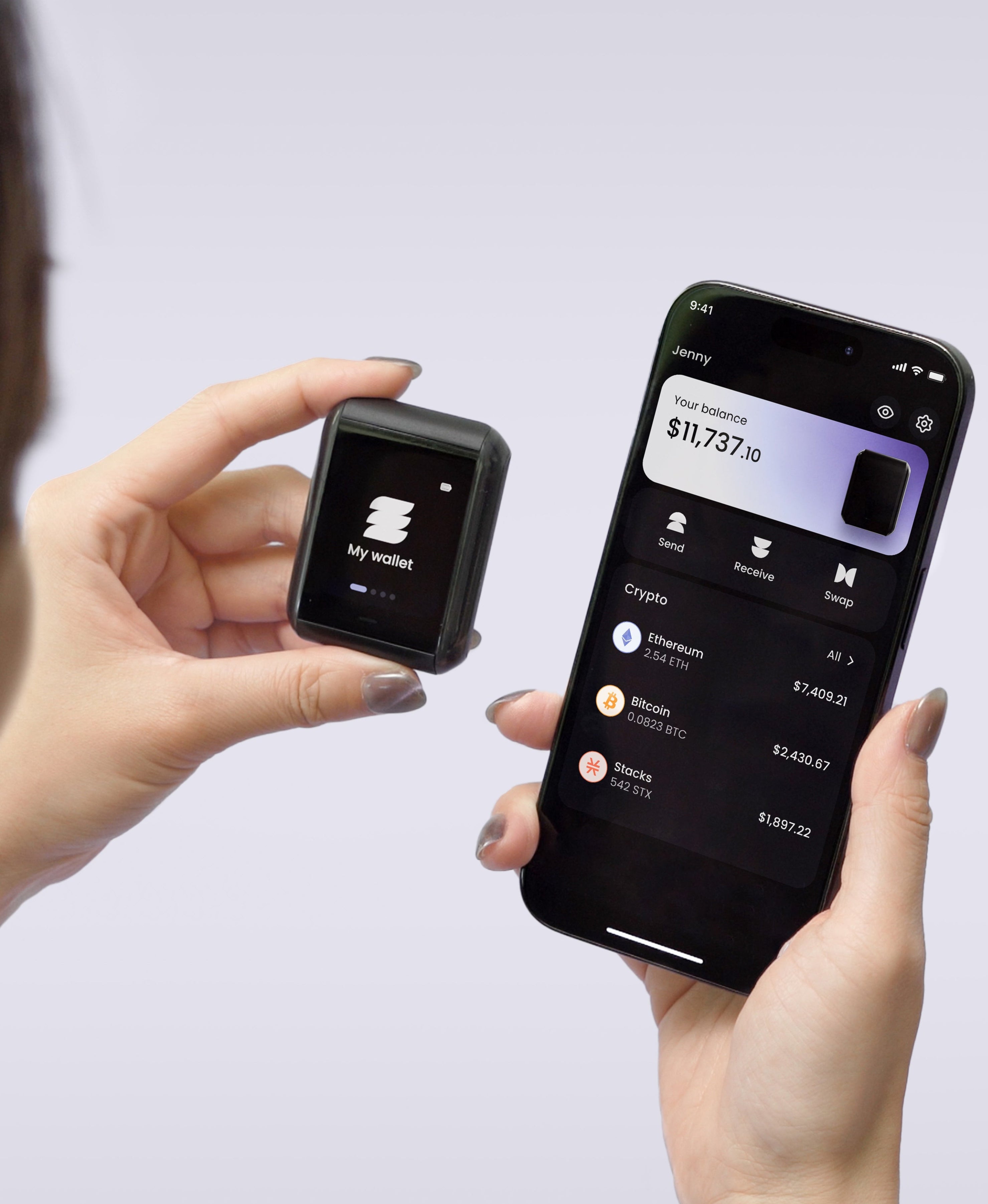
Ryder One holds LINK the same way it holds any ERC-20. Your private keys are generated inside an EAL6+ certified Infineon SLC38 secure element and never leave the chip. When you sign a transaction (a LINK transfer, an approval to the Chainlink staking contract, an unbond request), the details render on the 1.6-inch AMOLED touchscreen so you can read the destination, amount, and contract call before pressing the confirm button wired directly into the chip.
The device talks to your phone over NFC only, with no USB port, no Bluetooth radio, and no wireless data path a remote attacker can work through while you're routing LINK across chains or approving a staking contract. That matters more once contracts lock funds for a month at a time; a signed approval to the wrong address would mean spending the unbonding period watching your position drain.
Backup is where we took a different approach. Paper seed phrases can be lost to fire or water, and metal seed plates upgrade the durability but still leave security hinging on one object surviving every scenario. TapSafe Recovery removes that single point of failure by splitting your recovery secret across a Recovery Tag (IP69K rated), your paired phone (encrypted into iCloud or Google Drive rather than the device itself), and up to two optional Recovery Contacts who never see your wallet contents. The BIP-39 seed phrase stays available on-device as a last resort, so you're never locked to our hardware, and Ryder One ships at $229 with the Recovery Tag, Qi wireless charging pad, and travel pouch in the box.
The bottom line
Chainlink is easy to underestimate because the pieces are invisible when they work. Data Feeds price the collateral, Data Streams price the trades, Proof of Reserve backs the stablecoins, VRF settles the randomness, and Staking gives LINK a working role as economic security under all of it. CCIP gets the headlines, but the rest of the stack is what most DeFi users depend on without noticing. For a LINK holder, the storage question is ordinary ERC-20 self-custody, and the mitigation for staking approvals is signing every important transaction on a device you control.
For more on the cross-chain piece, see our companion article: Chainlink CCIP in 2026: What Cross-Chain Means for Self-Custody.
Ready to hold LINK offline? Ryder One keeps your keys inside an EAL6+ secure element, verifies every transaction on-device, and backs it up with TapSafe Recovery so no single object holds your crypto hostage.
SEO
- Target keyword: chainlink crypto
- SEO title: Chainlink Beyond CCIP: Data Feeds, Staking, and Oracles (55 chars)
- Meta description: Chainlink's Data Feeds, Staking, VRF, and Proof of Reserve are the hidden layer under most of DeFi. Here's what LINK holders need to know. (138 chars)
- Hero alt text: Chainlink oracle Data Feeds staking 2026 — Ryder self-custody hardware wallet



Share: