


# Cardano (ADA) in 2026: Hydra, Midnight, and the Stack
Cardano is one of the last top-tier L1s that gets written about with less noise than its market cap deserves. Bitcoin has the treasuries story, Ethereum has staking and rollups, Solana has the throughput headlines, and Cardano has spent years quietly shipping a research-first stack that most crypto media covers only when the ADA price moves. In mid-2026 the network sits inside the top-15 by market capitalization, ships new Hydra tooling every quarter, and has stood up a privacy sidechain called Midnight that few casual holders can describe in one sentence.
In this piece we look at what Cardano and ADA are, how Ouroboros and the extended UTXO model work, what Hydra and Midnight add on top, and how self-custody works for an ADA holder in 2026.
What Cardano and ADA are
Cardano is an open-source public blockchain that went live in September 2017 with an initial mainnet release called Byron. The protocol was designed by Input Output Global under Charles Hoskinson (an Ethereum co-founder who left the project in 2014) and is stewarded jointly by IOG, the Cardano Foundation, and the Emurgo commercial arm. Peer-reviewed academic research sits at the front of the process, with more than 200 papers published across cryptography, consensus, and formal verification.
ADA is the native asset, named after the mathematician Ada Lovelace, and it pays transaction fees, secures the chain through staking, and casts votes inside the on-chain governance system that came in with the Chang hard fork in September 2024. The supply cap sits at 45 billion, and roughly 35 billion ADA circulate today per CoinGecko. The remaining ten billion sits in a reserve pool that funds staking rewards on a decaying schedule, so ADA emission trends lower every epoch rather than following a fixed inflation rate.
Ouroboros and the extended UTXO model
Cardano's consensus algorithm is Ouroboros, presented in a 2017 paper by Aggelos Kiayias and colleagues at IOHK as the first proof-of-stake protocol accepted at a mainstream cryptography conference. The chain divides time into epochs of five days, each split further into one-second slots, and elects a slot leader for every slot in proportion to the stake it delegates. Blocks are produced by pools that stake operators run, and holders delegate ADA to a pool without moving their tokens out of their own address. There is no lockup period, no slashing, and rewards land automatically at the end of each epoch.
The other design choice worth knowing is the extended UTXO model. Bitcoin uses a UTXO ledger where each transaction consumes discrete coin outputs and produces new ones, and Ethereum uses an account model where balances update in place. Cardano keeps the UTXO structure but attaches contract state and datum fields to each output, which is what the "extended" part of the name means. That gives Cardano a few properties Ethereum does not have. Transactions execute in parallel because each one touches its own set of inputs, contract fees can be calculated deterministically off-chain before submission, and a failing script cannot leave the chain in a half-updated state because failing transactions never touch ledger state. The trade-off is that some patterns familiar to Solidity developers require different design, and the Plutus smart-contract language leans on Haskell semantics rather than the more common EVM approach.
Hydra L2 and the Midnight sidechain
Hydra is Cardano's family of layer 2 protocols, with Hydra Head as the state-channel implementation that has been running on mainnet since 2024. A Head opens between a set of participants who lock ADA on the L1, exchange transactions off-chain at very high throughput, and settle a final state back to the L1 when they close the channel. IOG's own Hydra documentation describes the design as a way to reach thousands of transactions per second inside a Head, and the current use cases lean toward game economies, micropayment rails, and settlement between institutions that share a small quorum of counterparties. Hydra Tail and Hydra Interhead are the next steps on the roadmap and aim to widen the model beyond fixed participant sets.
Midnight is the other scaling piece, and it sits closer to a privacy sidechain than to a rollup. IOG built Midnight on a modified Cardano codebase with zero-knowledge proofs powering selective disclosure, so applications can hold data encrypted on-chain and reveal only what a counterparty needs to see. The Midnight overview page frames the target audience as enterprises with compliance obligations and consumer apps that want to keep user data off a public block explorer. Midnight uses its own utility asset called DUST for transaction shielding, while ADA is used for the network's staking layer through a partner-chain design that borrows security from Cardano's Ouroboros.
The Cardano ecosystem in mid-2026
The application layer has matured over the last two years even as the price chart has been sideways for stretches. Plutus V3 shipped with the Chang hard fork and cut script sizes for common DeFi patterns, Marlowe gives non-programmers a domain-specific language for writing financial contracts with formal guarantees, and native tokens continue to run at the ledger layer rather than through a smart-contract standard the way ERC-20 works on Ethereum. Total value locked on Cardano DeFi crossed the 500 million USD line in early 2026 after starting the year lower, with Minswap, Indigo, and Liqwid leading the AMM and lending categories.
Governance is the newer story. Chang introduced on-chain constitutional voting through a body called the Constitutional Committee alongside delegated representatives (DReps) that any ADA holder can vote for or become themselves. The design gives ADA holders a direct role in protocol parameter changes, treasury spending from the reserve, and future hard-fork decisions, and it moves the network past the founding-team era into something closer to a lasting stakeholder democracy. Voter turnout has been low in the first year, which is a pattern other on-chain governance systems have hit at similar stages.
The self-custody read on ADA
Cardano uses ed25519 signatures for its account keys, the same curve behind Solana and Stellar and a different family from the secp256k1 pair behind Bitcoin and Ethereum. A Cardano address is generated from a payment key and a staking key concatenated together, which is how a single address can hold ADA and delegate that same balance to a pool without needing a second transaction. Delegation never moves the ADA off your own address; the stake key just tells the network which pool your balance should count toward for reward accounting.
Popular hardware wallets support ADA out of the box. Ledger and Trezor have shipped Cardano firmware for years, common wallet apps like Yoroi, Eternl, and Lace integrate with those devices for signing, and delegation flows can be run end to end with the private key never leaving the secure element. The custody risks are the ones every layer 1 shares. Keys sitting on a phone or a browser extension get exposed to phishing pages, malicious wallet-connect prompts, clipboard swaps that replace an address at paste time, and social engineering aimed at recovery words. Moving the signing key onto a hardware wallet cuts most of that surface off in one step.
Where Ryder One fits
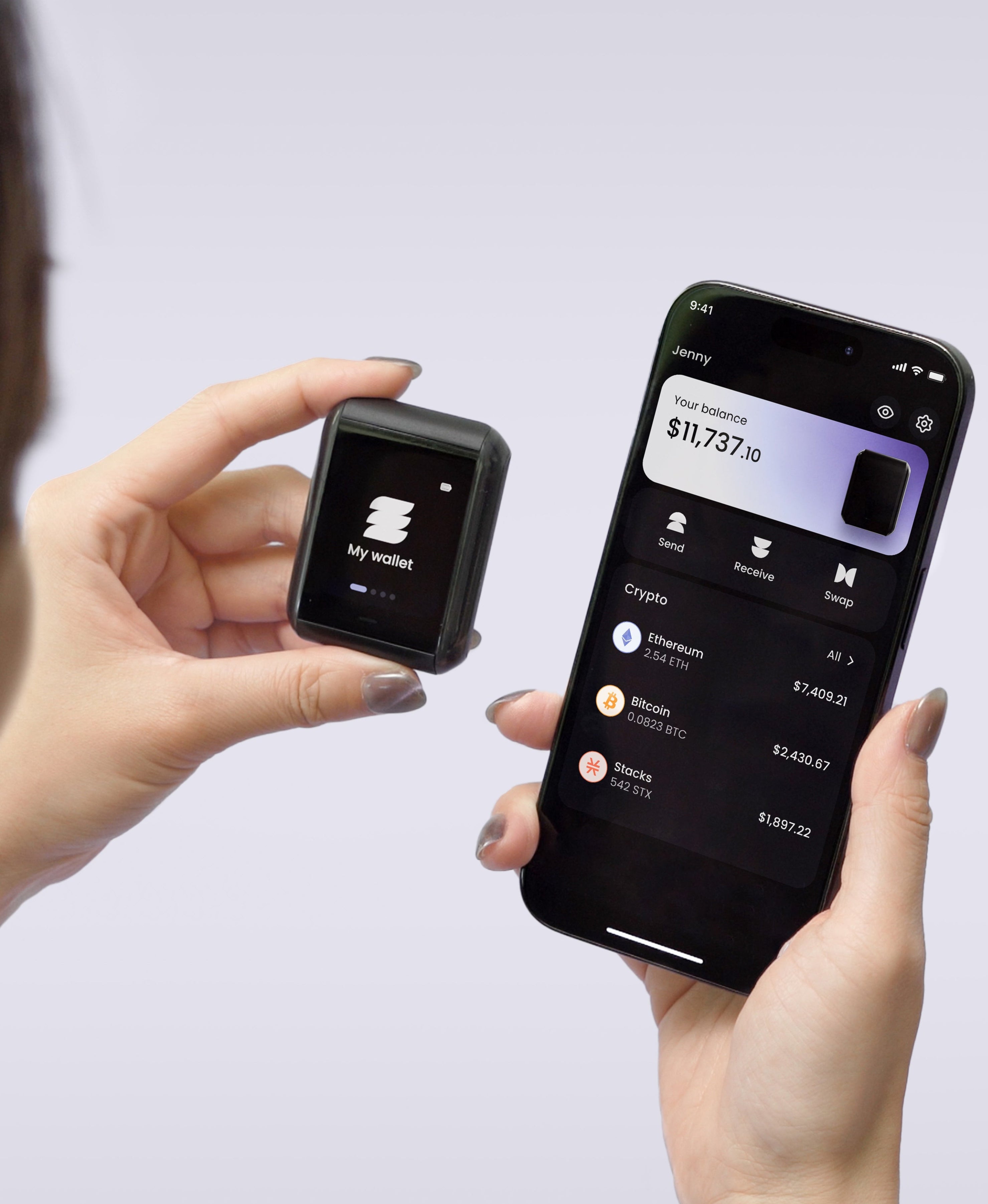
Ryder One signs Bitcoin, Ethereum, Solana, and a growing list of top ERC-20 and SPL tokens today, and Cardano sits outside that current supported set. If ADA is part of your portfolio alongside those chains, keep it on a wallet that supports Cardano and hold the same security posture across every device you touch.
For the chains Ryder One does support, the model is the discipline any ADA holder would recognize on their own network. A 1.6-inch AMOLED touchscreen renders every transaction with full readable detail before you approve, so nothing gets signed blind. The EAL6+ certified Infineon SLC38 secure element generates the keys inside the chip and never releases them, with a hardware button wired directly to the element so no software path can produce a signature without your press. Communication is NFC-only, with no USB port, no Bluetooth radio, and no Wi-Fi surface for a remote attacker to reach.
Recovery uses TapSafe instead of a paper seed phrase tucked into a drawer. The Recovery Tag holds 50 percent of the wallet share and carries an IP69K rating that survives high-pressure water jets and dust, while the paired phone holds the other 50 percent stored encrypted in your iCloud or Google Drive so losing the handset does not wipe the backup. Ryder One ships at $229 with the Recovery Tag, a Qi wireless charger, and a pouch in the box, and the device itself carries an IP67 rating.
The bottom line
Cardano is a proof-of-stake L1 that has taken a slow, research-first path across nine years of shipping. ADA is the native asset behind a 45 billion supply cap, an Ouroboros consensus layer, and an extended UTXO model that offers parallel execution and deterministic fees where Ethereum offers account-based composability. Hydra sits above the L1 as a state-channel scaling family, Midnight sits alongside it as a ZK-powered privacy sidechain, and the on-chain governance layer introduced with Chang has moved decision-making from IOG toward the ADA holders themselves.
For a self-custody holder, the read on ADA is standard layer 1 hygiene. Keys behind a hardware wallet, addresses verified on a screen before you tap, backups stored so that no single accident wipes your access. That is the same posture Ryder One was built to support across the chains it signs today.
SEO
Target keyword: ada crypto
SEO title: Cardano (ADA) in 2026: Hydra, Midnight, and the Stack
Meta description: ADA crypto is the native asset of Cardano, a peer-reviewed proof-of-stake L1. Here is Ouroboros, Hydra L2, Midnight, and the self-custody read.
Hero alt text: Cardano ADA blockchain Hydra Midnight — Ryder self-custody hardware wallet


Share: