


BlackRock's iShares Bitcoin Trust (IBIT) holds approximately $80 billion in Bitcoin as of mid-June 2026, making it the largest single Bitcoin holding entity outside of (likely lost) Satoshi-era coins. IBIT alone holds more Bitcoin than every government on Earth combined, and roughly equal to the combined holdings of every corporate Bitcoin treasury company in the world.
For retail Bitcoin holders, the concentration is worth understanding. IBIT is not Bitcoin. It's a wrapper that gives investors price exposure to Bitcoin without holding the asset directly. The structure has clear advantages (regulated, tax-reportable, accessible through any brokerage) and clear trade-offs (custodian counterparty risk, ongoing expense ratio, no programmable spending).
This piece walks through what IBIT is, how it accumulated $80 billion in Bitcoin in two years, what its concentration means for Bitcoin's market structure, and what the structural questions are for retail holders deciding between IBIT exposure and direct self-custody.
How IBIT got to $80B
The iShares Bitcoin Trust launched January 11, 2024 as one of 11 US spot Bitcoin ETFs approved that day. From day one, BlackRock's distribution scale and brand recognition made IBIT the dominant inflow recipient.
The accumulation timeline:
- Jan 2024: Launched with $0; first day inflows ~$1B
- Jun 2024: ~$15B in assets
- Dec 2024: ~$35B
- Jun 2025: ~$55B
- May 2026: ~$104B (peak before the June outflow streak)
- Jun 2026: ~$80B (after $3.3B IBIT-specific outflows)
The May 2026 peak coincided with Bitcoin's $71K high. The June drawdown moved both price and AUM down together. As of mid-June, IBIT still holds approximately 1.1 million BTC, the bulk of the spot ETF complex's ~1 million BTC combined holdings.
What the IBIT structure actually is
IBIT is a Securities Act-registered exchange-traded fund that holds Bitcoin in custody and issues shares representing fractional ownership. The shares trade on Nasdaq under ticker IBIT.
The custody arrangement: Bitcoin held by IBIT is custodied with Coinbase Custody Trust Company, regulated as a New York-licensed limited-purpose trust. Coinbase holds the keys and produces an attestation of holdings to BlackRock on a recurring basis.
The structure means IBIT shareholders have indirect Bitcoin exposure. They don't hold keys. They don't sign transactions. They can't withdraw Bitcoin to a self-custody wallet. The exposure is purely financial.
This is fine for most use cases. It's not fine for use cases that depend on the holder controlling the asset directly (long-term inheritance planning where the holder wants to control the keys, on-chain payments, multi-signature arrangements, etc.).
What the concentration means for Bitcoin's market structure
Three structural implications.
Liquidity is partly captive. When IBIT receives inflows, it buys Bitcoin from the market. When it sees outflows, it sells. The 1.1 million BTC held by IBIT is functionally locked until shareholders redeem, which means the effective Bitcoin float available for sale at typical market prices is smaller than the nominal circulating supply.
Price correlation to TradFi. When IBIT trades on Nasdaq, its price moves with broader equity flows in a way that pure-spot Bitcoin doesn't. The 13-day ETF outflow streak in May-June 2026 correlated with broader risk-off positioning in US equities, not with anything Bitcoin-specific.
Custodian concentration. Coinbase Custody holds the Bitcoin for IBIT, FBTC (Fidelity), and most other major spot ETFs. The aggregate custodied amount is approximately 1.4 million BTC, which is a significant share of all Bitcoin held by institutions. A single custody failure would be catastrophic in a way that the underlying Bitcoin protocol isn't designed to address.
What this means for retail holders
The IBIT vs self-custody decision is structural, not aesthetic.
Pick IBIT (or a similar ETF) if: you want Bitcoin price exposure without operational complexity, you're holding in a tax-advantaged account (401k, IRA) where ETF wrapping is the cleanest path, you don't want to manage hardware or backup, and the 0.25% annual expense ratio is acceptable.
Pick direct self-custody if: you want to hold the actual Bitcoin and not a wrapper on it, you want to use Bitcoin on-chain (payments, Lightning, multi-sig), you want a one-time cost rather than an ongoing expense ratio, or you want to remove the custodian counterparty layer.
The decisions aren't mutually exclusive. Many holders run both — a small ETF position in a retirement account, a larger direct-custody position for the long-term core.
What the ETF outflows of May-June 2026 actually signaled
The $4.4 billion outflow streak that hit the spot ETF complex (with IBIT taking $3.3B of the $4.4B) was the largest sustained redemption period in the funds' history. Three different reads:
Read 1: ETF investors are exiting Bitcoin entirely. A portion of the redeemed capital went to cash and out of the asset class. This is the bearish read.
Read 2: Capital is rotating from ETF to direct custody. On-chain analytics suggest a meaningful share of post-redemption capital flowed to known self-custody addresses. This is the neutral read — same Bitcoin position, different wrapper.
Read 3: Cycle de-risking, not structural exit. Investors took profits at the $71K local high and are waiting for a clearer entry point. This is the cycle-management read.
All three are partially correct. The mix between them isn't fully knowable from public data, but the rotation to direct custody is visible enough to suggest the trend has staying power beyond this specific drawdown.
Where Ryder One fits
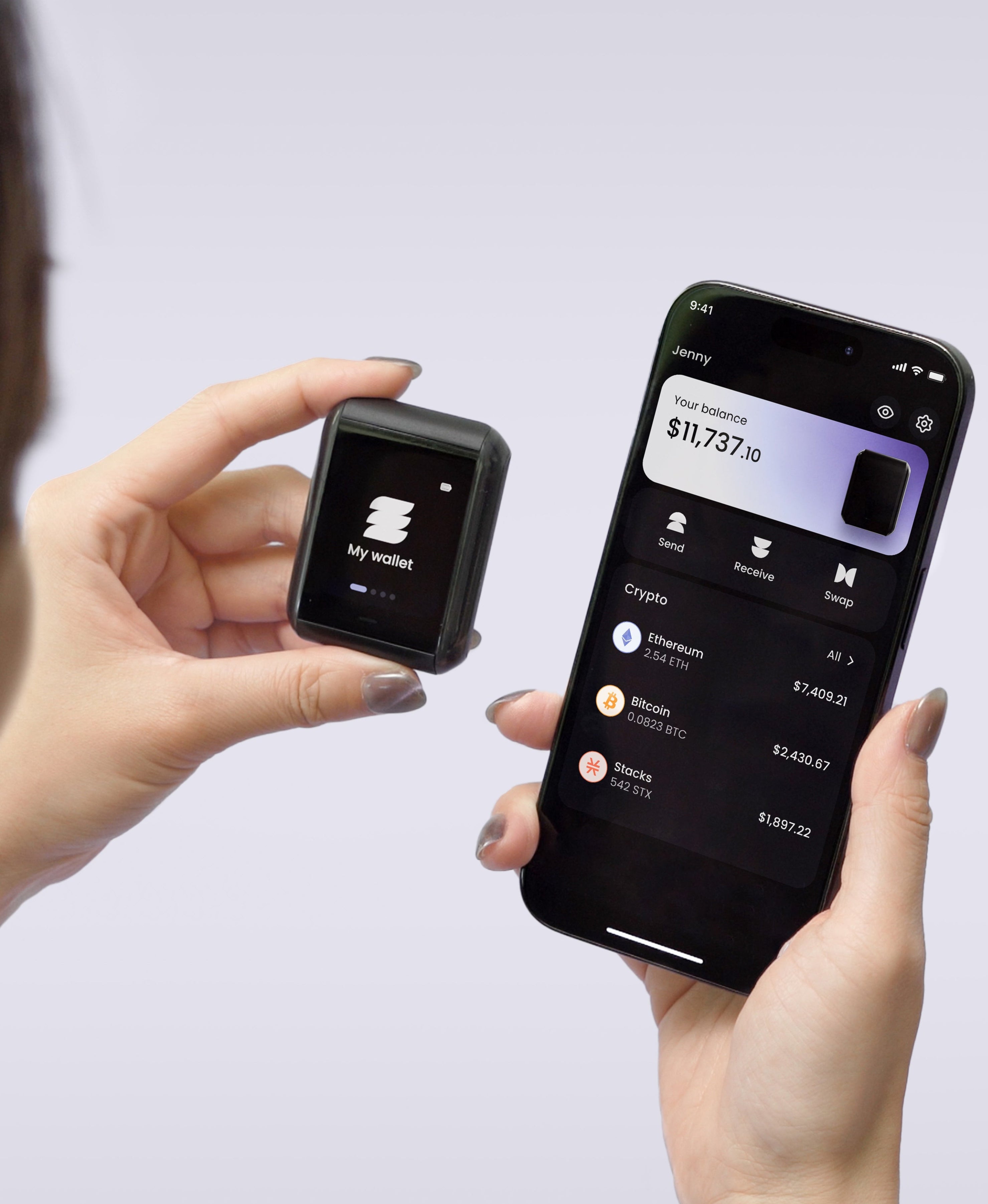
For holders rotating out of IBIT and into direct custody, Ryder One is the self-custody endpoint. The EAL6+ Infineon SLC38 secure element holds the Bitcoin private key offline. Every transaction is verified on the device's 1.6-inch AMOLED touchscreen with a physical button press. TapSafe Recovery splits the backup across hardware (Recovery Tag), phone (encrypted cloud backup), and optional people you trust.
The migration mechanics: sell IBIT in your brokerage, receive cash, buy Bitcoin through any spot venue (or directly via Ryder One's MoonPay integration), receive on a Ryder One address. The position changes from "ETF share" to "Bitcoin on a device I control." No annual expense ratio, no custodian in the chain, no redemption queue.
The bottom line
BlackRock's IBIT holds approximately $80 billion in Bitcoin as of June 2026, making it the largest single Bitcoin holding entity outside of (likely lost) Satoshi-era coins. The structure provides Bitcoin price exposure through a regulated wrapper, with the trade-off that holders don't control the underlying asset directly. For retail holders deciding between IBIT and self-custody, the question isn't which is "better" — both have real use cases — but which trade-off matches your specific needs. The ETF outflows of May-June 2026 suggest at least some of IBIT's largest holders are migrating to direct self-custody, and the structural reasons for that migration aren't going away.
The same Bitcoin. None of the wrapper. Ryder One holds your BTC offline on an EAL6+ secure element, with TapSafe Recovery as the backup. No expense ratio. No custodian. See how it works.
SEO
- Target keyword: blackrock bitcoin etf
- SEO title: BlackRock IBIT Holds $80B in Bitcoin. What That Means for Retail (60 chars)
- Meta description: BlackRock's IBIT holds ~$80B in Bitcoin as of June 2026, the largest single Bitcoin position outside Satoshi-era coins. Here's what it means for retail self-custody. (162 chars)



Share: