


Bitcoin's network hash rate hit a fresh all-time high of roughly 840 EH/s in June 2026, even as Bitcoin's price drifted from $71K to $63K over the same window. Miners kept adding capacity into a declining price environment, which is one of the more telling signals about where Bitcoin sits in the current cycle.
Below, we walk through where bitcoin mining 2026 sits today, why hash rate keeps climbing through the price drop, what's happening to mining profitability, and what self-custody holders should take from the wider picture.
Where mining sits in 2026
Three data points are worth tracking.
The first is network hash rate, now at about 840 EH/s. That's up from 600 EH/s in early 2025 and 350 EH/s in early 2024, and the growth comes from fresh ASIC deployments, repurposed capacity from older operations, and continued buildout by public mining companies. None of those drivers depend on this week's price.
The second is mining difficulty, which has reached an all-time high. Difficulty readjusts every 2,016 blocks to keep block time near 10 minutes regardless of how much hash rate joins the network. According to BitInfoCharts, the June 2026 readjustment pushed the metric to record levels, which means each individual miner has to do more computational work for the same Bitcoin reward.
The third is the block reward, currently 3.125 BTC per block following the April 2024 halving. The next halving, due in April 2028, will cut that to 1.5625 BTC. Mining economics have to adjust again as the reward halves.
Why hash rate keeps climbing through the price drop
A few forces overlap here.
ASIC deployment timing carries momentum. Mining hardware that was ordered six to twelve months ago is still arriving on site, and miners committed that capital before the recent drawdown. A 20% Bitcoin move doesn't cancel the deployment; the new rigs come online regardless, because the cash was already spent.
Public-miner competition adds a second push. Marathon Digital, CleanSpark, Riot, and other listed miners are racing to defend market share, and each one has to grow hash rate just to hold its proportion of the block reward. The competitive dynamic means rigs keep coming online even when per-miner profitability compresses, because losing share to a rival is worse than thinning margins.
Energy efficiency gains supply the third tailwind. Modern ASICs (Bitmain S21 Pro, MicroBT M66S) deliver more hashes per watt than 2023-2024 generation hardware, so miners replacing older rigs raise hash rate while lowering the energy cost per hash. At the unit-economics level, the upgrade decision pencils out even at lower BTC prices.
Put those three forces together and hash rate growth has decoupled from short-term price action. The old read of "hash rate falls during a drawdown, so sentiment is weakening" no longer holds the way it once did, and growth has kept rolling through every recent dip regardless of cycle position.
What mining profitability looks like
For a typical large-scale operation running Bitmain S21 Pro at $0.04/kWh electricity, the daily math today looks like this:
- Revenue per TH/s per day: ~$0.045 (at $63K BTC)
- Electricity cost per TH/s per day: ~$0.026
- Gross margin per TH/s per day: ~$0.019
That gross margin is materially tighter than 2024, when the same setup ran near 30% gross margins. The squeeze comes from three forces stacking at once: price drawdown, rising difficulty, and ASIC efficiency improvements by competitors that compress everyone else's share.
The downstream result is that less efficient miners get squeezed out. Older ASIC generations (S19, S19j) at higher electricity costs (above $0.06/kWh) sit at or below breakeven, so they get repurposed, sold off, or shut down entirely. Their hash rate drops out of the network, difficulty readjusts downward in the next epoch, and profitability ticks back up for the operators that remain. Mining always settles toward whichever miners have the cheapest power and the newest rigs.
What's at stake for the next halving
The April 2028 halving will cut the block reward from 3.125 BTC to 1.5625 BTC. Mining revenue will effectively halve overnight unless Bitcoin's price roughly doubles in the meantime. The same operation that's marginally profitable today would be clearly unprofitable post-halving at the current spot price.
The bull case for miners is that Bitcoin appreciates ahead of the halving (driven by reduced new supply, ongoing ETF flows, and continued institutional adoption) to a level that preserves mining economics afterward. Historical halvings in 2012, 2016, 2020, and 2024 each preceded sizeable Bitcoin price appreciation in the 12 to 18 months that followed, although past performance is famously not a guarantee. The bear case is the inverse: institutional demand fails to materialize at the expected pace, mining margins compress further, less-efficient operators exit, hash rate dips, and network security leans more heavily on the remaining efficient miners.
Both cases are plausible. Mining is a geared play on Bitcoin's continued appreciation, and the math falls apart if appreciation slows.
What this means for self-custody holders
A few takeaways come out of the mining picture.
Mining concentration is climbing. As marginal miners get squeezed, the largest operations (Marathon, CleanSpark, Riot) keep gaining share. Network hash rate is increasingly concentrated in a handful of publicly traded companies with shareholders, balance sheets, and quarterly reporting pressures. This isn't an existential issue for Bitcoin yet, although it does shift the security model from "distributed across many small operations" toward "dominated by a few large ones," and that's worth keeping an eye on.
Hash rate growth supports security at the network level. More hash rate means a higher cost to mount a 51% attack, so the 840 EH/s network is materially harder to attack than the 600 EH/s network of 18 months back. For holders thinking about long-term Bitcoin security, that's unambiguously good news.
Mining doesn't bear on the direct-holder experience. A Bitcoin held on a hardware wallet is the same Bitcoin no matter who mined it. Self-custody holders don't need to track mining dynamics for their own positions; they hold the wallet, the wallet holds the coin, and the rest is upstream weather.
Where mining-equity exposure fits
Some holders pair their direct Bitcoin position with mining-equity exposure (MARA, CLSK, RIOT). The pitch is that mining stocks are geared Bitcoin (they hold BTC and operate the mining rigs), and the equity tends to outperform Bitcoin in bull markets while underperforming in bear markets.
The trade-off is that mining equity carries operational risk that direct Bitcoin doesn't. Electricity-price changes, ASIC supply-chain disruptions, regulatory pressure, and corporate finance decisions all move mining stocks but don't move the underlying Bitcoin. For self-custody holders, mining equity is a separate decision from the direct Bitcoin position. It's a complementary wrapper rather than a replacement for holding the asset yourself.
Where Ryder One fits
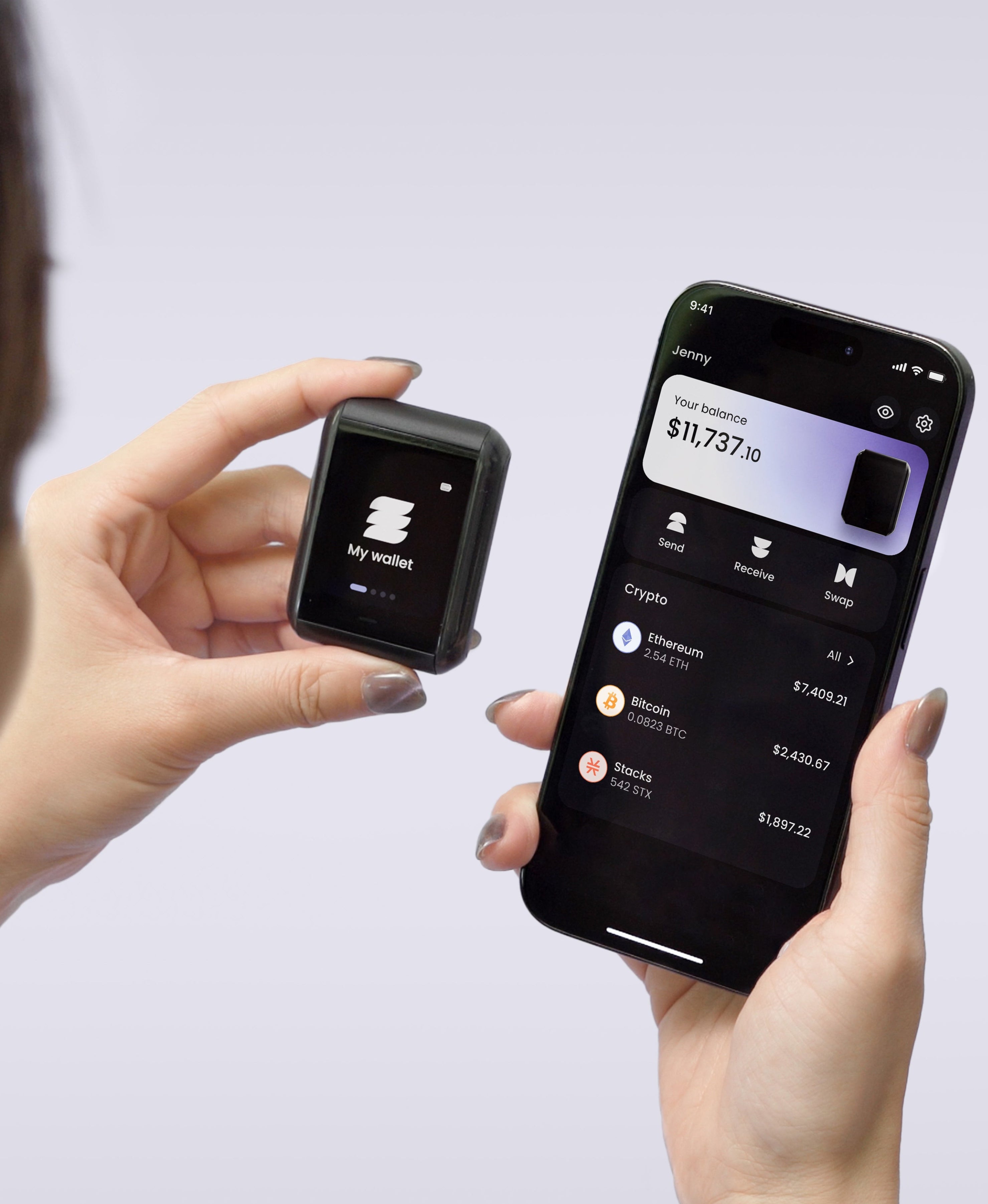
Ryder One holds Bitcoin on an EAL6+ Infineon SLC38 secure element, with NFC-only communication and on-device verification of every transaction through the 1.6-inch AMOLED touchscreen. The mining picture doesn't reach into the wallet at all; the device just holds whatever Bitcoin you put on it, and the network handles itself out there at the edge.
We built TapSafe Recovery to keep the backup from becoming a single point of failure. The Recovery Tag holds 50% of the recovery share, your paired phone holds the other 50% encrypted in iCloud or Google Drive (not on the phone itself), and up to four optional Recovery Contacts can each hold 25%. Your BIP-39 seed phrase stays accessible on-device as a last resort, so the wallet never locks you to our hardware. Ryder One ships at $229 with a Recovery Tag, Qi wireless charger, and travel pouch in the box.
For holders watching the 2026 mining dynamics, Ryder One is the structural position that sits independent of who's mining, what difficulty is doing this epoch, or which public miner just announced a new ASIC deployment. The wallet holds the position; the position doesn't depend on the operational mining picture upstream.
The bottom line
Bitcoin's network hash rate hit an all-time high of roughly 840 EH/s in June 2026, even through a 20% price drawdown. The growth came from continued ASIC deployment, public-miner competition, and energy efficiency gains rather than any active price-driven response. Mining margins are tight, although not collapsing. The April 2028 halving will reset economics unless Bitcoin's price appreciates substantially in the meantime. For self-custody holders, the mining picture is useful background; the wallet holds the position regardless of what's happening at the network's edge.
Hold the asset, ignore the mining noise. Ryder One keeps your Bitcoin offline on an EAL6+ secure element with TapSafe Recovery as the backup. The wallet doesn't watch the hash rate.
SEO
- Target keyword: bitcoin mining 2026
- SEO title: Bitcoin Mining in 2026: Hash Rate at All-Time Highs (54 chars)
- Meta description: Bitcoin's network hash rate hit 840 EH/s in June 2026 even as price drew down. Why miners keep adding capacity and what it means for self-custody. (147 chars)



Share: