

Bitcoin's base layer is intentionally slow. Blocks confirm every ten minutes, the block size is capped, and the script language is constrained. That conservatism is what gives Bitcoin its security guarantees. It also means that anything fancier than a basic send (smart contracts, fast payments, programmable money) has to happen somewhere else. That somewhere else is what people mean when they talk about Bitcoin Layer 2. In 2026 the Bitcoin L2 ecosystem is finally maturing. Lightning has years of production usage, Stacks has launched sBTC, Botanix is running an EVM that settles to Bitcoin and Liquid has been around since 2018 and is still relevant. For hardware wallet users, the question is which of these your device can sign for, what the trust model is, and whether the convenience is worth the new assumptions. This piece walks through the major Bitcoin L2s, what each one offers in practice, and what you should ask before using one with funds you care about.
What "Bitcoin Layer 2" means in practice
The phrase is used loosely. The narrow definition is a separate protocol that settles back to Bitcoin's chain for security (Lightning's two-of-two channels, BitVM's optimistic proofs, RGB's client-side validation). The broader definition includes any system that uses BTC or BTC-derived assets as the unit of account, regardless of how it settles back (federations, sidechains, wrapped tokens). The trust models vary substantially. Lightning channels are trust-minimized as long as you watch the channel state. Federated sidechains like Liquid require trusting the federation members not to collude. Smart-contract bridges to EVMs require trusting the bridge contract and the validators that monitor it. When someone says "Bitcoin Layer 2," the right follow-up question is always: "settled how?" The answer determines what you're trusting.
The major L2s in 2026
Lightning Network: Payment channels between two parties, with multi-hop routing through a network of nodes. Transactions are instant and cheap (single-sat fees) because they don't hit the base chain until the channel closes. As of early 2026, Lightning's public network sits at around 17,000 nodes, 40,000 channels, and roughly 5,000 BTC of public capacity, with total capacity including private channels estimated above 12,000 BTC. The trust assumption: you need to watch your channel state, either yourself or via a watchtower service, or your counterparty can cheat you by broadcasting an old channel state. Stacks: A separate blockchain that uses Bitcoin as its security layer through the Proof of Transfer consensus and sBTC, a Bitcoin-backed asset on Stacks. Stacks supports Clarity smart contracts and DeFi-style applications with BTC exposure. sBTC mainnet deposits launched in December 2024 with withdrawals following in early 2025, and the peg is currently maintained by a 15-signer set operating under a 70% consensus requirement, with the protocol moving toward a permissionless signer network over time. Botanix: An EVM L2 that settles to Bitcoin, allowing Ethereum-style smart contracts with Bitcoin as the gas token and unit of account. Botanix went live on mainnet in July 2025 with a 16-node founding federation including Galaxy, Fireblocks, and Alchemy, transaction finality around five seconds, and average fees near 0.02 USD. The roadmap moves the network toward a permissionless 100+ node set over time. Liquid: A federated sidechain operated by Blockstream and a federation of approved members. Liquid Bitcoin (L-BTC) is a 1:1 pegged token on the sidechain. Faster block times (one minute), confidential transactions, and asset issuance capabilities. Trust assumption: the federation doesn't collude or get compromised. Liquid has been live since 2018 with no peg failures. RGB: A client-side validation protocol that issues assets on top of Bitcoin without modifying the base layer. Smart contracts run off-chain with on-chain commitments. Trust model is mostly trustless once the protocol is well-implemented, but the tooling is less mature than Lightning or Stacks. Other mentions: Rootstock (RSK) has been around for years with an EVM-on-Bitcoin model and a federated peg. Spiderchain, Arch, and several other proposals are in various stages of development. The Bitcoin L2 landscape is the most active it has ever been.
What hardware wallet users need to ask
Three practical questions before using any Bitcoin L2 with funds that matter. Does my hardware wallet support signing for this L2? Most hardware wallets handle Bitcoin base-layer signing natively. L2-specific signing depends on whether the wallet supports the relevant transaction format. Lightning channels require holding a hot key online to respond to channel events, which most pure cold-storage hardware wallets don't do directly. Stacks transactions need the wallet to support the Stacks signing format. EVM-on-Bitcoin L2s usually need Ethereum-style signing support. What's the recovery model if I lose access? Lightning channels can be force-closed unilaterally from a static channel backup, which protects against catastrophic loss but may lose recent payment state. Sidechain assets are recoverable through the peg if the federation is functional. Wrapped tokens on bridges are only as recoverable as the bridge contract. How does the L2 hold my Bitcoin while it's in use? Each L2 parks your BTC somewhere different. Lightning holds it in a payment channel jointly controlled by you and your counterparty. Stacks sBTC sits in a federated multisig held by stackers, Liquid L-BTC sits in the federation multisig, and Botanix BTC sits in a bridge contract. The deeper the abstraction layer between your BTC and the base chain, the more trust assumptions stack on top.
What Ryder One supports
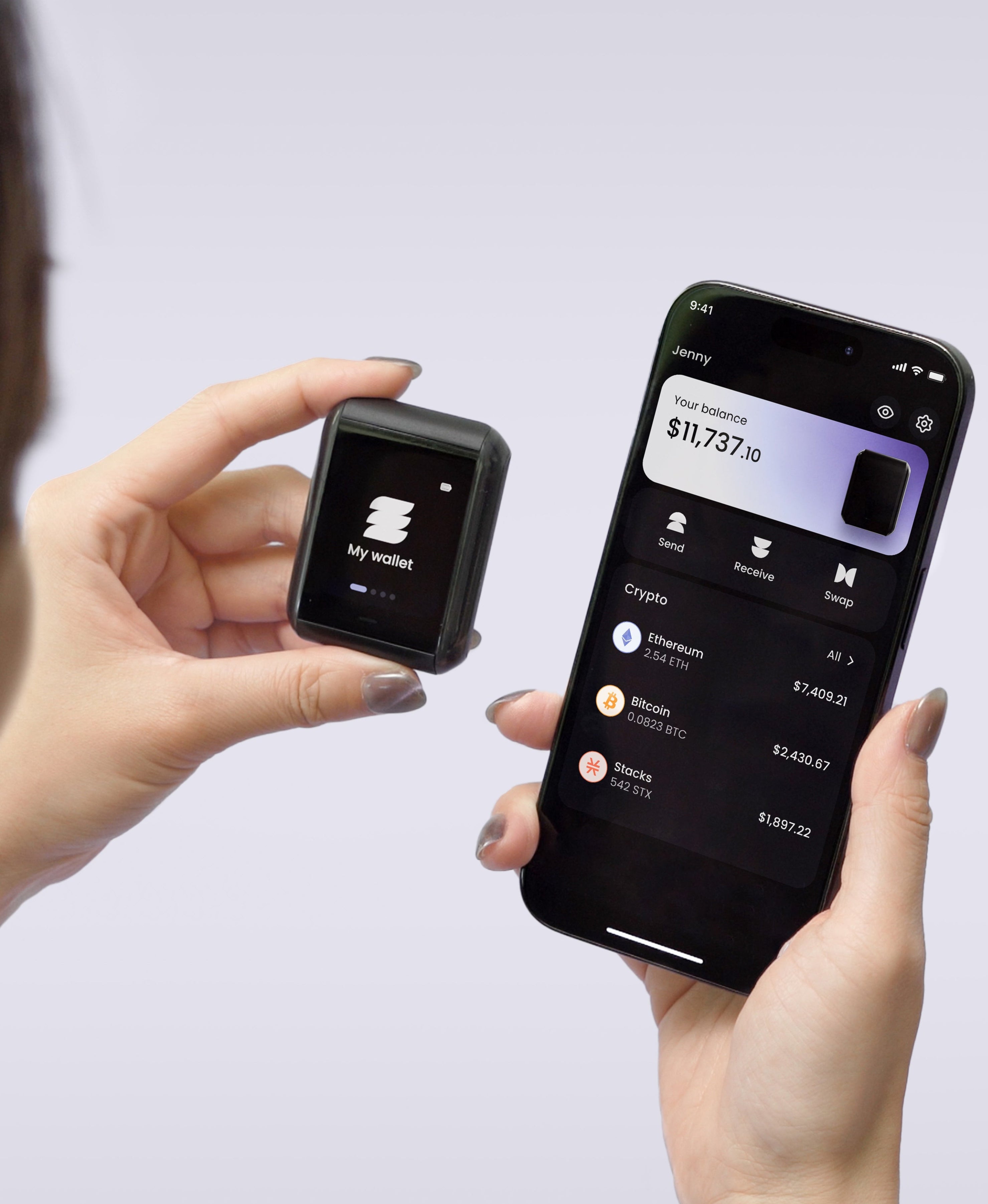
Ryder One holds Bitcoin natively on its EAL6+ Infineon SLC38 secure element, with every transaction verified on the device's 1.6-inch AMOLED touchscreen. For users who want to use a Bitcoin L2, the right setup depends on what the L2 demands. Lightning users typically pair a hot wallet for channel management with a hardware wallet for the on-chain backing position. Stacks users can hold their Bitcoin on the hardware wallet and interact with the Stacks ecosystem through a companion software wallet. Sidechain users typically peg in from a hardware-held Bitcoin position and back out when they want their funds at base-layer trust.
When a Bitcoin L2 is worth it
A reasonable framework: use the base layer for amounts you're willing to settle slowly and trust nobody on. Use an L2 for amounts and use cases where the L2's trust model is acceptable. Small daily-spending Bitcoin runs well on Lightning, where the trust model is reasonable for amounts you can afford to lose to a channel breach. If you want BTC-denominated DeFi exposure, Stacks or Botanix can be appropriate depending on the use case. And for confidential transactions or asset issuance on a faster chain, Liquid has the longest track record. For any of these, the key custody question is the same: where does the key that controls your funds at the L2 layer live? If it's a hot key on a laptop, the L2's trust model doesn't help against laptop malware. If it's signed by a hardware wallet, you've added a layer of L2 functionality without giving up the cold storage properties of the underlying Bitcoin.
The bottom line
Bitcoin L2s are the answer to base-layer Bitcoin's deliberate constraints. Lightning is mature and well-used for payments. Stacks, Botanix, and Liquid each fill different niches. The trust models vary, the tooling varies, and the right L2 depends on what you're trying to do with it. For hardware wallet users specifically, the useful question is what this specific L2 trusts and whether your hardware wallet still controls the key at the level that matters. The answer varies per L2, and it determines whether the convenience is worth the new assumptions. Get the details before you peg in.
Use L2 without giving up cold storage. Ryder One holds Bitcoin natively on an EAL6+ secure element, with on-device transaction verification and TapSafe Recovery protecting your backup. See how it works.



Share: