

If the second factor on your exchange account is your phone number, you don't have two-factor authentication. You have one factor and a courtesy notification. This sounds dramatic until you watch how a SIM-swap attack works. The attacker calls the carrier, talks the agent into porting the number to a new SIM, and within minutes is receiving every SMS code intended for you. Bank logins, exchange logins, password resets. The phone in your pocket goes silent. The attacker is already through the door. For crypto holders, this matters more than for most users. Exchange accounts are high-value targets, and the recovery flow that protects you from a forgotten password is the same flow an attacker uses against you.
Why SMS isn't a strong second factor
Three problems, in roughly the order they show up: SIM swapping is industrialized: Reports across the last few years show it's a routine attack with a mature playbook. Social engineering at the carrier, insider help, sometimes both. The cost to an attacker is low. The payoff for a crypto target is high. SS7 and protocol-level interception: Even without a SIM swap, the cellular signaling protocols have known weaknesses that allow SMS interception in some networks. Less common than swapping, but not theoretical. SMS isn't designed as a security channel: It's a delivery mechanism for short text. There's no confidentiality, no proof the recipient is the intended one, no resistance to social engineering at the carrier. None of this is news to security teams at the major exchanges. Most of them now nudge users toward stronger 2FA methods. The path of least resistance for a new account is still often SMS, which is the gap an attacker uses.
What hardware keys do differently
A hardware security key is a small device, usually USB-A, USB-C, NFC, or Lightning, that implements the FIDO2 / WebAuthn standards. Common examples are YubiKeys, Titan keys, and SoloKeys.
The critical properties:
- The private key never leaves the device
- Authentication is bound to the origin (the actual domain), not the URL the user sees
- Phishing-resistant by design: a fake login page on binance.support can't authenticate against your real binance.com key
- No shared secret with the platform; even a database leak can't compromise your key
The phishing resistance is the part that matters most. Most account takeovers, including SIM-swap-assisted ones, rely on getting the user to enter a code on a page the attacker controls. A hardware key won't sign for the wrong origin, full stop.
Where TOTP fits
A middle option: time-based one-time passwords from an authenticator app like Google Authenticator, Authy, or Aegis. TOTP is much better than SMS. The codes never traverse the cellular network, the secret is on your device, and an attacker needs the device itself or a backup of the seed. TOTP's weakness is phishing. A user on a fake login page will enter the six-digit code into the attacker's form, and the attacker will use it before it expires. That's solvable, but it requires user discipline that hardware keys enforce automatically. A reasonable hierarchy: hardware key everywhere it's supported, TOTP everywhere else, SMS only as a fallback you avoid using.
What this looks like for crypto users
A practical setup: - Hardware key on your primary exchange account, with a backup key stored separately - Hardware key or TOTP on every email account that touches financial recovery - A non-public phone number for any service that still requires SMS, separate from your daily number - Carrier-side port-out protection (a PIN or lock) on every line, even the secondary one - A password manager with its own hardware-key 2FA The hardware key is the foundation. The rest is making sure no easier path exists around it.
Where the hardware wallet fits
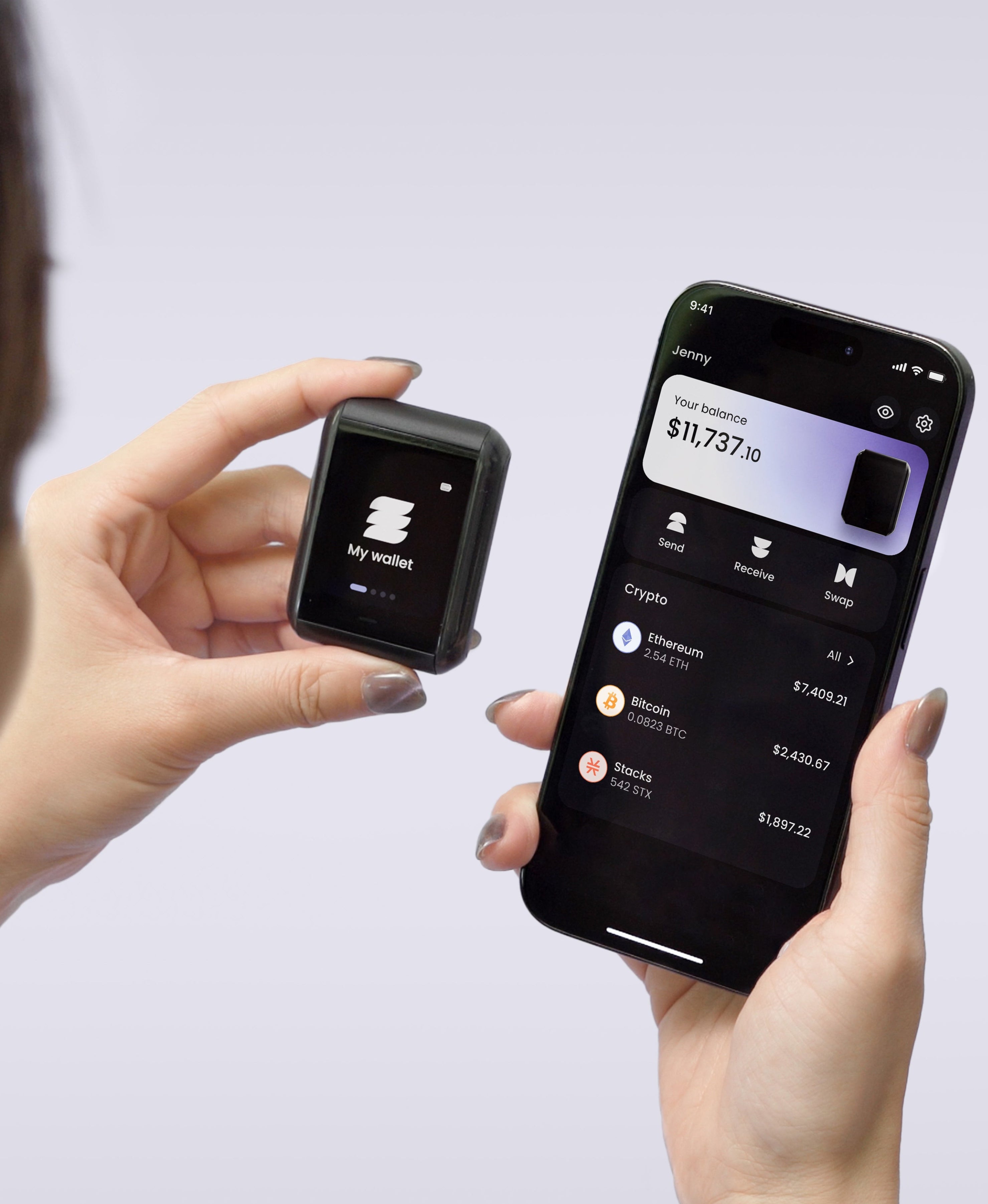
A hardware wallet and a hardware security key do different jobs that get confused because the names sound similar. - A hardware wallet (like Ryder One) holds the private keys to your crypto and signs transactions on-device - A hardware security key authenticates you to web services You want both, for different reasons. The wallet protects your self-custodied funds. The security key protects your accounts on the platforms that surround them: exchanges, email, password manager.
Common objections
"My exchange already requires 2FA." It requires some form of 2FA. Check what kind. SMS-only is the default at many platforms unless you opt into something stronger. "I don't want to carry around a USB key." NFC and on-device biometric keys exist. So do keys you can leave plugged into your laptop. The friction has dropped a lot in the last few years. "What if I lose the key?" Keep a backup. Most platforms let you register two or more keys. Store the backup somewhere different from the primary, the same way you would with a hardware-wallet recovery method.
How to switch
A quick sequence that works: 1. Buy two compatible hardware keys, not one 2. Set up the primary on your most important account (usually email, then exchange) 3. Set up the backup on the same account 4. Verify both work, then disable SMS as a 2FA option 5. Repeat across the rest of your accounts in order of value 6. Add carrier-side port-out protection on your phone number while you're at it The whole exercise takes an afternoon, less time than recovering from a single account takeover.
FAQ
Is SMS 2FA better than no 2FA? Marginally. It catches casual attackers and stops password-stuffing attacks. It doesn't stop a targeted SIM-swap attempt against a known crypto holder. Are passkeys the same as hardware keys? Passkeys are built on the same WebAuthn standard. They can be device-bound (which behaves like a hardware key) or synced across an account (which is more convenient and slightly less robust). Both beat SMS. Do I need a hardware key for self-custody? For your hardware wallet itself, no. The wallet has its own authentication model. For the exchanges and accounts around your wallet, yes. That's where most account-takeover losses originate.
Bottom line
The phone-number-as-second-factor era is over for any account worth attacking. Hardware keys, used correctly, raise the cost of compromise to a level most attackers won't pay. For crypto users, that's the cheapest upgrade in the security stack.


Share: