

A passkey wallet is a crypto wallet that uses your device's biometric authentication — fingerprint, face scan, or PIN — instead of a seed phrase to protect and recover your private keys.
Think of the difference between a house key and a fingerprint door lock. Anyone can copy or steal a house key without you knowing. A fingerprint lock is tied to you — it can't be handed to someone else or found in a drawer. Passkey wallets work the same way: your identity becomes the credential, not a string of 24 random words.
Traditional crypto wallets require you to write down a seed phrase — a sequence of 12 to 24 words that acts as the master key to your funds. Lose that paper, and your crypto is gone. Show it to the wrong person, and your crypto disappears just as fast. A passkey wallet solves both problems by replacing the seed phrase with a cryptographic credential stored in your device's hardware security chip — the same technology that powers Apple Pay and Google Pay.
When you set up a passkey wallet, your device generates a unique private key and locks it inside a secure enclave. To sign a transaction, you unlock your phone or laptop via Face ID, Touch ID, or your PIN. Nothing gets written down. Nothing leaves your device. This method follows the WebAuthn standard published by the W3C — the same protocol major browsers use for passwordless login.
The category has grown fast. In 2026, major Solana wallets launched passkey-native accounts, and Ethereum's account abstraction frameworks added WebAuthn signature support. The FIDO Alliance, the standards body behind passkeys, counts Apple, Google, and Microsoft as members — meaning passkey support is now baked into every major platform.
Not all passkey wallets are built the same. Here's what separates a secure implementation from a risky one:
- On-device storage: Credentials should live in your device's secure enclave, not in a cloud account that could get compromised.
- No cloud backup dependency: Some wallets sync credentials to iCloud or Google Drive by default, which reintroduces account-takeover risk.
- Distributed recovery: The strongest implementations split your backup across multiple parties or physical devices using cryptographic sharing schemes, so there's no single point of failure.
The stakes are real. Over $3.4 billion in crypto was stolen in 2024 — much of it through phishing attacks targeting seed phrases and exchange accounts. A passkey wallet removes that entire attack surface by eliminating the seed phrase from the equation.
Why passkeys matter for your security
The seed phrase has been the single biggest target for crypto attackers. Passkey wallets remove it from the equation entirely. There's no piece of paper to photograph, no phrase to phish, no mnemonic to mistype. If you're evaluating how to move from an exchange to self-custody without the anxiety of managing a seed phrase, this is where the security model has shifted.
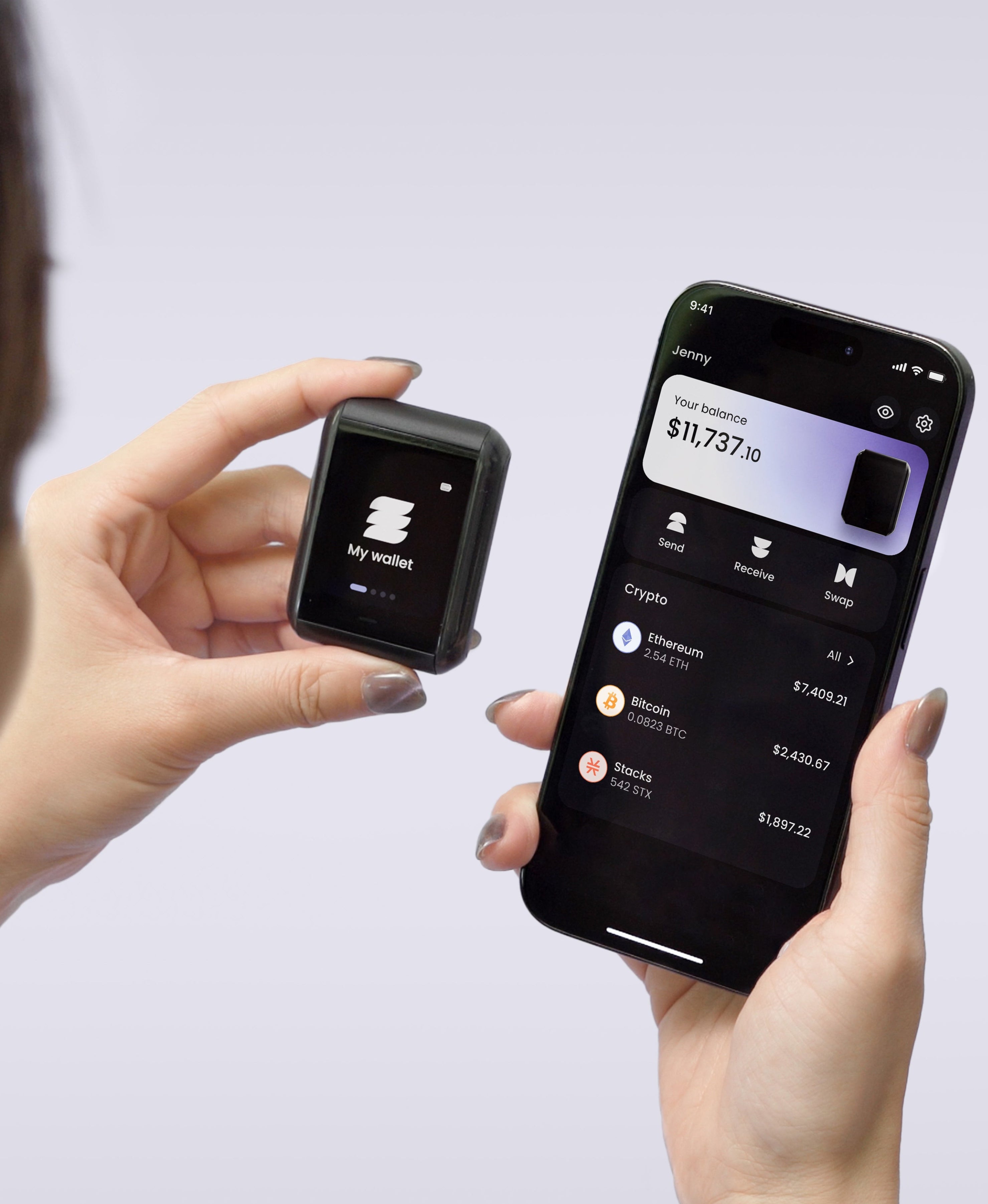
Ryder One takes this further. Instead of a seed phrase, your backup is split across physical Recovery Tags and trusted contacts using Shamir Secret Sharing — hardware-grade security with no single point of failure. Set up in 60 seconds, no seed phrase required.
Related: What is a seed phrase · What is self-custody · What is a hardware wallet · What is Shamir Secret Sharing


Share: