If you set up a hardware wallet in the past five years, your recovery phrase is almost certainly BIP-39. It's the 12 or 24-word standard that runs essentially every consumer crypto wallet on the market. It works, it's portable, and almost every wallet on earth knows how to read it. It also has one structural problem most holders never think about: there is exactly one of it, and whoever holds it has your funds.
SLIP-39 is the alternative most holders haven't heard of. It uses Shamir Secret Sharing to split your seed into multiple shares, with a threshold required to reconstruct, so no single loss wipes you out. It's been around since 2017. It's quietly the better answer for many people. And it's the upgrade most holders miss because their wallet doesn't show it as an option.
What BIP-39 is
BIP-39 is a Bitcoin Improvement Proposal published in 2013 that defines how a wallet generates a human-readable recovery phrase from random entropy. The wallet picks a number, maps it to a sequence of 12 or 24 words from a fixed dictionary of 2,048 words, and that phrase becomes your master backup. From it, the wallet can derive every private key for every coin and every account.
It works because the dictionary is standardized, the derivation math is open, and any wallet that implements BIP-39 can read another wallet's BIP-39 phrase. That's the portability advantage. Lose your hardware wallet, write the words into a different one, and your funds appear.
The problem is the same as the advantage: it's one phrase, and one phrase is one point of failure. Whether you write it on paper, stamp it into metal, or seal it in a fireproof safe, you've turned a 256-bit cryptographic secret into a single physical object. If that object burns, gets stolen, or quietly disappears in a house move, the funds it protects are gone with it.
What SLIP-39 is
SLIP-39 is a SatoshiLabs Improvement Proposal published in 2017 by the team behind Trezor. It uses the same idea (a wallet generates a master secret from entropy) but instead of producing one phrase, it produces a set of shares using Shamir Secret Sharing.
Each share is 20 words from a different dictionary than BIP-39 (the SLIP-39 wordlist is built specifically for this format). You choose the total number of shares and the threshold needed to reconstruct the master secret. A 2-of-3 SLIP-39 backup gives you three shares, any two of which can recover your wallet. A 3-of-5 setup gives five shares with a threshold of three.
Below the threshold, the math gives nothing away. One share alone reveals zero information about the master secret. This is the structural difference between SLIP-39 and "I cut my BIP-39 phrase into pieces with scissors." Cutting a phrase still leaks word positions. SLIP-39 shares are statistically indistinguishable from random noise until you cross the threshold.
How TapSafe changed the game
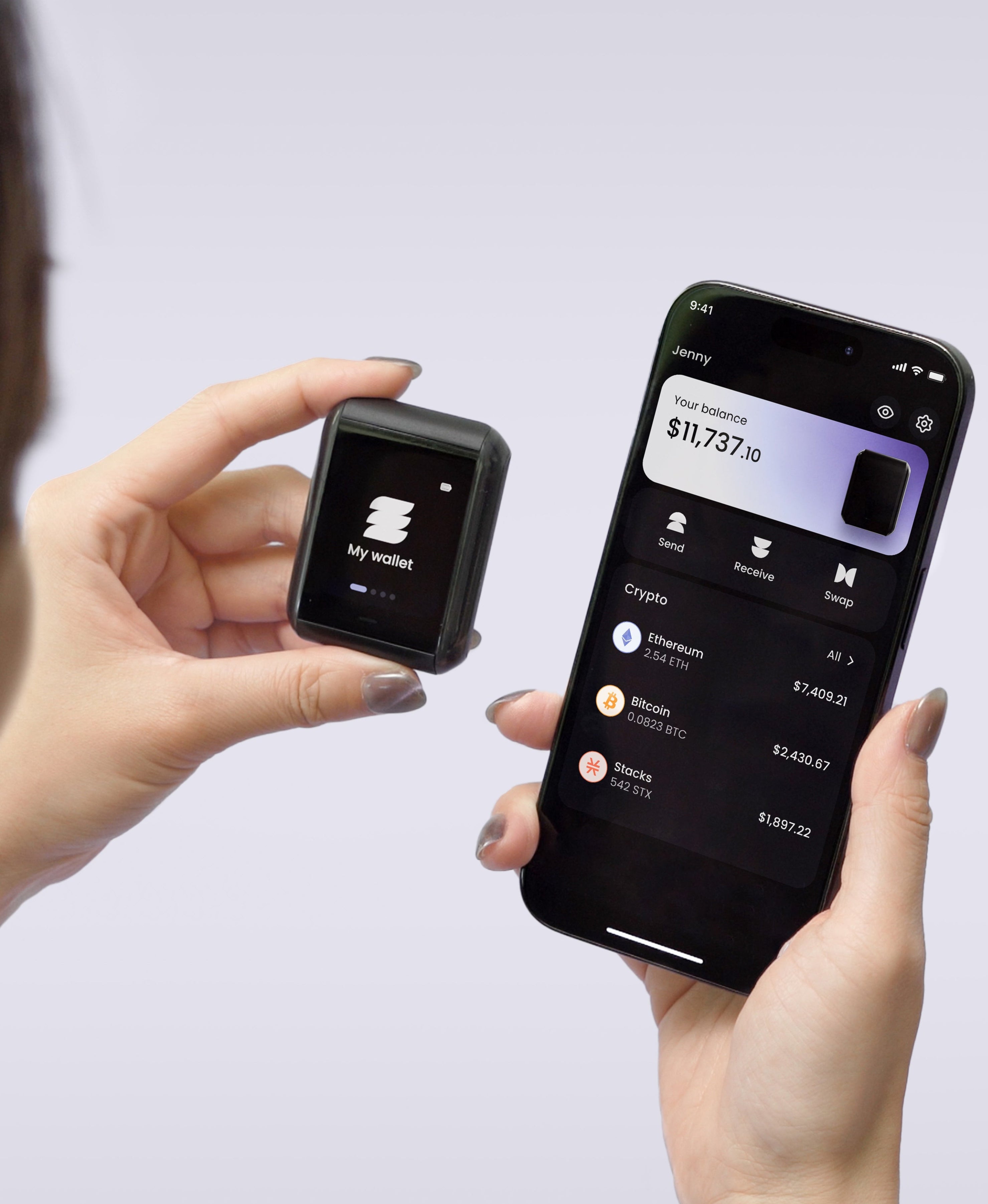
What we built on top is TapSafe Recovery, which solves the same single-point-of-failure problem SLIP-39 solves but with a different architecture. TapSafe distributes recovery across three layers: a battery-free, IP69K-rated Recovery Tag (50%), a phone backup encrypted in iCloud or Google Drive (50%), and optional Recovery Contacts who each hold 25%. Tag plus phone equals 100% recovery; no single layer alone gives access to your funds. The seed phrase is always available on-device as a last resort.
Since TapSafe is built on the BIP-39, it gives you the safety of SLIP-39 whilst being compatible with other hardware wallets. You can import your existing wallet and layer on TapSafe's security without the fear of any complications along the way
How they differ in practice
The BIP-39 setup is one phrase, one location to protect (or one location with redundant copies, which raises a different problem). The SLIP-39 setup is multiple shares across multiple locations, with a threshold for recovery.
The recovery experience differs too. BIP-39 recovery is "type the words." SLIP-39 recovery is "gather K shares, type them all in." It takes longer and it's also more resilient. A fire that destroys one share doesn't end your access, a theft of one share doesn't compromise your wallet and the threshold model removes a class of single-point-of-failure scenarios that BIP-39 cannot handle by design.
There's a portability gap. BIP-39 is supported essentially everywhere. SLIP-39 is supported by Trezor (Model T, Safe 3, Safe 5), Keystone, and a small number of other wallets. If you generate a SLIP-39 backup on Trezor and want to import it into a wallet that only speaks BIP-39, you'd need to reconstruct the master secret and convert it, which most wallets won't help you do directly.
When SLIP-39 makes sense
SLIP-39 is the right tool when your threat model includes physical loss or theft of a single backup, and when you have the operational discipline to manage multiple shares across multiple locations over time. Common situations where it shines: holdings large enough that single-location backup feels like a liability; inheritance scenarios where you want shares distributed across family members so any K of N can recover; geographic redundancy where you keep shares in different cities or countries to survive regional disasters; households with multiple stakeholders where you want a threshold rather than full access for any one person.
It's not the right tool when you're a casual holder with a small balance, when the operational complexity will lead you to lose track of your shares, or when you need maximum portability across many wallets.
Where wallet support stands today
BIP-39 is universal. Every consumer hardware wallet supports it. Every software wallet supports it. The standard works across vendors and across coins.
SLIP-39 support is limited. Trezor supports it natively (this is the wallet the standard was designed for). Keystone added support. A handful of other vendors offer compatibility, with caveats. Most other hardware wallets, including Ledger, do not support SLIP-39 directly.
This matters for two reasons. First, your choice of wallet constrains whether SLIP-39 is even an option. Second, if you switch wallets later, you may need to reconstruct your master secret and re-import under BIP-39, which collapses the SLIP-39 advantage during the migration.
The takeaway
BIP-39 is the universal standard. It's portable, it's everywhere, and it's the right answer for most casual holders. SLIP-39 is the upgrade for holders who want to remove the single point of failure from their backup, supported by Trezor and Keystone but not most other wallets.
If you already own a BIP-39 hardware wallet but want the structural security of multi-share recovery, Ryder One delivers it through TapSafe Recovery while keeping BIP-39 portability under the hood.


Share: