

Search for a seed phrase template and you will find hundreds of them: tidy numbered grids, twelve or twenty-four boxes, some with a spot for the wallet name and the date. They exist because the moment after a wallet hands you your words is an awkward one, and a printable sheet feels like the responsible thing to reach for. It is a reasonable instinct that solves the smallest part of the problem, and the part it leaves untouched is the one that costs people everything.
Where a seed phrase template helps, and where it stops
A template does two useful things. It stops you transcribing the words in the wrong order, and it gives the sheet an obvious shape so future-you knows what you are looking at instead of finding twelve unexplained words on the back of an envelope.
What it cannot do is anything about the sheet's survival or its secrecy. A grid of boxes is still ink on paper in a drawer, and that object now holds complete control over everything the wallet protects. Ryder's answer to this, TapSafe Recovery, exists because we decided the sheet should not have to carry that weight alone.
The download is the first mistake
Before we get to the drawer, consider how the sheet reached you. You searched for a template, downloaded a PDF onto an internet-connected computer, and sent it to a printer, which on most home and office networks means the file passed through a spool and may still be sitting in the printer's memory. If the template came from a site you had never heard of before that morning, you also allowed a stranger to choose the layout of the document you are about to write your keys onto.
The template itself is unlikely to be malicious; it is a grid. The pattern around it is where the harm lives, because the same search results are full of pages offering to generate the words for you.
Take this as the fixed rule of self-custody: words that arrive from a website are already known to whoever runs that website. Your seed phrase must be created by the device that will hold it, offline, in front of you, and no legitimate wallet company will ever ask you to type it anywhere afterwards. A box that arrives with words already printed inside is a theft waiting for you to fund it.
What happens to paper over ten years
House fires reach temperatures that leave nothing of a paper sheet. Floods and burst pipes turn ballpoint into a grey smear. Beyond the dramatic failures sits the ordinary one: somebody tidies a drawer, sees an unlabelled sheet of words, and throws it out.
Then there is discovery, which is the failure people underestimate most. Anyone who finds the sheet owns the coins, with no password to guess and no second step, and hiding places that feel clever to you are the first places a burglar checks. That risk stopped being abstract in August 2026, when Trezor confirmed that a breach at one of its shipping providers had exposed customer names, phone numbers and home addresses, and SafePal disclosed days later that a flaw in its order-tracking plugin had exposed data for 39,798 customers. No keys were touched in either case. What leaked was a list of people who own hardware wallets, along with where they sleep.
Metal is the standard upgrade, and it isn't the answer
The usual next step is a steel plate, and it deserves its reputation. Stamped metal survives fire, water and time in a way ink never will, and if the only thing you change today is moving from paper to steel, that is a worthwhile afternoon.
It doesn't change the shape of the risk though. One object still holds a complete secret, so the plate has to stay intact and stay unread by everyone who passes through your home for as long as you hold crypto. You have upgraded the armour on your single point of failure without removing the single point of failure.
Splitting the secret instead of hardening it
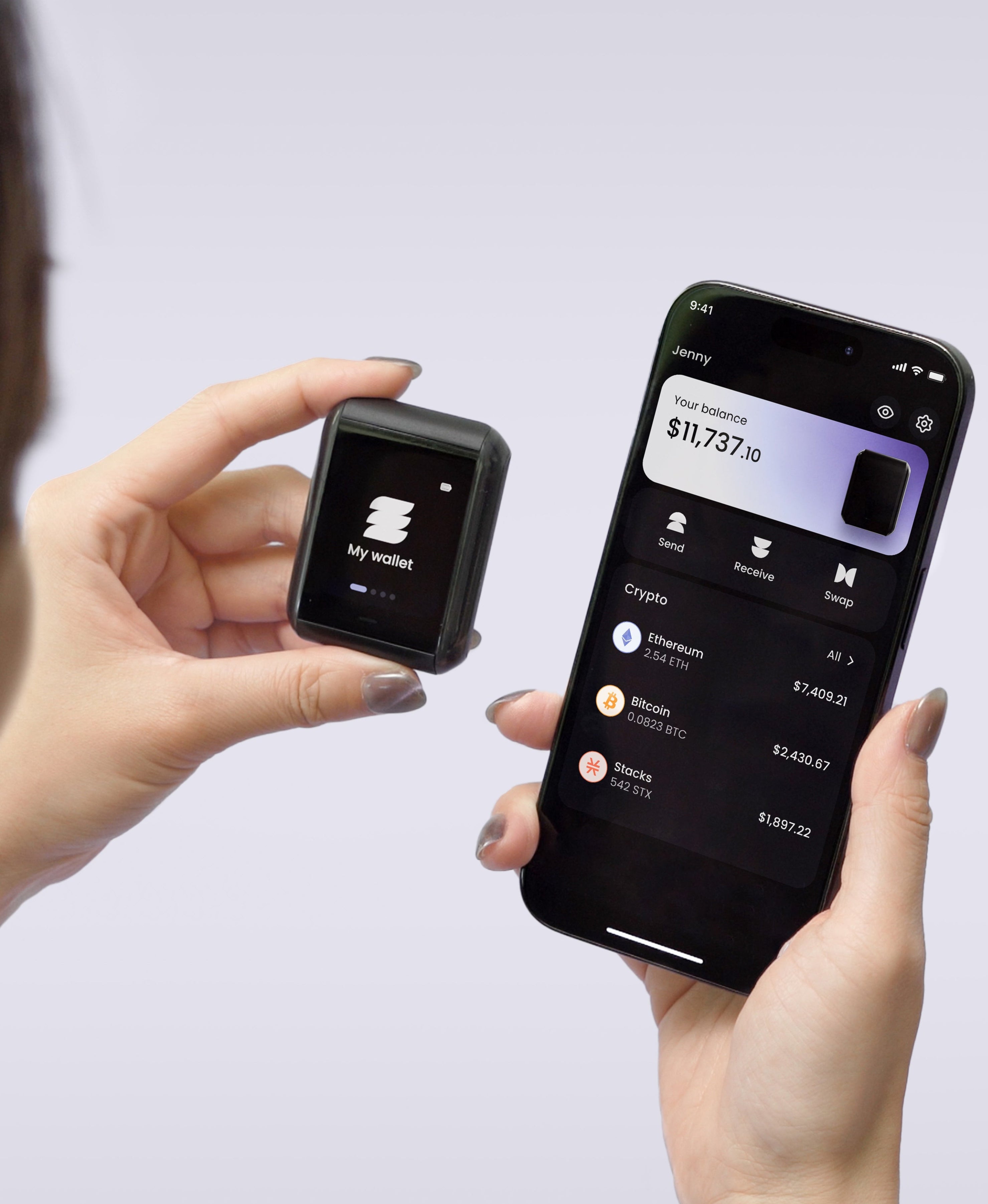
The alternative is arranging things so no one object is worth stealing. On the Ryder One, recovery splits across a Recovery Tag that holds half of what is needed and your paired phone, which holds the other half encrypted into your own iCloud or Google Drive rather than on the handset itself. Both halves have to meet before anything opens, which means the tag in your desk is inert to a burglar and losing your phone costs you nothing. Recovery Contacts are optional and hold a quarter each, set up in person by tapping, and they never learn a thing about what you hold.
Underneath is a custom implementation of Shamir's Secret Sharing, and the seed phrase stays available on the device as a last resort under the BIP-39 standard, so you keep the escape hatch and can move to any other wallet whenever you want. Keys are generated inside an EAL6+ certified Infineon SLC38 secure element and never leave the chip. Halborn audited the firmware and published the report.
If you have already filled one in
Assume the sheet is findable and act accordingly. Move it out of the room where the device lives, because keeping both together hands a thief the whole thing in one visit, and split the sheet across two locations if you have two you trust.
If the words ever touched a screen, a photo, a password manager or a printer queue, treat that wallet as compromised and move the coins to a freshly generated one. It feels excessive right up until it isn't. And if you have been putting off the backup question because every option asks you to protect one irreplaceable object for the rest of your life, that is the question we rebuilt from scratch. Get your Ryder One.
Meta description: A seed phrase template fixes transcription errors and nothing else. Why the download, the printer and the drawer are the real risks, and what to do instead.


Share: