

The SEC crypto custody question came back into view on 18 August 2026, when the agency proposed its first purpose-built rulebook for crypto offerings after nearly a decade of regulating the industry through enforcement actions and informal guidance. Coverage treated it as the moment crypto finally got legal clarity in the United States. Read the proposal and something else stands out, which is how little of it concerns the thing most holders worry about: who is holding the coins.
What Regulation Crypto Assets does
The proposed framework, Regulation Crypto Assets, covers how certain investment contracts involving crypto assets can be offered without full Securities Act registration. It sets out a lifecycle model in which an issuer discloses what it promises to build, reports while that work continues, and provides evidence when the promised work is finished.
Two exemptions sit at the centre. A startup exemption allows offerings up to 5 million USD over as long as four years, and a larger fundraising exemption runs in tiers up to 75 million USD in any twelve-month period. Antifraud and antimanipulation rules stay in force throughout, and the proposal leaves anti-money-laundering, sanctions, tax and cybersecurity obligations exactly where they were.
For anyone building or funding a token project, this is the most consequential document the SEC has produced on crypto. For someone holding Bitcoin and wondering whether their coins are safe, it does close to nothing, because the rule governs how tokens are sold rather than where they live afterwards.
Where the SEC stands on crypto custody
The agency's public posture on self-custody has warmed considerably. Chairman Paul Atkins told the SEC's Crypto Task Force roundtable in June 2025 that "the right to have self-custody of one's private property is a foundational American value that should not disappear when one logs onto the internet", and he has repeated the theme since. At the Bitcoin 2026 conference, speakers argued the case as a civil liberties question rather than a technical preference.
Meanwhile the agency's own investor bulletin on crypto asset custody tells retail investors plainly that when a third party holds your crypto, you are relying on that third party's controls, solvency and honesty. Both statements point the same direction, and neither of them is a rule that protects you.
Regulation moves the risk, it does not remove it
This is the part worth internalising before the next round of headlines. Rules of this kind govern conduct: who may sell what, what must be disclosed, which licence a business needs. When a regulated firm fails anyway, the rules give you a claim in a proceeding rather than your coins back.
Customers of FTX learned the distinction in 2022, when roughly 8 billion USD of customer funds went missing from a company that operated in plain sight. Binance paid 4.3 billion USD to settle with the Department of Justice in 2023 and kept operating. In both cases the law worked as designed, slowly, after the money was gone. A balance on an exchange is a promise from a company, and the strongest possible regulation makes that promise better supervised without making it yours.
Holding your own keys changes the category of risk rather than eliminating risk. You take on the job of not losing the keys, and you stop depending on anyone's solvency, compliance department, or willingness to process your withdrawal on a bad week.
What clarity is worth to a holder
Better rules do help, and it is worth being precise about how. Clearer offering standards should mean fewer outright frauds reaching retail investors, and a regulated venue that knows what it must disclose is a safer place to buy coins than one operating in a grey zone. Buying is the part where regulation earns its keep.
Storing is where it stops. No provision in the August proposal changes what happens to your assets if the platform holding them fails, freezes withdrawals, or gets ordered to freeze yours. That gap is not an oversight; it is the boundary of what securities law is for.
Which leaves the question of your own setup
If the regulatory answer to custody is "hold it yourself if you want certainty," then the follow-up is the one worth spending an afternoon on. Once the keys are off the exchange, what happens when the device is lost, stolen, or destroyed, and what happens if somebody talks you into reading your backup words aloud?
Most wallets answer with a single recovery phrase that restores everything to whoever holds it. We built TapSafe Recovery differently, splitting access so no single item carries a complete answer: a Recovery Tag holds 50 percent, your paired phone holds 50 percent stored encrypted in your own iCloud or Google Drive rather than on the handset, and optional Recovery Contacts hold 25 percent each while learning nothing about your holdings. Tag and phone together restore the wallet, and either alone restores nothing. Your seed phrase stays available on the device as a last resort under the BIP-39 standard, so you are never locked to our hardware.
The rule you write yourself
Washington is drafting the clearest crypto rules the United States has ever had, and the chairman of the agency writing them has called self-custody a foundational American value. Neither fact puts a single coin in your control. That still comes down to a decision you make on an ordinary weekday about where your keys sit.
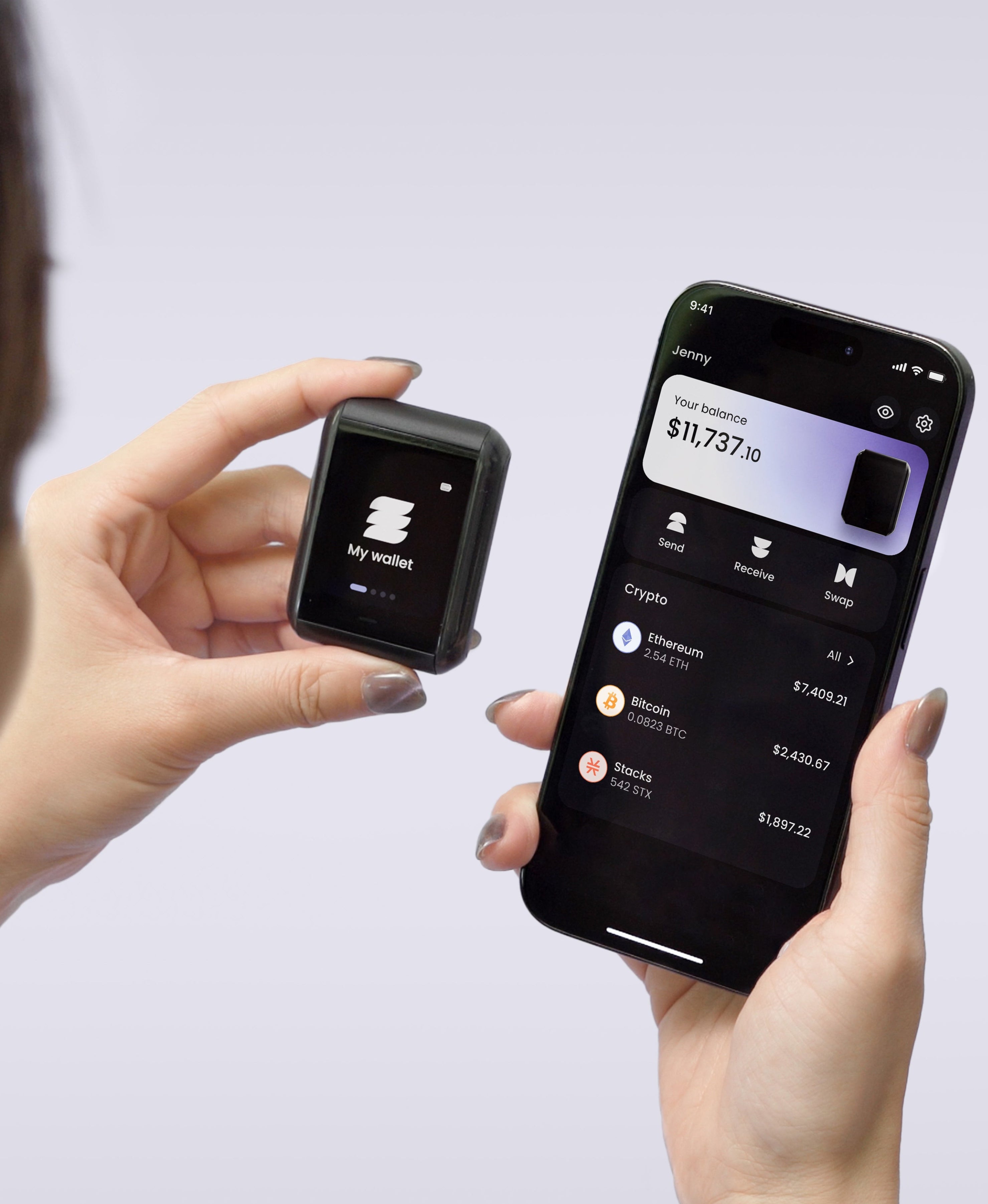
On the Ryder One, keys are generated inside an EAL6+ certified Infineon SLC38 secure element and never leave it, the firmware was independently audited by Halborn with the full report published, and every transaction renders on the 1.6-inch AMOLED touchscreen before you approve it. Communication runs over NFC and nothing else. Setup takes about 60 seconds, and the Starter Combo is 149 USD.
Let the regulators settle who is allowed to sell you a token, and decide for yourself who should ever be in a position to freeze one. See the Ryder One.
Meta description: The SEC proposed its first crypto rulebook on 18 August 2026. What Regulation Crypto Assets covers, what it says about crypto custody, and what it leaves to you.


Share: