

On 6 September 2026, close to 4,000 bitcoin left the wallet that backs Blockstream's Liquid Network in two transactions worth roughly 320 million dollars. That was most of the network's entire backing, which sat at about 4,200 BTC. Nobody's private keys were stolen, no seed phrase was phished, and no user did anything wrong. The coins moved anyway, and the reason they could is the part worth understanding whether or not you have ever touched a sidechain.
What L-BTC represents
Liquid is a Bitcoin sidechain built by Blockstream, aimed mostly at traders and exchanges who want faster settlement and confidential transaction amounts. The mechanism is a peg. You send bitcoin in, a group of signers called the federation locks it, and an equivalent token called L-BTC appears on the sidechain for you to use. Send the L-BTC back and the federation releases the bitcoin.
Read that again with the ownership question in mind. While your balance is denominated in bitcoin, what you hold on the sidechain is a token whose value depends entirely on a group of companies continuing to hold the collateral and continuing to honour redemptions. It's closer to a warehouse receipt than to bitcoin in a cold wallet. That arrangement can work well for the trading desks it was designed for. It stops working the moment the accounting behind the warehouse goes wrong.
What went wrong
The withdrawal moved through a Peg-out Authorization Key tied to SideSwap, and Blockstream has said that key was not compromised and that it found no compromise of any other federation key either. The weakness appears to sit in Elements, the Bitcoin Core fork Liquid runs on, where a bug in range-proof verification caching seems to have allowed L-BTC to exist without the bitcoin that is supposed to back it. Put plainly, the ledger could be convinced that money existed which did not, and the peg-out then paid out against it.
Blockstream disabled bridge nodes and asked exchanges to suspend L-BTC deposits and withdrawals, which froze the sidechain while the problem was worked out.
The negotiation happened on Bitcoin itself
What followed was strange enough to be worth recording. The party holding the coins sent messages to Blockstream through OP_RETURN data embedded in Bitcoin transactions, along with PGP-encrypted text, saying they would return most of the funds once the bug was fixed and every node was patched. Blockstream replied with a PGP-signed on-chain message reading that bridge nodes were patched and it was safe to return the funds, verifiable against the security key published on its own website.
The coins came back on 8 September: 3,400 BTC returned, with 598.5 BTC worth around 47 million dollars retained, about 15 percent of the total. No agreement explaining that share has been made public. Calling it a white-hat episode is generous when a sixth of the money stayed behind, though the outcome was clearly better than the alternative.
The uncomfortable summary
Every safeguard people normally worry about held up. Keys were uncompromised, the signers behaved, and the hardware protecting those signers did its job. What failed was an accounting rule sitting several layers below anything a user could inspect, and that failure put nearly the whole reserve into a stranger's hands for two days while a negotiation played out in public.
You cannot audit that from the outside, and no amount of care with your own security posture would have changed your exposure. This is the same shape as the Cronos and Tectonic halt we wrote about, and the same shape as an exchange balance: a number on a screen that depends on somebody else's code and somebody else's goodwill.
Bitcoin you hold has no such layer
When bitcoin sits at an address whose private key was generated inside a secure element in your hand, there is no federation, no peg, no bridge node and no range-proof cache between you and the coins. Moving them requires your device and your approval. A bug in someone else's ledger software cannot mint a claim against your balance, because your balance isn't a claim.
That's the trade. Sidechains and wrapped tokens buy you speed, privacy features and access to venues, and they charge you a dependency you can't inspect. Use them for what they're good at, and be deliberate about how much sits there and for how long.
Where your backup fits
Bringing coins home solves the counterparty problem and hands you a new job, which is keeping the keys recoverable for as long as you intend to hold. Most people manage this with a sheet of paper in a drawer, and a stamped metal plate is the usual upgrade, durable against fire and water while still concentrating everything into one object that has to survive and stay unread for decades.
TapSafe Recovery takes the object out of the middle. Your recovery splits between a Recovery Tag holding half of what's needed and your paired phone holding the other half, encrypted into your own iCloud or Google Drive rather than stored on the handset, so losing one piece costs you nothing and stealing one piece gets a thief nowhere. Recovery Contacts are optional, hold a quarter each, never see anything about your balances, and are added in person with a tap. It runs on a custom implementation of Shamir's Secret Sharing, and your seed phrase stays reachable on the device as a last resort under the BIP-39 standard, so you are never tied to our hardware.
What to do this week
If you hold L-BTC or any wrapped version of bitcoin, work out how much and why. Wrapped assets earn their place when you're using the venue they unlock, and they're a poor default for coins you plan to sit on.
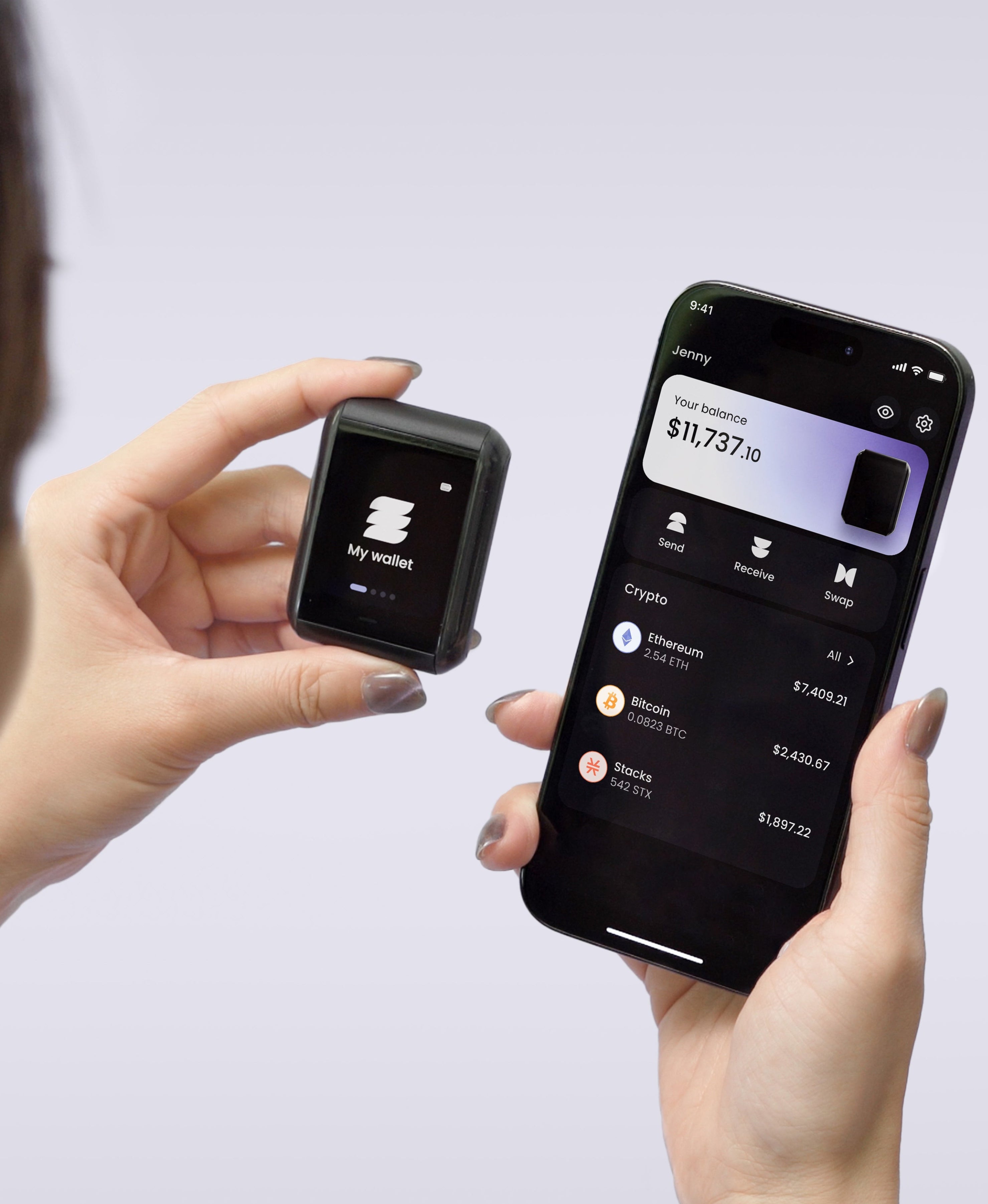
Then look at the rest of your holdings the same way and ask which of them depend on an entity staying solvent, staying online and staying correct. Whatever's left after that question is the part you own outright. On the Ryder One that part lives on a device with no USB port, no Bluetooth and no Wi-Fi, wakes up when you tap it against your phone, and shows you every transaction in full on its screen before a button wired to the secure element will sign anything. Get your Ryder One.


Share: