

The Ledger Flex sits in an awkward spot in Ledger's range, above the button-driven Nano models and below the curved-screen Stax, and it is the device most people land on when they decide the little two-button wallet is too fiddly to trust. It is a good product. Whether it is the right 249 dollars for you depends almost entirely on one question that the specification sheet never asks out loud: after you buy it, where does your backup live?
What the Ledger Flex is, in plain terms
Ledger launched the Flex in July 2024 at 249 USD, positioning it between the 149 dollar Nano X and the 399 dollar Stax. The headline feature is the display: a 2.8-inch monochrome E Ink touchscreen running at 480 by 600 pixels behind Gorilla Glass, which stays readable in daylight and holds an image without drawing power. According to Ledger's own product page, the device talks to phones and laptops over a wired connection, Bluetooth, and NFC, and private keys stay inside a certified secure element running Ledger's own operating system.
Asset support is the widest in the category by a distance, the build quality is good, and Ledger Live is a polished app that most people can work out without a tutorial. None of that is in dispute here.
The screen is the point, and it earns the money
Give Ledger credit for the part that matters. On the Flex, the E Ink panel is driven by the secure element itself, which means the transaction detail you read on screen comes from the same chip that holds your keys rather than from a second processor that could be fed something different. Blind signing, where you approve a transaction you cannot read and hope the address on your laptop is the address being signed, is how a large share of self-custody losses happen. A screen wired directly into the secure element closes that gap, and it is the strongest argument for spending 249 dollars instead of 79.
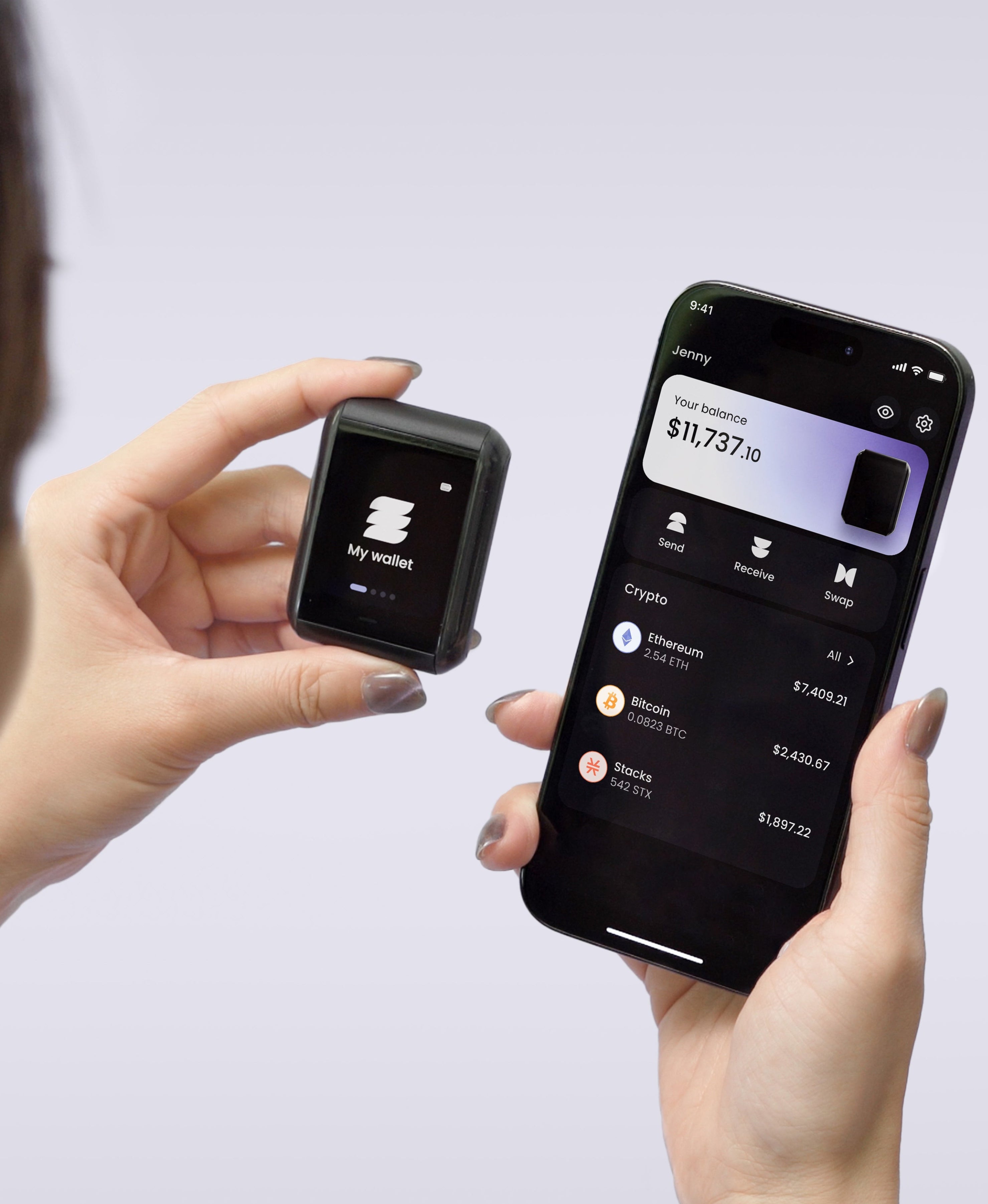
We take the same view of on-device verification with the 1.6-inch AMOLED touchscreen on Ryder One, where every transaction is shown in readable detail before the button press, and the button itself is wired to the secure element so no software path can sign without it. Any wallet that asks you to trust a screen you cannot verify is selling you less than it looks like.
What the price does not cover
Two things sit outside the box. The first is the radio. A Bluetooth connection is convenient, and Ledger has done the work to make it defensible since the signing still happens on the device, but it is an extra attack surface that a wallet without a radio never has to defend. Ryder One communicates over NFC only, with no Bluetooth, no wired data transfer and no Wi-Fi, so the only way to talk to it is to hold it against your phone.
The second is the customer list. Ledger has been through two data leaks that had nothing to do with its hardware and everything to do with the systems around it. In 2020, the company's own leadership confirmed that a compromised e-commerce and marketing database exposed roughly 272,000 detailed customer records including postal addresses and phone numbers, alongside about a million email addresses. In 2026, DL News reported a further leak of customer names and contact details through the payments partner Global-e. Trezor is dealing with a comparable failure at its shipping provider right now. This is a category problem rather than a Ledger problem, and it matters because a leaked address turns an abstract threat into someone knowing where your wallet sleeps.
Where your recovery still sits
Here is the question the spec sheet skips. On the Flex, the wallet reduces to a 24-word seed phrase that you write on a card during setup, and everything else in the product is built on the assumption that the card survives and stays secret for as long as you hold crypto. Ledger has softened that with the Recovery Key, a PIN-protected NFC card that stores the phrase inside its own secure element and restores your wallet with a tap; the company is clear that it complements the paper sheet rather than replacing it, and three wrong PIN entries wipe the card for good.
It is a sensible upgrade over a sheet in a drawer, and it still leaves one object holding one complete copy of everything. Paper degrades, steel plates survive fire and flood while remaining a single item that can be found, photographed or taken, and a backup card with a PIN raises the bar without changing the shape of the problem.
TapSafe Recovery changes the shape. Recovery on Ryder One is split using a custom implementation of Shamir's Secret Sharing: the Recovery Tag holds half, an encrypted share stored in your iCloud or Google Drive holds the other half, and neither one alone opens anything. Optional Recovery Contacts hold a quarter each and can see nothing about your wallet. The BIP-39 phrase remains available on the device if you ever need it, so you keep the escape hatch and stop depending on it day to day.
Ledger Flex vs Ryder One
| Ledger Flex | Ryder One | |
|---|---|---|
| Price | 249 USD | 149 USD Starter Combo, 179 USD Super Safe Combo |
| Screen | 2.8-inch E Ink touch, 480 x 600, monochrome | 1.6-inch AMOLED touch, 320 x 360, colour |
| Connectivity | Wired, Bluetooth and NFC | NFC only |
| Secure element | Certified secure element, Ledger OS | Infineon SLC38, EAL6+, RyderOS |
| Default backup | 24-word phrase on a card, optional Recovery Key | TapSafe split across Recovery Tag and phone share |
| Charging | Rechargeable over a cable | Qi wireless charging, charger in the box |
| Independent audit | Secure element certified by the chip vendor | Firmware audited by Halborn, report public |
Ledger Flex is best for someone who holds a long tail of assets across many chains, wants the widest coin support available, and is comfortable managing a 24-word phrase themselves. Worth knowing: the Bluetooth radio is always part of the device, and the recovery model still resolves to one artifact you have to protect alone.
Ryder One is best for someone who wants on-device verification without a radio in the product, and who would rather their recovery not hinge on a single card surviving the next decade. Worth knowing: coin support covers Bitcoin, Ethereum, Solana and a growing list of top ERC-20 and SPL tokens, so a holder with an exotic portfolio should check the list first.
So which one
If your portfolio spans a dozen chains and you have already solved backup to your own satisfaction, the Flex is a competent device and the secure screen is worth the premium over a Nano. If you are buying your first hardware wallet, or if the reason you have been putting this off is the twenty-four words rather than the hardware, the Flex leaves that part of the problem exactly where it found it.
Setup on Ryder One takes three taps and under sixty seconds, and the 149 USD Starter Combo includes the Recovery Tag, the wireless charger and the pouch. See what comes in the box.
Meta description: Ledger Flex costs 249 USD for an E Ink touchscreen driven by the secure element. What that buys, what it leaves out, and how it compares to Ryder One.


Share: