

If you are searching for how to recover stolen cryptocurrency, you want a direct answer, so here it is: the blockchain itself will not give the money back, and the paths that sometimes work run through companies and police rather than through code. Those paths are narrow, they close quickly, and your odds depend almost entirely on where the thief tries to cash out.
That is a hard thing to read when the loss is fresh. It is better than the alternative, which is paying someone a fee to tell you otherwise.
Why the chain will not reverse it
A confirmed transaction is a settled fact. There is no administrator who can unwind one, no support desk with a reversal button, and no dispute window of the kind a card network gives you. The property that makes self-custody work, which is that nobody can move your coins without your key, is the same property that stops anyone from moving them back.
So the question is never how to undo the transaction. It is whether the coins can be caught somewhere downstream, at a point where a company with the power to freeze an account still controls them.
The three ways money comes back
The thief returns it. This sounds unlikely and it accounts for the largest recoveries of 2026. When around 320 million USD in bitcoin left Blockstream's Liquid Network in early September, the people behind it described themselves as white hats, and TRM Labs reported that roughly 85 percent of the funds were returned. Negotiated returns and bug-bounty settlements are a meaningful share of all recovered crypto, and they apply to protocol exploits rather than to an individual whose wallet was emptied.
An exchange freezes it at the off-ramp. Stolen coins are worthless to a thief until they become something spendable, and converting them usually means touching a platform that runs identity checks. If you can get a report in front of that platform's compliance team while the funds are still there, a freeze is possible. This is the route that works most often for ordinary victims, and it is also the one with the shortest clock.
Law enforcement seizes it. Slower, occasionally very effective, and dependent on the amount being large enough to justify a case. Filing a report also creates the paper trail that any exchange will ask for before it acts on your behalf.
What September showed about the odds
September 2026 was the worst month of the year, with CertiK putting losses at roughly 766.4 million USD across exploits and phishing. Reading the month's recoveries next to its losses tells you something useful about who gets money back.
Liquid got most of its bitcoin returned because the attackers chose to return it. Bitget, which confirmed a 351.6 million USD loss after a backend compromise, is a company with a balance sheet and a legal team. The 6,678 individual wallets drained in the attack on the D'CENT App Wallet had none of that, and the funds were swapped across chains and moved toward off-ramps while the incident was still being investigated.
The pattern is uncomfortable and consistent: recovery correlates with having institutional weight behind the claim. An individual holder is the least likely party in the system to see their money again.
What to do in the first few hours
Speed is the only advantage you have, so work in this order.
- Move whatever is left. If the compromised wallet still holds anything, get it to a new wallet whose keys were generated somewhere the attacker has never had access to. Assume the old wallet is still exposed.
- Record the transaction hashes. Copy the exact transaction IDs, the receiving addresses, and the timestamps. Every later step depends on these, and nobody will act on an approximate account.
- Trace where the funds went. Paste the receiving address into a block explorer and follow it forward. You are looking for the moment the coins arrive at a named exchange.
- Report to that exchange immediately. Most large platforms have a dedicated channel for theft reports. Give them the hashes, the addresses, and the time, and ask for a freeze on the receiving account.
- File with law enforcement. In the US that means a report to the FBI's Internet Crime Complaint Center, plus a local police report. An exchange will often want a case number before it will share anything.
- Decline every offer of help that arrives afterward. Being publicly identified as a victim attracts a second wave of people promising retrieval for an upfront fee. Treat unsolicited recovery offers as part of the attack.
What this means for how you hold crypto
Everything above is damage limitation, and the honest summary is that most individual thefts end with the money gone. That is why the work worth doing happens before anything goes wrong rather than after.
Most wallet drains do not involve broken cryptography. They involve keys that were reachable: typed into a website, held by software on a machine running something else, or sitting in an app that had been handed a recovery phrase it never needed. September's worst outcome for individuals came from exactly that shape of mistake. Keys generated inside a chip that has no network path, on a device whose only radio is a short-range tap, remove the category of attack that produces the majority of these reports.
The backup problem, and what TapSafe does with it
There is a second kind of loss that no police report covers, which is the wallet you lock yourself out of. Paper burns, gets thrown out, or turns up water-damaged in a box in a garage years later. Steel plates are a sound improvement, since metal survives a house fire that paper does not, and the structure stays the same: one object holds the entire wallet, and it has to remain both intact and unseen for as long as you own anything.
TapSafe Recovery splits that single object apart. Using a Shamir's Secret Sharing implementation we built ourselves, your Recovery Tag holds half of the recovery and your paired phone holds the other half, encrypted into your own iCloud or Google Drive rather than stored on the handset. Optional Recovery Contacts hold a quarter each and learn nothing about what you hold. Because no single share opens the wallet by itself, losing one is an inconvenience you can repair instead of a loss you report. Your seed phrase remains available on the device as a last resort under the BIP-39 standard, so you are never tied to our hardware.
The part you control
Stolen crypto comes back when a thief chooses to return it, when a compliance team freezes an account in time, or when a prosecutor builds a case. None of those three are things you can arrange on your own behalf, which is a poor position to plan around.
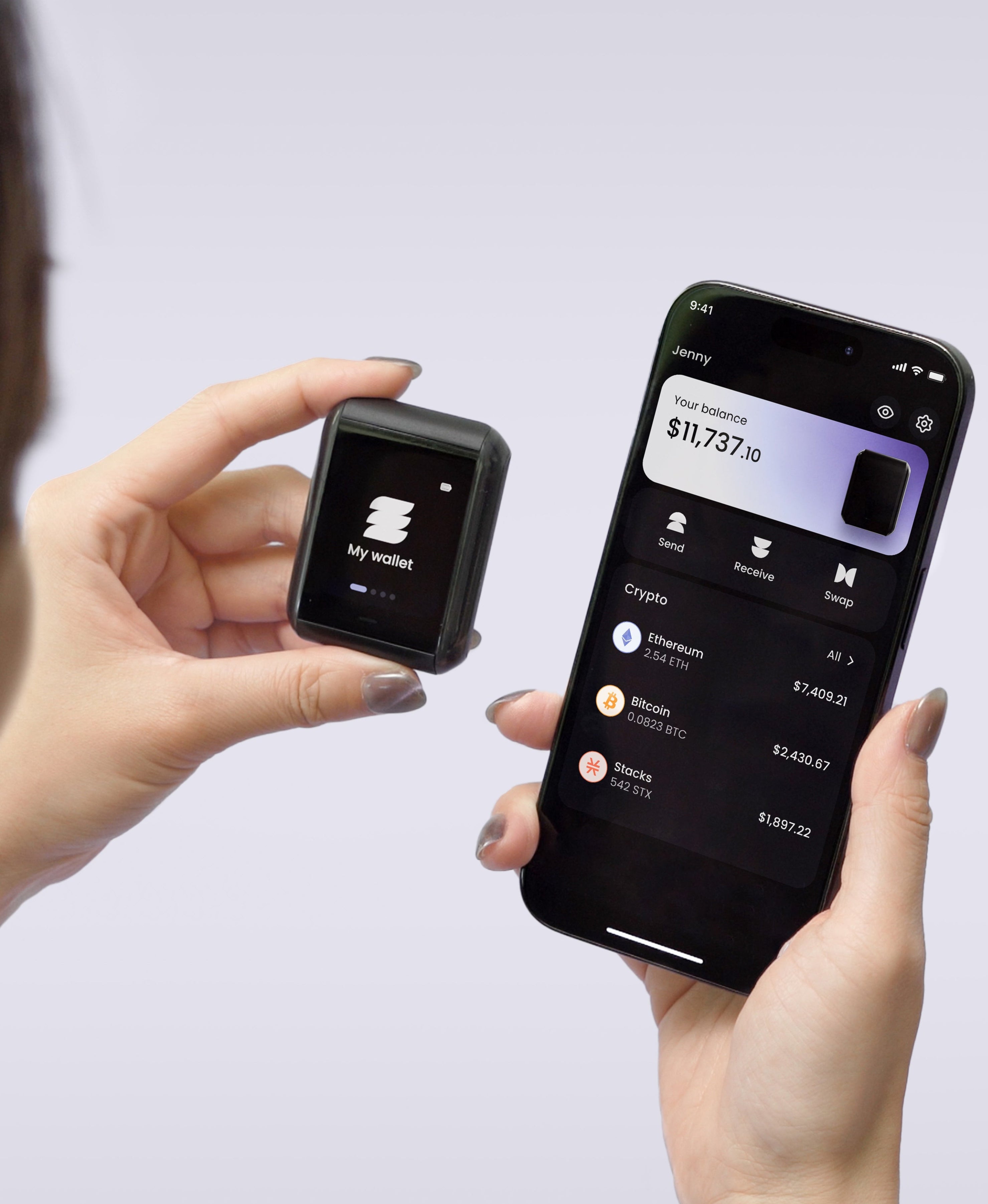
The Ryder One is built so that the question comes up less often. Keys are generated inside an EAL6+ certified Infineon SLC38 secure element and never leave it, the device communicates over NFC only with no Bluetooth, no Wi-Fi and no cable data path, and the signing button is wired straight to the secure element so nothing in software can approve a transaction by itself. Each transaction appears in readable detail on the 1.6-inch AMOLED screen before you confirm it, and on-device address verification is there to catch the substituted destination that clipboard attacks rely on. Halborn audited the firmware independently and the report is public. It costs 149 USD for the Starter Combo and 179 USD for the Super Safe Combo.
Recovering stolen cryptocurrency is a long shot on a short clock, and the people who get their money back are mostly the ones with a legal department behind the request. Building a setup where the question never comes up is the cheaper plan. Get your Ryder One.


Share: