

Search for a decoy wallet and half of what comes back is a leather billfold stuffed with expired cards, sold to travellers who expect to be pickpocketed. The crypto version borrows the same idea and applies it to keys: you keep a small balance somewhere an attacker can find, so that handing it over ends the encounter before anybody starts asking about the rest. Whether it works comes down to details that most guides skip past.
How a decoy wallet works
The mechanism is older than the marketing around it. Your seed phrase is a list of 12 or 24 words that restores one wallet, and the BIP-39 standard also allows an optional passphrase, often described as a 25th word. Add a passphrase to those same words and they restore a different wallet with different addresses and a different balance, while the words on their own still open the first one.
Two wallets come out of one backup. The passphrase-free wallet holds a modest amount and does the work of the decoy, and the passphrase wallet holds what you are keeping. Somebody who takes your device and your written words gets the first one and finds nothing pointing at the second, because the second leaves no mark on the device or in the word list.
What a decoy wallet is meant to protect you from
The threat has a name the industry borrowed from a comic strip: the wrench attack, where an attacker skips the cryptography and applies pressure to the person holding the keys. Jameson Lopp has kept a running catalogue of these incidents for more than a decade, and his list recorded roughly 70 assaults on crypto holders during 2025, which works out at more than one a week and almost certainly undercounts the total.
One case reached the industry itself. Ledger co-founder David Balland and his partner were abducted from their home in central France in January 2025, and France 24 reported that the kidnappers demanded a large ransom in cryptocurrency and sent a video of a severed finger to a second co-founder before the GIGN tactical unit freed them both inside about 48 hours. Part of the ransom was paid, and French authorities later said almost all of it had been traced and frozen.
Where the idea breaks down
A decoy only helps if the person holding the wrench decides to stop, and four things tend to decide that.
Credibility comes first. A wallet created last week with one round-number deposit reads as staged to anyone who has seen a wallet before, so the decoy needs months of small transactions behind it and a balance somebody would believe you keep on a device day to day.
Then there is what the attacker already knows. If they chose you because your address was tied to your name on-chain, because a vendor leaked their customer list, or because you talked about a good year at a dinner table, they arrived with a figure in mind and a reason to keep asking.
The third problem has no technical fix: you cannot demonstrate the absence of a second wallet. Every honest person in that situation sounds exactly like a person hiding something, and the attacker decides which one you are.
Finally, the passphrase feature is public knowledge, documented openly by every major vendor, so a prepared attacker knows to ask whether one exists. Forgetting it carries its own cost, since a passphrase wallet has no recovery path at all: lose those characters and the coins behind them stay where they are forever.
Setting one up without fooling yourself
Fund the decoy with an amount you would be unhappy to lose, because an attacker weighing whether to believe you is reading your reaction as much as the number on screen. Spend from it through the year so the history looks like a wallet somebody uses, and keep the passphrase in a separate place from the words it modifies, since storing them together collapses the two wallets back into one. It also helps to decide in advance what you would say, rather than improvising it under pressure.
Most of the value, though, sits upstream of any of this. Attackers pick targets from information that was available to them, so the habits that keep your holdings out of public view do more work than a clever wallet arrangement does.
What your backup has to survive
Any setup you build has to answer a plainer question: what happens when one thing goes wrong on an ordinary day. Paper burns and fades. Steel plates handle fire and water and are the sensible upgrade from paper, though the underlying problem stays where it was, because one object still hands full access to whoever reads it and total loss to you if it vanishes. A decoy arrangement adds a second secret on top of that single object and gives you two ways to be locked out instead of one.
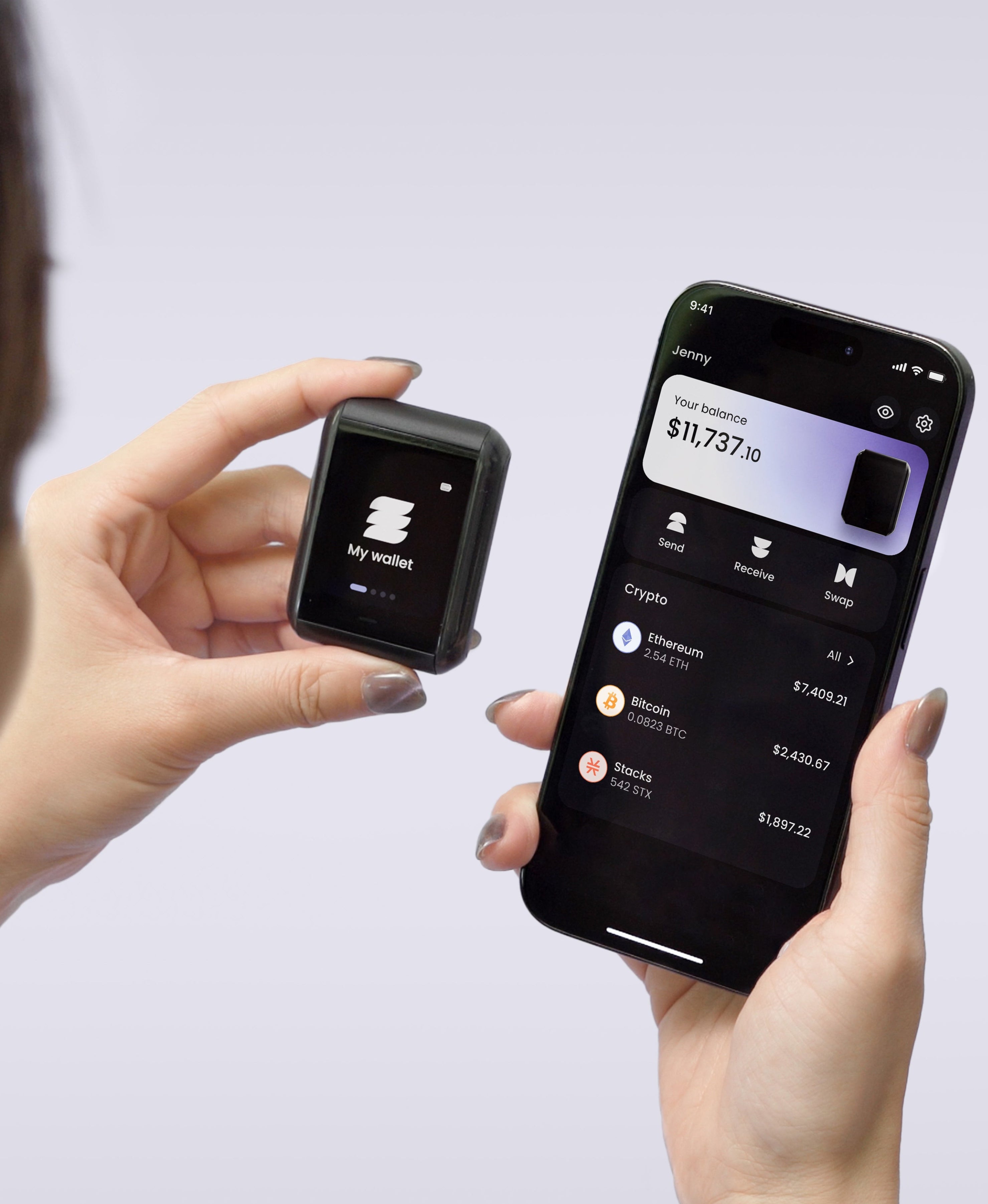
TapSafe Recovery removes the single point of failure rather than stacking another secret on it. The Recovery Tag carries half of what a recovery needs, and your paired phone carries the other half, encrypted in your own iCloud or Google Drive rather than stored on the handset, so replacing a phone costs you nothing. Both halves together restore the wallet, and either one alone reveals nothing. Optional Recovery Contacts hold a quarter share each and can see no balances or addresses. Your seed phrase stays reachable on the device as a last resort under the BIP-39 standard, so you are never tied to one manufacturer.
Where that leaves you
A decoy wallet is a reasonable layer for somebody whose holdings are already known to people outside their household, and it is close to useless as a substitute for keeping quiet about what you own. Treat it as the last item on the list rather than the first, and be clear-eyed that it manages a conversation with an attacker instead of preventing one.
Ryder One is 149 USD for the Starter Combo, and the Super Safe Combo is 179 USD. Private keys are generated inside an EAL6+ certified Infineon SLC38 secure element and never leave the chip, the device talks over NFC only with no Bluetooth, no Wi-Fi and no wired data path, and every transaction is shown in readable detail on a 1.6-inch AMOLED touchscreen before you approve it. The firmware has been audited by Halborn, with the full report published.
Meta description: A decoy wallet hands an attacker a small balance so they stop looking. What the passphrase trick does, where it breaks down, and what it cannot protect.


Share: