

Most hardware wallets end setup the same way. The screen shows you twelve or twenty-four words, you copy them onto a card, and from that moment everything you own rests on where that card ends up. The Cypherock X1 opens from a different position, and whatever you conclude about the device itself, the question sitting underneath it is one more wallet makers should be asking.
How the Cypherock X1 splits your key
Five components carry the secret. There is the X1 Vault, which is the part with the screen and the buttons, and there are four X1 Cards that sit against it and communicate by tap. Your key gets generated once and then cut into five pieces using Shamir's Secret Sharing, a method that divides a secret so that a set number of pieces can rebuild it while anything below that number gives away nothing. The vault keeps one piece and the cards carry the other four, and the design assumes you will scatter them: a drawer at home, a relative's house, a deposit box, anywhere a single fire or burglary cannot reach all of them in one go.
The threshold is two. Cypherock's documentation sets out why the default is 2 of 5, which in practice means either the vault plus one card, or two cards between them, will reconstruct the wallet. Three of the five components can go missing and you still get your coins back.
What that buys, and what it costs
Measured against a card of words in a drawer, the gain is easy to see. No single object ends the wallet when it burns, and no single object hands the wallet over when someone finds it. A flood, a house move, a curious guest in the spare room: each of those turns from an ending into an inconvenience you route around using the pieces you still hold.
The cost lives in the same number. Two of five is a low bar for a thief as much as for the owner, and Decrypt's reviewer put the objection plainly, pointing out that plenty of people will keep the vault and one card together because that pairing is what you need in hand to sign anything. Do that and the five-way split folds back into one location, which is the exact situation the product exists to escape. Raising the threshold to three of five would make that mistake harder to commit, and it would also make ordinary Tuesday-afternoon use harder to tolerate.
What "seedless" leaves out
Cypherock's marketing leans hard on the absence of a recovery phrase, and the device is more careful than the marketing is. The same review confirms that you can view and export a BIP-39 seed phrase from the X1 if you want a paper copy, and that the vault doubles as a holding place for phrases imported from other wallets, with four slots to fill.
Keeping that door open is the correct call, because a wallet you cannot leave is a wallet you are trapped inside. It does mean the older failure mode remains available to anyone who chooses it. Export the phrase, write it down, leave it in the safe next to the vault, and the architecture goes back to protecting one piece of paper.
The chip, the audits, and the screen
On hardware, the X1 uses a Microchip ATECC608 secure element, and Decrypt's teardown notes that earlier units shipped the ATECC608A with current batches moving to the 608C. Cypherock says the device was security audited by Keylabs and scrutinised by WalletScrutiny, and the firmware is open for inspection. That is a defensible position for a smaller manufacturer, and it deserves crediting rather than glossing over.
Two practical notes from people who have used one. The OLED display is dim enough that outdoor use is awkward. And the tapping choreography, vault against card, card back into its pouch, takes longer than a single-device flow, which is the price the split model charges every time you sign.
How to judge any split backup
The question worth carrying into any wallet with a split-recovery story is where the pieces end up in a normal life, since a scheme that is elegant on a whiteboard can collapse in a kitchen drawer. Ask how many pieces you must physically handle, whether the default arrangement encourages you to store two of them together, and what the system does when a piece is lost rather than what it does when everything is in place.
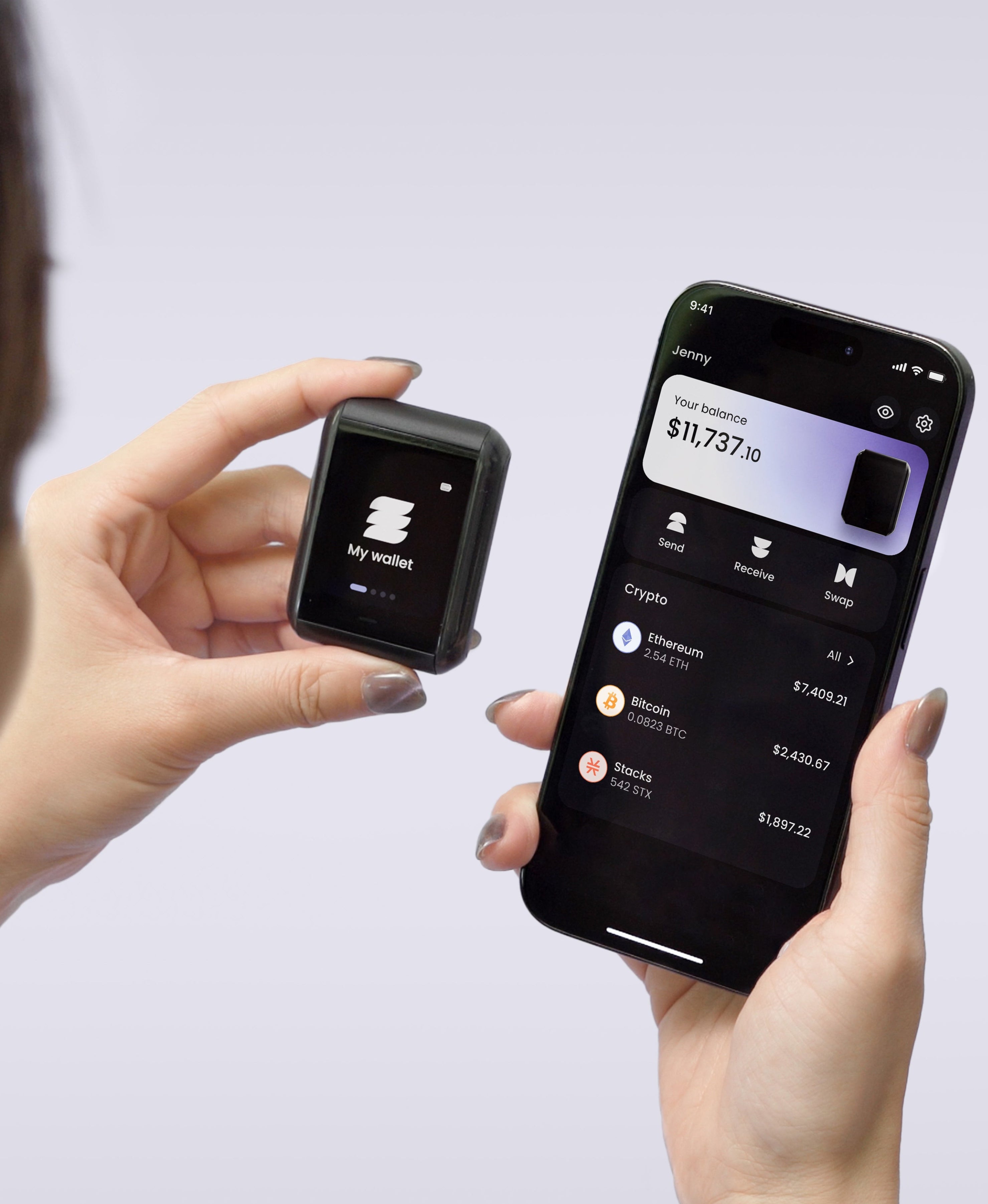
TapSafe Recovery answers those questions differently. Recovery on Ryder One runs through a custom implementation of Shamir's Secret Sharing where half sits on the Recovery Tag and half sits as an encrypted share in your iCloud or Google Drive, so one of the two pieces is somewhere a burglar cannot walk out with. Recovery Contacts can each hold a quarter, and they never see anything about your balances. There is nothing to shuffle and nothing to scatter by hand, because the split happens during a setup that takes under a minute. Your seed phrase stays readable on the device under the BIP-39 standard when you want it, so leaving is always an option.
Which one fits which person
Someone who enjoys the ritual of custody, who has four sensible places to put four cards and will keep them separate for a decade, will get what they came for from the X1. It is a thoughtful device from a team that identified the right problem years before most of the market did.
Someone who wants the same protection without running a filing system will find the manual version harder to sustain, because backup plans decay quietly and nobody notices until the day they are needed. That is the gap Ryder One is built for: an EAL6+ Infineon secure element, NFC-only communication with no other radios to worry about, firmware audited by Halborn, and a split recovery that sets itself up. It is 149 USD for the Starter Combo and 179 USD for the Super Safe Combo, which ships with three Recovery Tags. Take a look at the device.
Meta description: The Cypherock X1 splits your key across five cards with a 2-of-5 threshold. What that protects, where the design leaks, and what to ask of any split backup.


Share: