

For most of the last decade the crypto debit card was a novelty that worked badly, cost too much, and got cancelled when the issuing partner changed its mind. That stopped being the case somewhere around 2025. The volume is now large enough to show up in payment industry reporting, the card programs are numerous enough that choosing between them takes research, and the interesting question is no longer whether these cards work. It's what has to happen to your coins before you can tap one.
The category got big while nobody was watching
Spark's research on the stablecoin card market, published 6 July 2026, puts cumulative crypto card transaction volume at 7.8 billion dollars through May 2026, with monthly spend reaching 656 million dollars in May and monthly volumes growing around 230% year over year.
Visa carries most of it. Roughly 90% of crypto card transactions run on Visa rails, across more than 130 stablecoin card programs in over 50 countries, and Visa's own stablecoin settlement hit a 7 billion dollar annualised rate by April 2026 after climbing 50% in a single quarter. On settlement currency the split is lopsided in a way that surprises people who follow US policy debates: about 72% of card payment volume settles in USDT and roughly 18% in USDC.
How a crypto debit card works
The merchant never sees crypto. When you tap, the card network authorises a fiat transaction the way it would for any debit card, and the card programme converts your crypto or stablecoin balance into fiat to fund it. The conversion happens in the background, at a rate and a spread the programme sets.
That mechanism is why the custody question exists. Something has to be able to move your funds at the instant of purchase, in under a second, without asking you to sign anything on a device in your other pocket.
Custodial and self-custodial cards work differently
Two models have emerged, and the difference matters more than the cashback rate.
Custodial cards ask you to deposit funds with the provider first. Coinbase Card, Crypto.com, and KAST work this way. Your balance sits with the company, the company converts and settles when you spend, and the experience is smooth because the provider controls both sides of the transaction. What you've done is move coins from your own keys to someone else's, which is the same arrangement as leaving funds on an exchange, with a card attached.
Self-custodial cards keep the funds in a wallet you control and pull from it at the moment of purchase. Gnosis Pay is the most established example, issuing a Visa debit card in Europe that spends EURe, GBPe, and USDce stablecoins directly from a Safe smart account on Gnosis Chain. Holyheld runs a comparable model. Your keys stay yours, and the card contract has permission to draw against a specific account when you tap.
The trade-off is honest in both directions. Custodial cards are easier, usually cheaper, and available in more countries. Self-custodial cards keep you in control and typically ask you to keep a working balance in a hot smart account, which is a different exposure rather than no exposure. A smart account connected to a card contract is online by design.
The tax detail almost nobody mentions
In the United States, spending crypto is a disposal. Buying coffee with Bitcoin is a taxable event, and you owe capital gains on the difference between what you paid for that Bitcoin and what it was worth when you spent it, per the IRS guidance on virtual currency transactions.
Stablecoins soften this considerably, since a dollar-pegged token spent at roughly the price you acquired it produces little or no gain. That's a large part of why the market shifted from "crypto cards" to "stablecoin cards" over the past two years, and it's worth understanding before you fund a card with appreciated Bitcoin and generate a hundred small tax lots.
What belongs on a card and what belongs in cold storage
The sensible arrangement mirrors how people already use bank accounts. You keep a spending balance where it can move quickly and accept that it carries provider risk or hot-wallet risk, and you keep savings somewhere that neither applies.
Card balances should be small enough that losing one would annoy you rather than hurt you. Whatever you'd be upset to lose belongs off the card, off the exchange, and under keys you hold. That second category is where backup becomes the whole question, because coins you can't recover are coins you don't have, and the standard twelve words on a card leave your access resting on one object staying private and intact for as long as you hold crypto.
TapSafe Recovery distributes that instead of concentrating it. Your Recovery Tag carries 50%, your paired phone carries 50% encrypted into your own iCloud or Google Drive rather than sitting on the handset, and optional Recovery Contacts hold 25% each while learning nothing about your wallet. Nothing in that arrangement recovers your funds alone, so no single item has to survive everything.
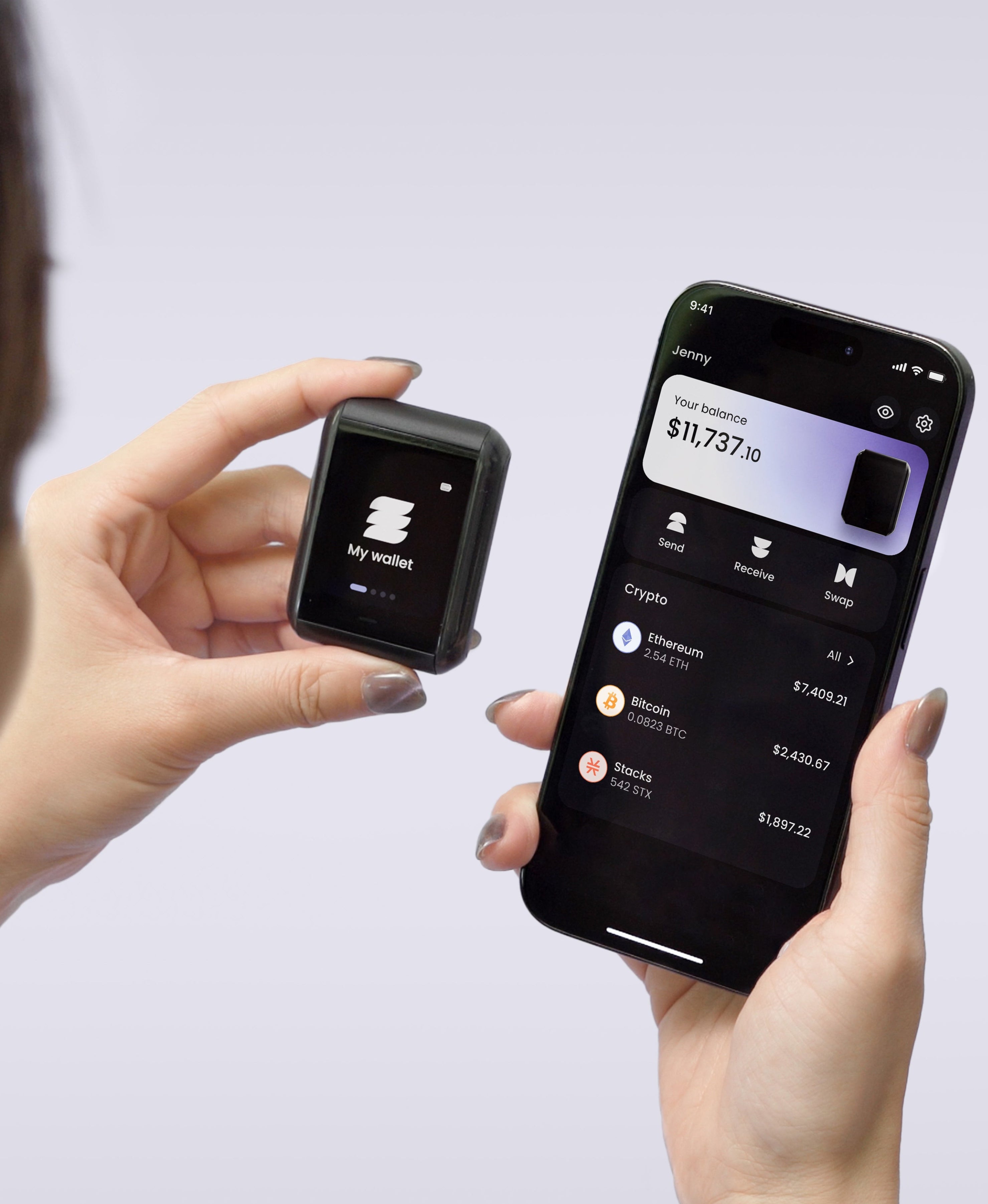
On the Ryder One, keys are generated inside an EAL6+ certified Infineon SLC38 secure element and never leave the chip, the firmware was independently audited by Halborn with the full report public, and every transaction renders in readable detail on the 1.6-inch screen before you approve it. Communication runs over NFC and nothing else, so there's no Bluetooth radio and no wired data path to attack.
How to choose one
Start with where you live, because availability decides more of this than any feature list. Then check three things: what the conversion spread costs you on a typical purchase, whether the provider holds your balance or draws from your wallet, and what happens to your funds if the programme shuts down, which has happened repeatedly in this market.
Cashback belongs last on that list. A 2% reward on a card whose issuer freezes withdrawals is worth nothing, and the history of this category has more discontinued programmes than surviving ones.
Spend from a card, hold the rest yourself. Get your Ryder One.
Meta description: Crypto debit cards in 2026: how they work, custodial vs self-custodial models, the US tax catch, and how much to keep on a card versus in cold storage.


Share: