

Citigroup said on 18 August 2026 that it expects to go live with bitcoin custody before the end of the year, built on a new platform called Custody+. For anyone who has spent a decade hearing that banks would never touch this asset, the announcement lands as a milestone. It's worth reading closely, because bank custody answers a question most individual holders aren't asking, and the arrangement underneath it differs from holding a key in ways that matter.
What Citi announced
The bank is starting with bitcoin and aiming custody at institutional clients, with traditional securities and crypto held inside one framework. Amit Agarwal, who heads custody at Citi Investor Services, described Custody+ as the product of a multi-year commitment to building infrastructure that matches the speed of client strategies. It sits alongside Citi Token Services, which moves tokenized deposits around the clock across selected markets, and the bank says more than 80% of its asset-servicing transaction volume now clears in real time.
None of this came out of nowhere. Citi had already signalled plans for native crypto custody during 2025, and the August update mostly moved the timeline from intention toward a date.
Who the product is for
Read the client list and the picture clarifies. This is institutional custody: asset managers, funds, corporate treasuries, and the kind of client that already holds equities and bonds with Citi and wants bitcoin recorded the same way. Institutions have obligations that make a bank the correct answer, including auditor requirements, fiduciary duties, insurance mandates, and internal controls that forbid a portfolio manager from carrying keys around.
An individual holder has none of those constraints. Nobody audits your household, no regulator asks who countersigned your transfer, and the reasons that make bank custody sensible for a pension fund don't transfer to a person holding savings.
What custody means legally
Here's the part worth sitting with. When a bank holds bitcoin for you, the bank controls the keys and you hold a claim. The arrangement is contractual: you have an entry in an account, terms describing how and when it converts back into an asset you control, and a legal position that depends on the institution honouring it.
Most of the time that works fine, and the exceptions are instructive. Withdrawals can be paused during operational incidents. Accounts can be frozen following a court order or a sanctions designation. Assets held by a custodian can be caught in the institution's own insolvency proceedings, which is where the distinction between segregated client assets and general balance sheet assets stops being academic and starts determining who gets paid.
The failures people remember make the point without much help from me. FTX customers were owed roughly 8 billion USD, and Binance paid 4.3 billion USD to settle with the Department of Justice in 2023 over anti-money-laundering and sanctions failures. A regulated global bank carries far better controls than either. It still operates on the same structure, where your holding is a promise from a company rather than a key in your possession.
The case for banks entering anyway
Institutional custody arriving is good news, and it's worth saying why. Pension funds and treasuries cannot hold bitcoin without a custodian that satisfies their auditors, so this unlocks demand that has been sitting on the sidelines. More institutional participation tends to mean deeper liquidity and steadier infrastructure for everyone, including people who never touch a bank product.
What it doesn't do is change the calculation for someone holding their own savings. Bitcoin's design already lets you hold the asset directly, and paying an intermediary to hold it reintroduces the counterparty that the asset was built to remove.
Keeping your own keys without the burden
The honest objection to self-custody has always been the recovery problem: one seed phrase, written down once, carrying the entire wallet forever. That model asks an ordinary person to run a small archival operation with no margin for error.
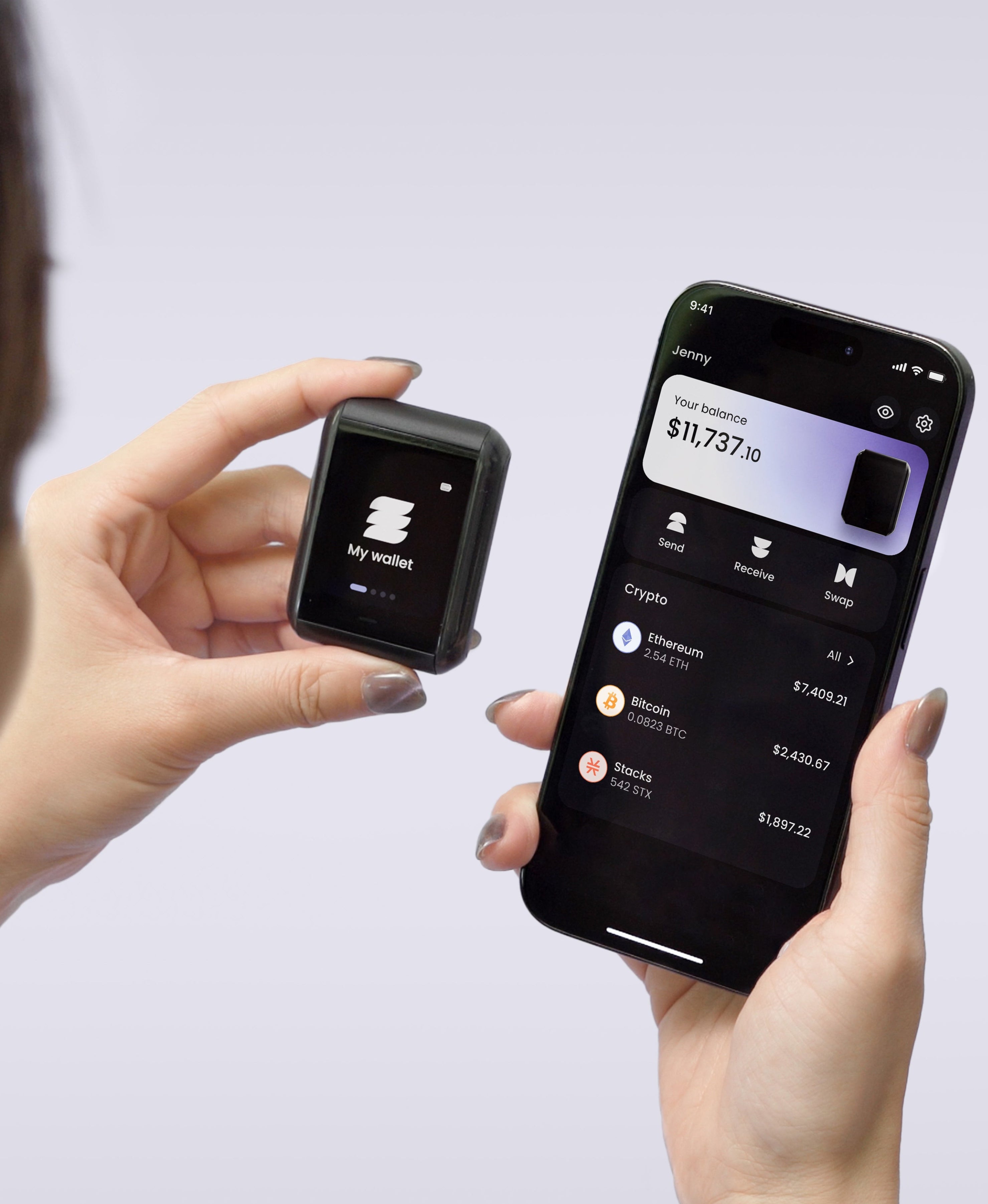
We built TapSafe Recovery to remove that concentration. Restoration splits across pieces, with your Recovery Tag holding 50%, your paired phone holding the other 50% encrypted into your own iCloud or Google Drive instead of on the handset, and optional Recovery Contacts holding 25% each without any view of your wallet. Two pieces bring the wallet back, one piece discloses nothing, and losing a component is a replacement task rather than the end of your holdings. The seed phrase remains available on the device as a last resort under the BIP-39 standard, so you can restore into other hardware whenever you choose.
The Ryder One generates keys inside an EAL6+ certified Infineon SLC38 secure element that they never leave, with firmware independently audited by Halborn and the report published in full. Transactions render in readable detail on the 1.6-inch AMOLED screen before you approve them, communication runs over NFC alone, and setup takes about 60 seconds across three taps. The Starter Combo is 149 USD and the Super Safe Combo is 179 USD.
Citi holding bitcoin for a pension fund is a sign the asset has arrived. Your own savings can skip the intermediary entirely, which was the point from the beginning.
Hold the asset itself. Get your Ryder One.
Meta description: Citi will launch bitcoin custody in 2026 under Custody+. What bank custody gives institutions, what it means legally, and why individuals can skip it.


Share: