

Searches for Blockstream Jade climbed sharply this month, and the reason isn't hard to trace. After a firmware flaw in a rival device drained roughly 1,816 BTC from more than 5,200 addresses, a lot of people started shopping for a replacement wallet, and Jade is one of the first names they land on. If you're weighing it against the Ryder One, the two devices turn out to be built on different assumptions about what a wallet should be, so the better question isn't which is stronger overall. It's which set of trade-offs matches the way you hold your crypto.
We make one of these two, so read this with that in mind. We've tried to describe Jade the way its own engineers would.
What Blockstream Jade gets right
Jade comes from Blockstream, a company with deep roots in Bitcoin infrastructure, and the device reflects that focus. It ships in two versions: the Jade Core at 99.00 USD and the Jade Plus at 169.99 USD. Both are fully open-source, hardware and firmware alike, which means anyone can read the code that handles your keys and check the manufacturer's claims against it. For a certain kind of owner that transparency is the whole argument, and it's a fair one.
The device runs a 1.9-inch colour IPS display at 320x170, connects over a wired USB port and Bluetooth, and supports air-gapped operation so you can sign transactions without ever plugging in. The Plus model adds a camera for QR-based air-gapped signing, an SD card slot, and a battery; the Core has neither camera nor battery. Jade handles Bitcoin and Liquid.
Best for: Bitcoin-only holders who want open-source code they can audit themselves, and who don't mind managing a seed phrase the traditional way.
Worth knowing: Jade's security model uses what Blockstream calls a virtual secure element, where key material is encrypted and protected through a blind oracle rather than sealed inside a dedicated certified chip. That's a deliberate design choice, made to avoid depending on a proprietary component nobody outside the vendor can inspect, and it comes with a different risk profile than a certified secure element. Which trade-off you prefer depends on whether you trust open code or certified silicon more. Also worth noting: if you hold anything beyond Bitcoin and Liquid, Jade won't cover it.
What Ryder One gets right
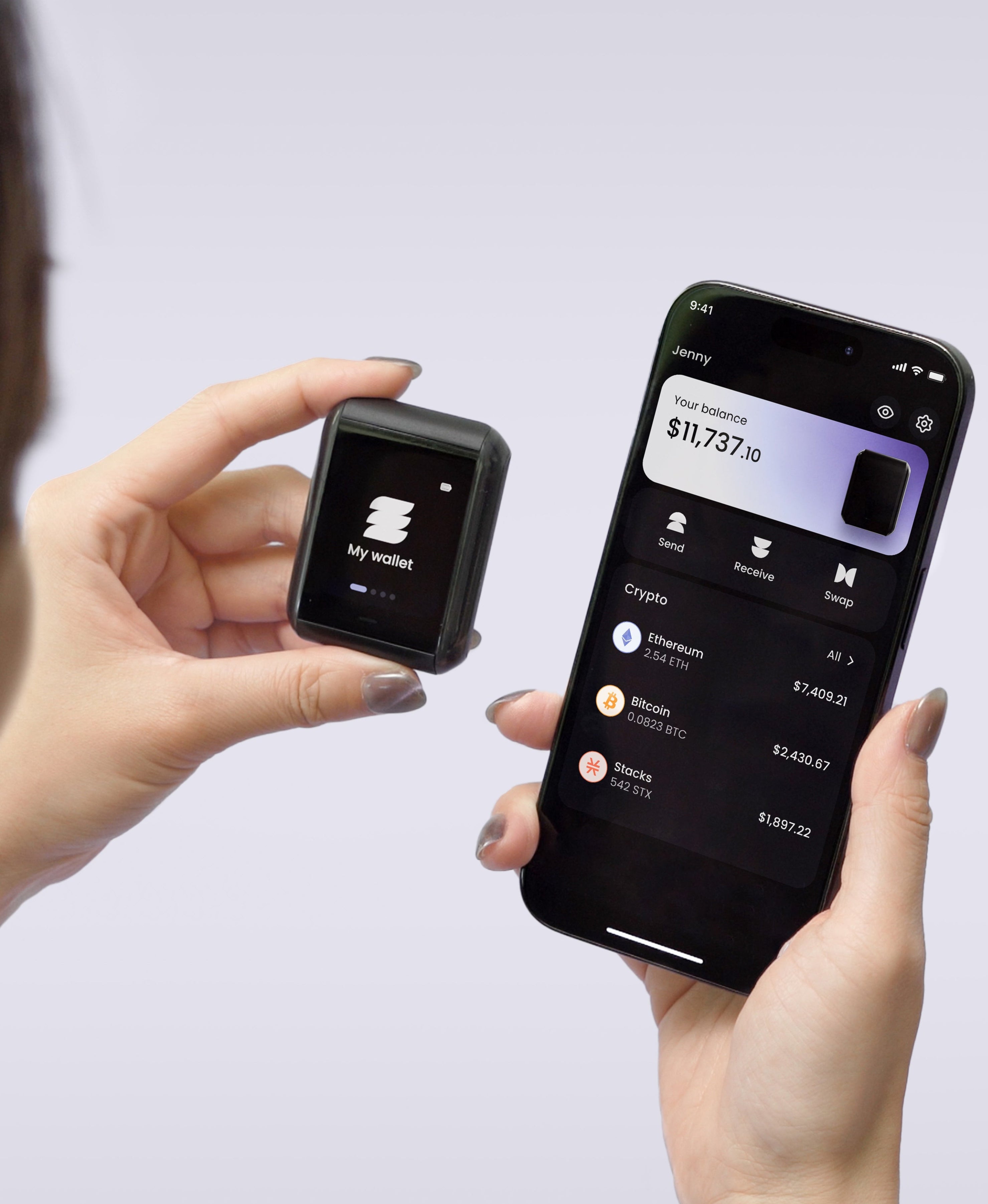
The Ryder One starts at $149.00 for the Starter Combo and $179.00 for the Super Safe Combo, which adds two extra Recovery Tags. It's a compact device at 41 x 55 x 14.5 mm, 38 grams, with a 1.6-inch AMOLED touchscreen running at 320x360, and it charges wirelessly over Qi from the charger in the box.
Keys are generated inside an EAL6+ certified Infineon SLC38 secure element and never leave the chip. The firmware has been independently audited by Halborn, and the full report is public. Connectivity is NFC only, so there's no USB data path, no Bluetooth radio, and no Wi-Fi; the device talks to your phone when you physically tap it, and stays silent otherwise. Every transaction renders in full readable detail on the screen before you approve it, and the physical confirmation button is wired directly to the secure element, so no software path can sign without your press.
Best for: People holding Bitcoin, Ethereum, Solana and major ERC-20 or SPL tokens who want recovery that doesn't rest on a single written phrase.
Worth knowing: It has a battery, so it needs charging, and the coin list is narrower than a general-purpose wallet aimed at long-tail altcoins.
Side by side
| Blockstream Jade Core | Blockstream Jade Plus | Ryder One | |
|---|---|---|---|
| Price | 99.00 USD | 169.99 USD | $149.00 (Starter), $179.00 (Super Safe) |
| Display | 1.9" IPS LCD, 320x170 | 1.9" IPS LCD, 320x170 | 1.6" AMOLED touch, 320x360 |
| Connectivity | Wired USB, Bluetooth | Wired USB, Bluetooth, SD card | NFC only |
| Air-gapped signing | Yes | Yes, with camera and QR | Yes, NFC tap |
| Key storage | Virtual secure element | Virtual secure element | EAL6+ Infineon SLC38, keys generated in-chip |
| Battery | No | Yes | Yes, 200 mAh, Qi wireless charging |
| Open source | Yes, hardware and firmware | Yes, hardware and firmware | Firmware audited by Halborn, report public |
| Assets | Bitcoin, Liquid | Bitcoin, Liquid | Bitcoin, Ethereum, Solana, major ERC-20 and SPL tokens |
| Backup model | Seed phrase | Seed phrase | TapSafe Recovery, seed phrase available on-device |
The part most comparisons skip: what happens when you lose it
Specs are easy to line up in a table. Recovery is where the two devices diverge most, and it's the part that decides whether a bad day costs you an afternoon or costs you everything.
Jade uses the standard model. You write down a seed phrase during setup, you store it somewhere safe, and that piece of paper or metal becomes the thing your crypto depends on. Every wallet using this model inherits the same structural property: one object, holding everything, and it has to survive fire, flood, theft, house moves, and your own memory of where you put it. Plenty of people manage this well. Plenty of others discover the gap years later, at the worst possible moment.
Ryder One splits recovery instead of concentrating it. TapSafe Recovery distributes your backup across a Recovery Tag that holds 50% and your paired phone that holds the other 50%, with the phone's share stored encrypted in your iCloud or Google Drive rather than on the handset itself. Losing the phone doesn't lose the share. Bring the tag and the phone together and you're at 100%. You can optionally add Recovery Contacts, people you trust who each hold 25% and can see nothing about your wallet, set up in person by NFC tap. Underneath it runs on a custom implementation of Shamir's Secret Sharing.
The seed phrase doesn't disappear. It stays accessible on the device as a last resort and follows the BIP-39 standard, so you're never locked to our hardware and you can walk your keys to another wallet whenever you want. What changes is that you're no longer forced to depend on it in normal use.
So which one should you buy
If you hold Bitcoin and nothing else, if reading the source code yourself is something you'd sit down and do rather than something you'd like to be able to do, and if you're comfortable running a traditional seed phrase backup, Jade earns its place. The Core at 99.00 USD is one of the cheaper ways into real cold storage, and Blockstream has been building in this space for a long time.
If your holdings run across Bitcoin, Ethereum and Solana, if you'd rather tap a device than plug one in, and if the thought of your entire portfolio resting on one hidden object bothers you, the Ryder One answers a different question. Certified silicon generating keys that never leave the chip, a public third-party audit, no radio that isn't NFC, and recovery that survives losing any single piece.
Neither device makes the decision for you. But the wallet you'll still be using in five years is usually the one whose failure modes you can live with, so pick against those rather than against the spec sheet.
Ready to hold your keys without betting everything on one piece of paper? Get your Ryder One.
Meta description: Blockstream Jade vs Ryder One compared: price, secure element design, air-gap options, supported coins, and the recovery model that separates them.


Share: