

When BitMart announced an orderly wind-down on 26 July 2026, users had a clear if unwelcome picture: the platform was closing, and the job was getting funds out before the doors shut. Four weeks later that picture changed. On 21 August the exchange said it is developing a potential restructuring plan as an alternative to a full wind-down, with certain operations possibly resuming in phases, and for anyone whose balance is still on the platform, that shift carries a meaning worth understanding.
What changed in four weeks
The original notice halted new registrations and deposits and progressively restricted trading, with trading due to cease altogether on 26 August 2026 at 01:00 UTC. BitMart has since appointed White & Case as restructuring counsel to advise on an alternative plan, one that could involve resuming some operations in phases alongside distributions to creditors.
The company has committed to a further roadmap update no later than 9 September 2026, which is expected to cover which operations could restart, the jurisdictions involved, how any creditor distribution would work, how claims get identified, and where funding for a restarted business would come from. Until that lands, users are left weighing whether a restructuring leaves them better off than the wind-down would have.
The word that changed everything
Read the language carefully and one term does most of the work: creditors. A distribution to creditors is a different event from a withdrawal.
When you withdraw, you're taking property the platform holds on your behalf, and the transaction requires nothing beyond the platform functioning. When you receive a distribution as a creditor, you're being paid a portion of what a restructuring process determines you're owed, on a timeline set by advisers and courts, in an order that ranks claims against each other. Secured creditors typically sit ahead of unsecured ones, professional fees come out of the estate before anybody else gets paid, and customers usually discover where they rank only once the process is underway.
That reclassification happens without you agreeing to it. Your balance looked identical on the screen the day before the announcement and the day after, and its legal character had already shifted.
Why this keeps happening
The pattern is old enough now to be predictable. An account balance at an exchange is a liability the company owes you, backed by whatever assets it holds and by its willingness and ability to pay. While things run normally the abstraction is invisible, because withdrawals clear and the number behaves like money in a drawer.
Stress makes the abstraction visible. FTX customers were owed roughly 8 billion USD when the fiction collapsed, and BitMart users are learning a gentler version of the same lesson: the platform decides whether your balance is available, and when it stops deciding in your favour, you become a line in someone's spreadsheet.
Proof-of-reserves reporting helps a little and settles less than people assume. A report shows that on-chain holdings covered customer liabilities at one timestamp, published by the company being examined. It says nothing about tomorrow, about obligations structured elsewhere, or about whether the exit door stays open when everyone reaches for it at once.
What to do if you have funds on BitMart
Practical steps first, and none of this is legal advice. Watch for the 9 September update and read the actual notice rather than summaries. Document everything now: account statements, balances, transaction history, and any correspondence, exported and stored locally where the platform cannot revoke your access to it. Register any claim through whatever process the restructuring establishes, and note the deadlines, because claims windows close and late filings tend to go badly. Where amounts are significant, talk to a lawyer who has handled insolvency rather than relying on a community thread.
Approach any message about recovering your funds as hostile until proven otherwise. Distressed users are a target list, and "recovery services" promising to retrieve locked crypto for an upfront fee are a well-worn scam that follows every collapse. Nobody legitimate needs your recovery phrase to process a claim.
The general rule this points to
Exchanges do useful work, and buying, selling, and converting all require one. The mistake is letting an account become storage by default, which happens through inertia rather than through a decision anyone consciously makes.
A simple discipline covers most of it: keep on a platform what you intend to trade in the near term, and move everything you're holding for the long run to a wallet whose keys are yours. Coins under your own key don't participate in anyone's restructuring, because there's no counterparty whose solvency they depend on.
Making that move something you can live with
The reason people leave funds on exchanges is rarely ignorance of the risk. It's the recovery burden: one seed phrase, written down once, carrying the whole wallet indefinitely, with no room for a mistake.
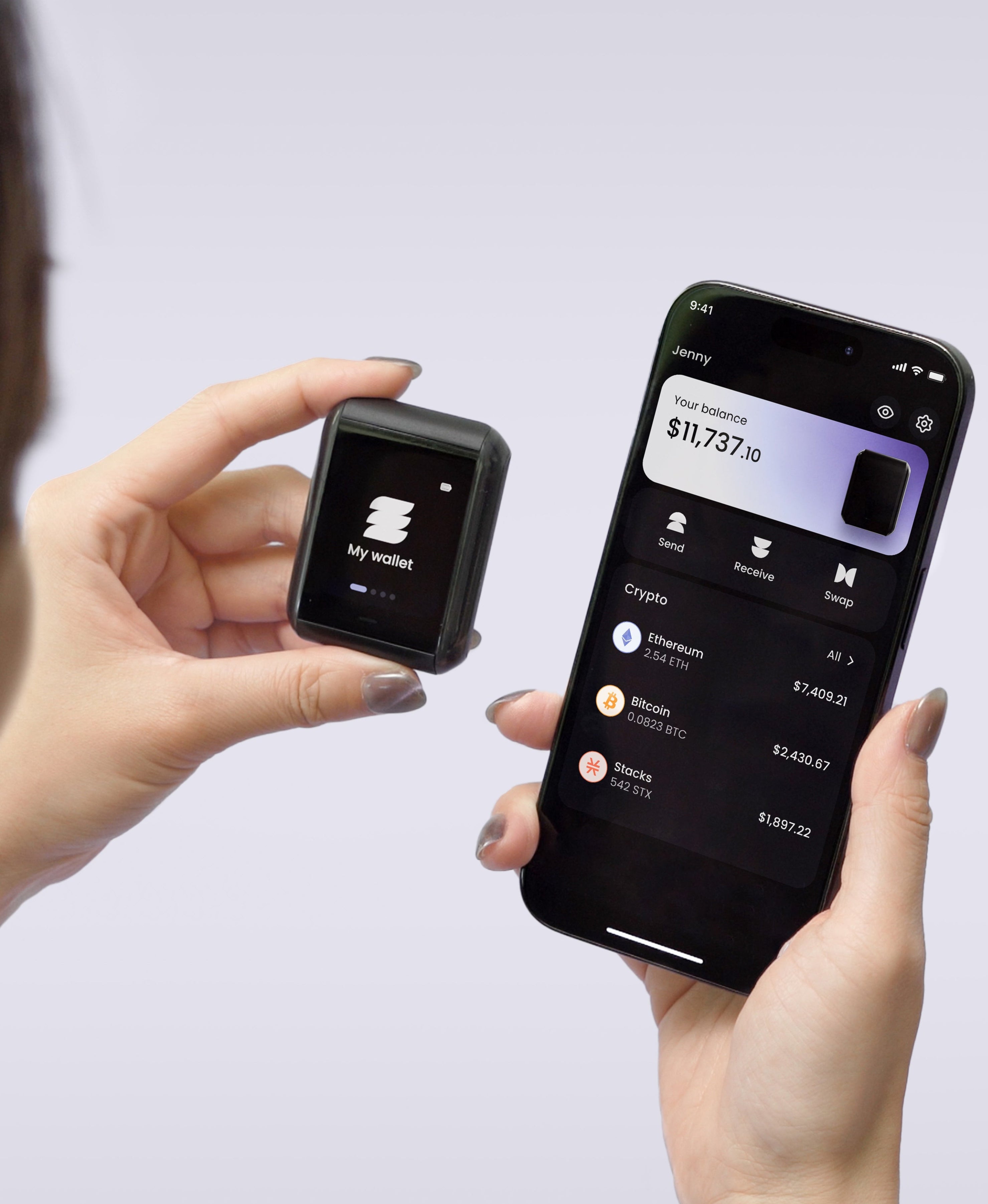
TapSafe Recovery splits that burden into pieces. Your Recovery Tag carries 50% of what a restore needs, your paired phone carries the other 50% encrypted into your own iCloud or Google Drive rather than on the handset, and optional Recovery Contacts hold 25% each while learning nothing about your wallet. Two pieces bring it back, one piece opens nothing, and a lost component becomes a replacement rather than a disaster. The seed phrase stays on the device as a last resort under the BIP-39 standard, which keeps you free to move to other hardware.
The Ryder One generates keys inside an EAL6+ certified Infineon SLC38 secure element they never leave, with firmware independently audited by Halborn and the report published openly. Every transaction shows in readable detail on the 1.6-inch AMOLED screen before you approve it, and the on-device address check catches the clipboard swaps that hit people moving funds under pressure. Setup runs three NFC taps in about 60 seconds, and the Starter Combo is 149 USD.
The BitMart update on 9 September will tell some users how much of their money is coming back. The holdings that were never in the queue are already home.
Keep your long-term coins out of anyone's restructuring. Get your Ryder One.
Meta description: BitMart is weighing a restructuring over a full wind-down. What it means when an exchange balance becomes a creditor claim, and how to avoid the queue.


Share: