

Bitcoin ran about 22% in five days in late August 2026, its strongest stretch since March 2024, and the reflex that follows a move like that is worth interrupting. Rallies pull coins toward exchanges rather than away from them, which means the moment your holdings are worth the most is often the moment they're sitting somewhere you don't control. A self-custody crypto wallet answers that, and the case for setting one up is easier to see while the price is climbing than after something breaks.
What the run looked like
The trigger was political. After President Trump convened crypto executives and regulators at the White House on 19 August and urged the Senate to pass the CLARITY Act, digital assets broke out of a months-long slump, with bitcoin settling above 77,000 USD and printing 77,864.10 USD on 21 August after an 8.3% day.
Flows followed the price. Spot bitcoin ETFs recorded 517 million USD of net inflows in a single session, a short squeeze amplified the move, and Treasury Secretary Scott Bessent's plan to expand long-term bond buybacks added a macro tailwind on top.
Where the coins went
Exchange data from the same period tells the part of the story the price chart leaves out. Binance's 45th Proof of Reserves report showed customers adding 16,349 BTC in the month to 1 August, lifting net user balances to roughly 656,644 BTC, a 2.55% increase over the July snapshot and the third consecutive monthly rise. Across those three disclosures, users moved close to 50,000 BTC onto the platform, and Bybit and OKX reported the same direction of travel.
That pattern makes sense at the level of individual decisions. Selling into strength requires the coins to be where the order book is, a rebalance is quicker when everything sits in one account, and a wallet you've been meaning to set up loses to the fear of missing an exit. Each choice is reasonable on its own, and together they concentrate a growing pile of value inside companies during the exact window when that value peaks.
What proof of reserves does and doesn't tell you
Binance's August snapshot put bitcoin and ethereum backing at 100.25%, with USDT at 103.62% and USDC at 107.64%. Numbers like those are useful, and reading them correctly matters. A proof of reserves report is a photograph of one moment, taken by the company being examined, showing that on-chain wallets covered customer liabilities at that timestamp. It says nothing about what happens tomorrow, about liabilities structured off the main ledger, or about whether you can withdraw during the hour everyone else wants to.
Brian Armstrong made the case for the CLARITY Act on CBS News on 20 August by pointing at FTX, arguing the bill "creates lots of consumer protections." He's right that supervision, capital rules, and disclosure would improve the picture. What supervision produces after a failure is a claims process, which is a queue with lawyers in it, and FTX customers were owed roughly 8 billion USD while they waited in one.
What a self-custody crypto wallet changes
Holding your own keys removes the company from the middle of the arrangement. Nobody approves your withdrawal, no maintenance window stands between you and your coins, and no counterparty's balance sheet decides whether your balance is honest. The tradeoff is that responsibility moves to you, and that tradeoff is precisely where most people stall.
The usual objection is that self-custody feels like a test you can fail. Write twelve words on paper, store the paper somewhere safe, hope you never learn what "safe enough" meant. That design puts the entire wallet into one object, and the object can burn, flood, fade, or be read by whoever opens the drawer.
A recovery model that doesn't rest on one piece of paper
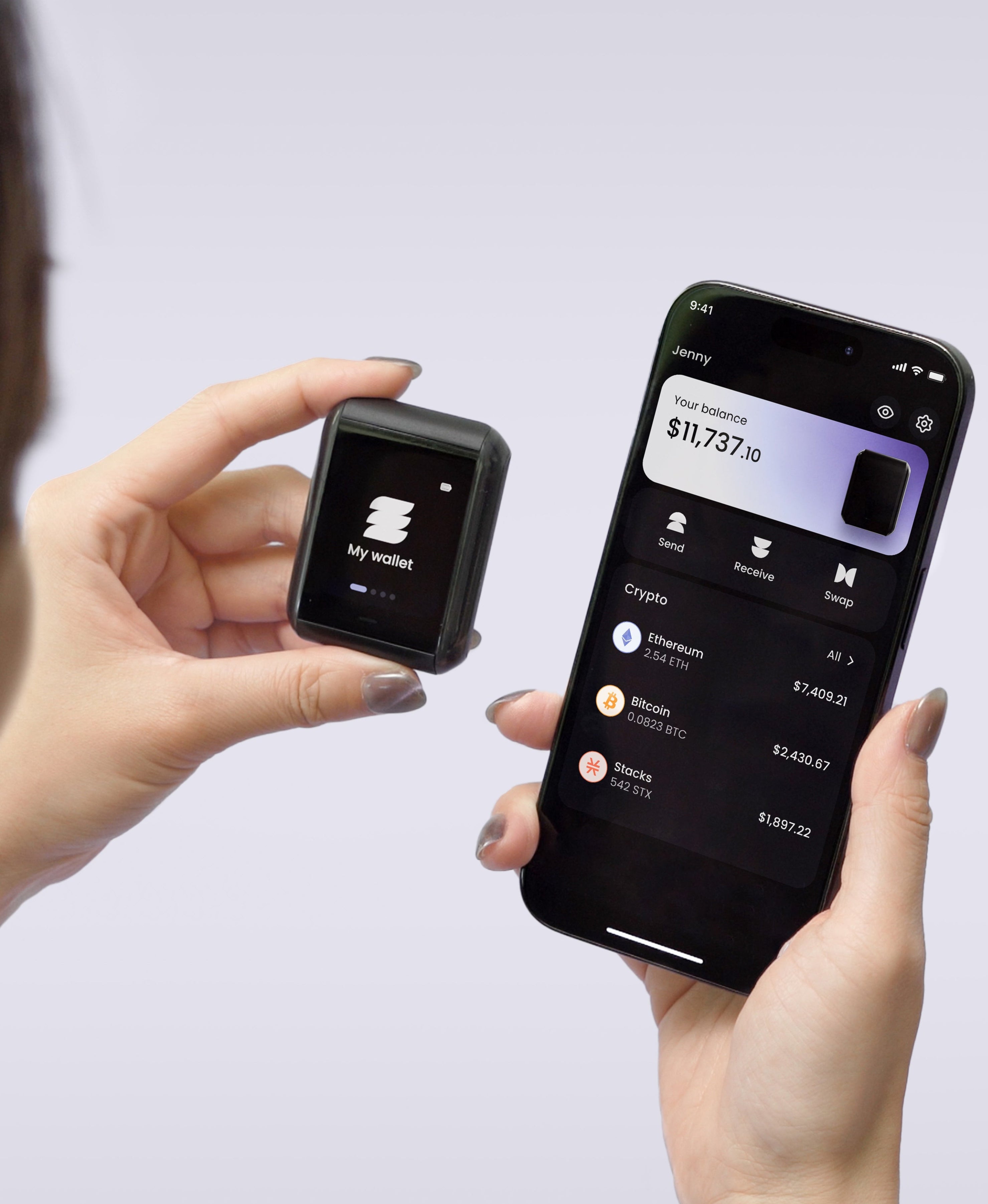
We built TapSafe Recovery so that restoring a wallet doesn't depend on any single item surviving. Your Recovery Tag carries 50% of what's needed, your paired phone carries the other 50% encrypted into your own iCloud or Google Drive instead of living on the handset, and optional Recovery Contacts hold 25% each while learning nothing about your holdings. Two pieces reunite the wallet, one piece reveals nothing, and losing a component becomes a replacement task rather than a loss.
For anyone who prefers the traditional route, the seed phrase stays available on the device as a last resort and follows the BIP-39 standard, so you can restore into other hardware whenever you want. Metal backup plates are a sensible upgrade from paper because they survive heat and water, though your recovery still hangs on one object staying both intact and unread, which is the dependency TapSafe removes.
Setting one up while the market is loud
The Ryder One takes three taps and about 60 seconds to set up: pair your phone over NFC, tap the Recovery Tag against the back, tap your phone to confirm. Keys are generated inside an EAL6+ certified Infineon SLC38 secure element and never leave it, and the firmware has been independently audited by Halborn with the report published in full.
Every transaction appears in readable detail on the 1.6-inch AMOLED screen before you approve it, so what you see is what you sign, and the receive-address check on the device defends against the clipboard swaps that catch people moving funds in a hurry. Communication runs over NFC and nothing else, with no Bluetooth radio and no wired data path. If you're importing an existing wallet, the device accepts a 12 or 24-word phrase and layers TapSafe on top of it. The Starter Combo is 149 USD with the Recovery Tag, wireless charger, and pouch included; the Super Safe Combo is 179 USD.
A rally is a poor time to discover how an exchange handles withdrawal volume, and a fine time to move the coins you intend to keep. The ones you plan to trade can stay where the order book is. The rest belong under a key that answers to you.
Move the coins you're holding for the long run. Get your Ryder One.
Meta description: Bitcoin rose 22% in five days and exchange balances climbed with it. Why a rally is the right moment to set up a self-custody crypto wallet you control.


Share: