


Key Takeaways
The seed phrase was a breakthrough in 2013. In 2026, it's the reason most people lose their crypto. These four hardware wallets let you skip it.
- Ryder One — Distributed recovery via TapSafe (Shamir's Secret Sharing), on-device AMOLED screen, NFC-only, $229. Best overall for people who want resilient recovery and independent transaction verification.
- Tangem — Card cloning with backup cards, no screen, NFC-only, ~$70. Best budget option for people who want simplicity above all else.
- Cypherock X1 — Shamir's Secret Sharing across a vault + 4 NFC cards, OLED screen, USB-C, $99–$199. Best for people who want maximum key distribution and open-source transparency.
- Bitkey — 2-of-3 multisig (device + phone + Block's server), no screen, NFC, ~$150. Best for Bitcoin-only holders who want the simplest seedless experience.
If you've been in crypto for any amount of time, you've probably heard this advice: write down 24 words, store them somewhere safe, and never lose them.
That advice isn't wrong. But it doesn't work for most people.
Over 3 million Bitcoin have been lost globally — not because of hacks, but because of seed phrase mismanagement. Paper stored in the wrong place, words written down incorrectly, backups destroyed by water or fire, or simply forgotten over the years. The seed phrase model puts the full burden of security on the user's ability to perfectly manage a piece of paper for decades. And statistically, people aren't great at that.
That's why a new generation of hardware wallets has emerged that either eliminates the seed phrase entirely or makes it optional. They use different cryptographic approaches — card cloning, Shamir's Secret Sharing, distributed key sharding — but they all share the same insight: the seed phrase is the single biggest point of failure in self-custody, and there are better ways to handle recovery.
We built Ryder One, so we're not neutral. But we've included every hardware wallet that genuinely qualifies for this list, and we've been honest about where each one is strong and where it isn't.
What "Without Seed Phrase" Actually Means
Before getting into the products, it's worth clarifying what "without seed phrase" means in practice, because not every wallet handles it the same way.
Fully seedless means the wallet never generates a seed phrase at all. Your private key exists only inside the hardware and is backed up through an alternative method, such as card cloning or key sharding. Tangem's default setup works this way.
Seed phrase optional means the wallet uses an alternative recovery method by default, but the seed phrase is still accessible if you want it. Ryder One and Cypherock X1 both work this way — TapSafe and key sharding handle recovery, but you can access the seed phrase on-device if you ever need to import into a different wallet.
Both approaches eliminate the requirement to write down and store a seed phrase. The difference is in whether you have a fallback option. For most people, "seed phrase optional" is the safer design because it gives you an exit path without forcing you to depend on one.
How We Evaluated
Not all seedless wallets are created equal. Here's what we looked at when evaluating the four wallets on this list.
Recovery resilience. What happens when you lose the device? How many components need to be compromised for someone to access your wallet? Can you add more backups over time, or are you locked into whatever came in the box? The best recovery model is one where no single component gives full access, and redundancy can grow with your needs.
Transaction verification. Does the wallet have its own screen, or does it rely on your phone? This matters because wallet drainer attacks stole nearly $494 million in 2024 by manipulating what you see before you sign. A device with an independent display is the primary defense against this.
Ease of use. How fast is setup? How intuitive is the daily workflow? Could someone new to crypto get started without a tutorial? The best security in the world doesn't help if the product is too complex for people to actually use.
Coins support. How many tokens and blockchains does it cover? Some wallets support 60+ mainstream assets, others cover 6,000+. If you hold niche tokens or work across many chains, coverage matters.
Value. Price, what's included in the box, and whether there are ongoing costs. A $70 wallet with trade-offs can be a better value than a $230 wallet for someone securing a small amount, and vice versa. We score value relative to what you get, not just the sticker price.
The Four Hardware Wallets Worth Considering
1. Ryder One

Price: $229 (includes Recovery Tag, wireless charger, travel pouch)
Recovery: TapSafe — Shamir's Secret Sharing across Recovery Tags, phone, and Recovery Contacts
Screen: 1.6" AMOLED color touchscreen
Connectivity: NFC only (air-gapped, portless)
Secure element: EAL6+ Infineon SLC38
Asset support: 60+ tokens across Bitcoin, Ethereum, Solana, Stacks
Security audit: Halborn (external, published)
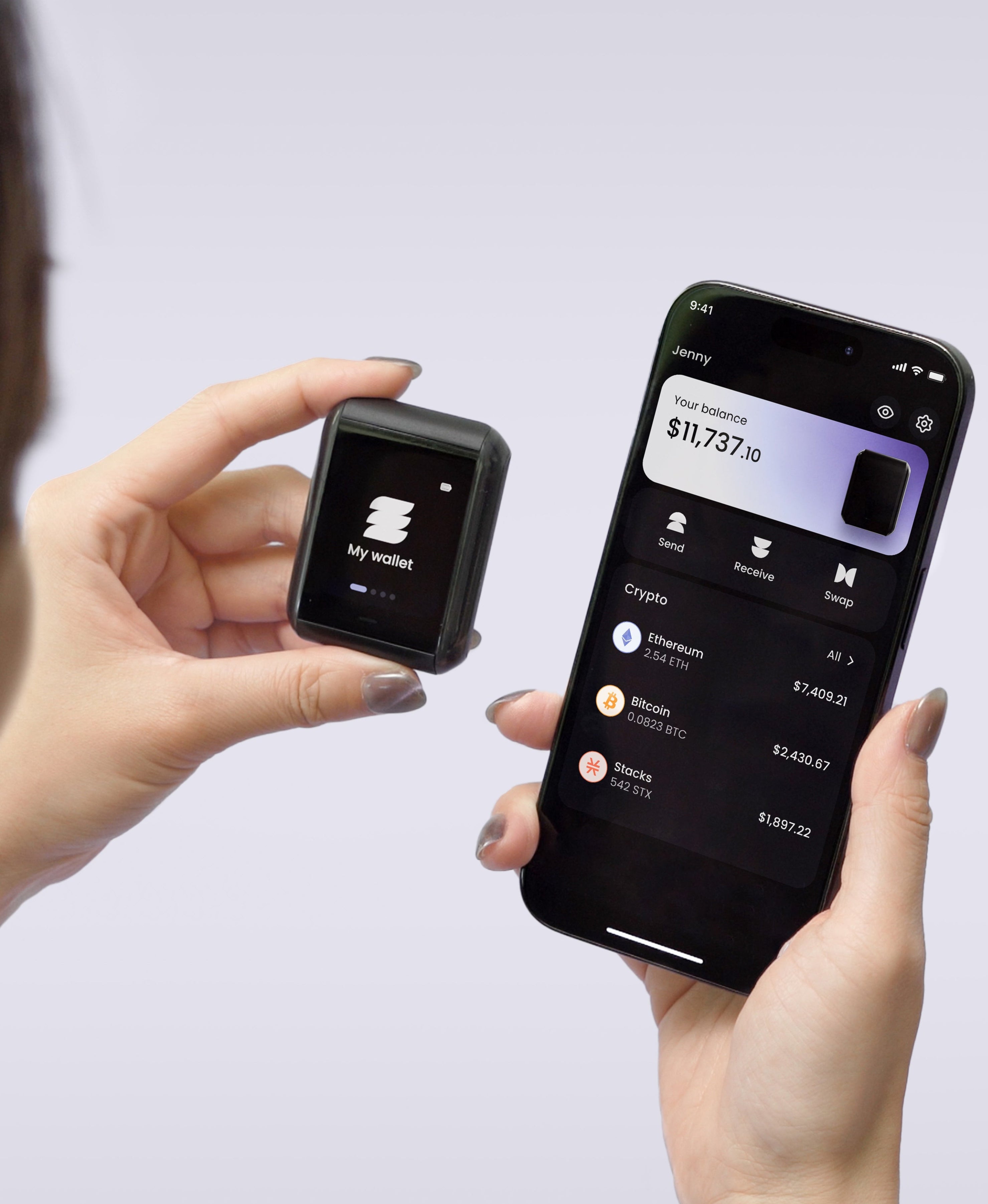
Ryder One is the only wallet on this list that combines distributed recovery with on-device transaction verification. During setup, your wallet is backed up with a single tap to a Recovery Tag. Your recovery is spread across multiple components — the tag, your phone, and optionally trusted contacts — using Shamir's Secret Sharing. No single piece holds enough information to access your wallet, so there's no single point of failure.
The Recovery Tag is waterproof, dustproof, and included in the box. You can add more tags over time for additional redundancy ($29 for a pack of two). There's no PIN to remember and no access code that could lock you out. If you ever need your seed phrase, it's accessible on the device, but you're never required to write it down or depend on it.
The AMOLED touchscreen means every transaction is verified on the device itself, not on your phone. This matters because it protects against malware that could alter transaction details before they reach the signing device — an attack vector that screenless wallets can't defend against.
Where it's strong: Recovery is the most resilient on this list. No single backup gives access. Expandable over time. On-device verification. Everything included in the box.
Where it's limited: Asset coverage is focused on mainstream chains: Bitcoin, Ethereum, Solana, and Stacks. If you need 6,000+ tokens or niche chains, Tangem covers more. Setup takes about 60 seconds, fast, but not as instant as tapping three Tangem cards.
Best for: People who want the most resilient recovery model, independent transaction verification, and a mobile-first experience without compromises on security.
2. Tangem

Price: ~$69.90 (3-card set)
Recovery: Card cloning — private key copied to backup cards
Screen: None
Connectivity: NFC only (air-gapped, portless)
Secure element: EAL6+ Samsung S3D232A
Asset support: 6,000+ tokens across 80+ blockchains
Security audit: Kudelski Security + Riscure (external)
Tangem is the most affordable hardware wallet on this list by a wide margin, and it's the simplest to understand. Your private key is generated on one card and cloned to one or two backup cards. If you lose your primary card, the backups take over. No words to write down, no complex setup.
The trade-offs are real, though. Each backup card is a full copy of your private key, protected only by an access code. If someone gets a card and your code, they have full access. If you forget your access code and don't have a second card to reset it with, you're locked out. And if you lose all your cards without having enabled the optional seed phrase feature, your crypto is gone permanently.
The biggest architectural difference from the other wallets on this list is that Tangem has no screen. All transaction details are displayed on your phone through the Tangem app. This means you're trusting your phone to show you accurate information before you tap to sign. If your phone is compromised, the card will sign whatever it receives. Wallet drainer attacks stole nearly $494 million from over 332,000 wallets in 2024 by manipulating what users see on their screen before signing. A device with its own display is the primary defense against this.
Tangem also experienced a security incident in late 2024 where a bug in the mobile app accidentally logged private keys for users who created wallets with the optional seed phrase feature. The issue was resolved quickly and affected fewer than 0.1% of users, but it's worth knowing.
Where it's strong: Price is unbeatable. Setup is dead simple. Asset coverage is the broadest on this list. Credit card form factor fits in your physical wallet.
Where it's limited: No screen means no independent transaction verification. Each backup card is a full key copy. Can't add more backups after initial setup. Access code lock-out risk. Firmware is immutable, so vulnerabilities can't be patched.
Best for: People getting started with self-custody, securing smaller amounts, or anyone who prioritizes affordability and simplicity above all else.
3. Cypherock X1

Price: $99–$199 (depending on bundle)
Recovery: Shamir's Secret Sharing across vault + 4 NFC cards (any 2 of 5 recovers)
Screen: OLED display with joystick navigation
Connectivity: USB-C
Secure element: EAL6+ (cards), dual-chip architecture (vault)
Asset support: 9,000+ tokens
Security audit: KeyLabs (external), open-source firmware
Cypherock takes the most aggressive approach to key distribution. Your private key is split into five shards using Shamir's Secret Sharing — one stored in the vault device, and one in each of four NFC cards. You need any two of the five to sign a transaction or recover your wallet. If you lose the vault and two cards, you can still recover with the remaining two cards and a new vault.
The X1 has an OLED screen and a joystick for on-device transaction verification, which means it doesn't rely on your phone or computer screen for signing — a genuine security advantage over Tangem.
The firmware is fully open source, which is the strongest transparency commitment on this list. Anyone can audit the code, verify the builds, and confirm there are no backdoors. This is a meaningful differentiator for security-conscious users who want to verify rather than trust.
The trade-off is complexity. Setup takes around 10 minutes and involves initializing the vault, pairing four cards, and distributing them. The USB-C connection means it's not air-gapped in the way Ryder One and Tangem are — the vault connects to your computer to sign transactions. The hardware is bulkier than a card or a compact device, and the learning curve is steeper than the other options.
Where it's strong: Most distributed key model: 5 shards, any 2 recover. Fully open source. On-device screen. Supports 9,000+ assets. Strong community and audit track record.
Where it's limited: USB-C connection, so not air-gapped. Bulkier form factor. Steeper learning curve. Requires managing 4 physical cards plus a vault. Desktop-first workflow.
Best for: Security-maximizers who want the most distributed key model, full open-source transparency, and are comfortable with a more hands-on setup process.
4. Bitkey

Price: ~$150
Recovery: 2-of-3 multisig — hardware device + phone app + Block's server (any 2 of 3 sign)
Screen: None (fingerprint sensor only)
Connectivity: NFC + USB-C (charging)
Secure element: Yes (custom)
Asset support: Bitcoin only
Security audit: Open source (app, firmware, and server code on GitHub)
Bitkey is built by Block, the company behind Square and Cash App, and it takes a fundamentally different approach from every other wallet on this list. Instead of generating a single private key and figuring out how to back it up, Bitkey uses a 2-of-3 multisig architecture. Three keys exist: one on the hardware device, one in the mobile app, and one encrypted on Block's servers. Any two of the three are needed to sign a transaction.
This means there's no seed phrase at all — not optional, not hidden in settings, just not part of the design. If you lose your phone, the hardware device and server key recover your wallet. If you lose the hardware device, the phone and server key handle it. If Block's servers go down, you can use the hardware device and phone together, plus an Emergency Access Kit that's stored in your cloud backup.
The recovery model is genuinely robust for its target audience. Bitkey also includes social recovery through trusted contacts, an inheritance feature for passing Bitcoin to family, and a 7-day security delay on recovery attempts to prevent unauthorized access.
The trade-offs are significant, though. First, one of your three keys lives on Block's servers. Bitkey can't move your funds unilaterally, but it means you're trusting a third party as part of your security model. For Bitcoin purists who believe self-custody means no third-party involvement, this is a dealbreaker. Second, Bitkey supports only Bitcoin — no Ethereum, no Solana, no tokens. Third, like Tangem, there's no screen on the device itself. Transaction details are reviewed on your phone, with the same blind signing trade-offs that apply to any screenless wallet.
The hardware is well-built — fingerprint scanner for biometric authentication, NFC for tap-to-sign, battery that lasts up to a year, and a distinctive design with a Corian top and stainless steel back. The app is polished and the setup experience is one of the simplest on this list. And the entire stack — app, firmware, server — is open source.
Where it's strong: Truly seedless, no seed phrase exists. Recovery is nearly foolproof for everyday users. Open source across the full stack. Inheritance feature. Built by a publicly traded company with deep engineering resources.
Where it's limited: Bitcoin only. One key lives on Block's servers, so it's not fully self-custodial in the traditional sense. No screen on the device. Relies on cloud backup for phone key recovery.
Best for: Bitcoin-only holders who want the simplest possible seedless experience and are comfortable with Block holding one of three keys.
How They Compare
Which One Should You Buy?
All four wallets on this list are genuine improvements over the traditional seed phrase model. Any of them is a better choice than writing 24 words on a piece of paper and hoping for the best. Here's how to decide.
You're new to self-custody and want the easiest entry
Go with Tangem. At ~$70, the barrier is as low as it gets. Setup is simple, the card fits in your wallet, and you don't need to understand cryptographic key sharding to get started. Just know the trade-offs: no screen, each backup card is a full key copy, and you can't expand recovery later.
You only hold Bitcoin and want seedless simplicity
Go with Bitkey. The 2-of-3 multisig model means recovery is nearly foolproof — you'd have to lose your phone, your hardware device, and your cloud backup simultaneously. The inheritance feature is a genuine differentiator. Just know that one key lives on Block's servers, so it's not fully self-custodial in the traditional sense.
You want maximum key distribution and open-source transparency
Go with Cypherock X1. Five shards, any two recover. Fully open-source firmware with reproducible builds. On-device screen for transaction verification. If you're the kind of person who verifies code before trusting it, Cypherock was built for you. The trade-off is a USB-C connection and a steeper learning curve.
You want the best balance of resilient recovery, on-device verification, and simplicity
Go with Ryder One. TapSafe gives you distributed recovery by default — no single backup gives access. The AMOLED screen gives you independent transaction verification. The NFC-only design keeps the attack surface minimal. Everything you need is in the box, there's no PIN to forget, and you can add more recovery layers over time. It's the only wallet on this list that checks every box: distributed recovery, on-device verification, air-gapped design, and expandable backups.
The right wallet depends on what you're securing, how much complexity you're willing to manage, and what trade-offs you can live with. But if you're reading this article, you've already made the most important decision: you don't want to depend on a piece of paper to protect your crypto.
Frequently Asked Questions
Is it safe to use a hardware wallet without a seed phrase?
Yes — if the alternative recovery method is well-designed. The seed phrase itself was never the security; it was just one way to back up a private key. Wallets like Ryder One, Cypherock X1, and Bitkey use cryptographic methods that are arguably more resilient than a single piece of paper, because they eliminate the single point of failure that a seed phrase creates.
What is Shamir's Secret Sharing?
It's a cryptographic method that splits a secret, like a private key, into multiple pieces, where no single piece reveals anything on its own. You define a threshold, for example any 2 of 3 pieces, and the secret can only be reconstructed when enough pieces are brought together. Ryder One uses this for TapSafe Recovery, and Cypherock X1 uses it for key sharding across its vault and cards.
Is Tangem safe without a screen?
For everyday use with smaller amounts, Tangem's phone-based verification is reasonable. But for larger holdings or DeFi interactions, the lack of an independent screen means you're trusting your phone to show you accurate transaction details. If your phone is compromised by malware, the card will sign whatever it receives without knowing the transaction was altered. This is the blind signing risk that on-device screens are specifically designed to prevent.
Can you recover a Ryder One without the seed phrase?
Yes. That's the whole point of TapSafe. Your recovery is distributed across a Recovery Tag, your phone, and optionally Recovery Contacts. You can recover your wallet using these components without ever needing the seed phrase. The seed phrase is still accessible on the device if you ever want it, for example to import into a different wallet, but you're never forced to depend on it.
What happens if Block shuts down and I have a Bitkey?
Bitkey includes an Emergency Access Kit that's stored in your cloud backup. This allows you to recover your Bitcoin using the hardware device and the kit, even if Block's servers are no longer available. The entire codebase is also open source, so the recovery process could be replicated independently.
Can I switch from a seed phrase wallet to a seedless one?
Yes. Ryder One specifically supports importing an existing seed phrase from another wallet and layering TapSafe recovery on top of it. This means you can migrate from a Ledger or Trezor without moving funds — just import the seed phrase into Ryder One and set up TapSafe as your new recovery method.
Ready to Go Seedless?
Ryder One makes self-custody simple and secure. No seed phrase handling required, every transaction verified on-device, and everything you need is in the box. Learn more about TapSafe Recovery and get your Ryder One today.


Share: