

Air-gapped signing has become the headline feature in hardware wallets, and the Keystone wallet is the device most people picture when they hear the term. Ryder One arrives at a similar destination by a different road: no Bluetooth, no Wi-Fi, no wired data path, and one short-range radio you have to hold your phone against. Both keep your keys away from anything an attacker can reach over a network. Where they separate is in how each one feels to live with, and in what has to happen on the day your backup gets used for the first time.
We build one of these two. Everything below about Keystone comes from its own store listing and from independent reviews, and where the comparison flatters us less, we've said so.
What the Keystone wallet gets right
Keystone picked one idea and committed to it. The Keystone 3 Pro signs transactions by showing a QR code on its screen and reading one back from your phone's camera, and the charging port carries power only, with no data path in or out. There's no Bluetooth radio, no Wi-Fi, and no NFC. If you want the strictest reading of "this device never touches another machine," Keystone gives you that in a way you can watch happen.
The screen is the other thing it does better than almost anyone. At four inches it's the largest display on a consumer hardware wallet, which matters more than it sounds: a long receiving address is easier to check on a screen you can read at arm's length, and the extra room lets the device print transaction detail in full instead of truncating it. A fingerprint sensor handles unlocking, and the device holds up to three separate wallets, each with its own passcode.
Inside are three separate security chips, listed by Coin Bureau's teardown as the Microchip ATECC608B, the Maxim DS28S60, and the Maxim MAX32520, splitting seed storage and fingerprint data across more than one part. The firmware is open source with published audit reports, so anyone motivated enough can read what the device is meant to be running. On coverage it's ahead of most of the field, supporting more than 5,500 assets across 200-plus blockchains and pairing with over 45 software wallets.
Backup is where Keystone made an unusual choice for a mainstream device: it supports Shamir Backup under the SLIP-39 standard, so you can split a recovery seed into several shares and set how many are needed to rebuild it, whether that's two of three or five of ten.
Best for: People who want QR-only air gapping they can see with their own eyes, a wide altcoin list, and a big screen for verifying what they're signing.
Worth knowing: A few things. The official store lists the device at $149, but the microSD card that some firmware updates require isn't in the box, so the working price is a little higher than the sticker. The four-inch screen makes it the bulkiest option in its class, which is a fair trade for readability and an awkward one for a pocket. Keystone leans on third-party software wallets rather than shipping a full app of its own, and native staking isn't available for most assets. Its three chips are named openly, though the company doesn't publish a single certification grade for them the way some competitors do for one part.
What Ryder One gets right
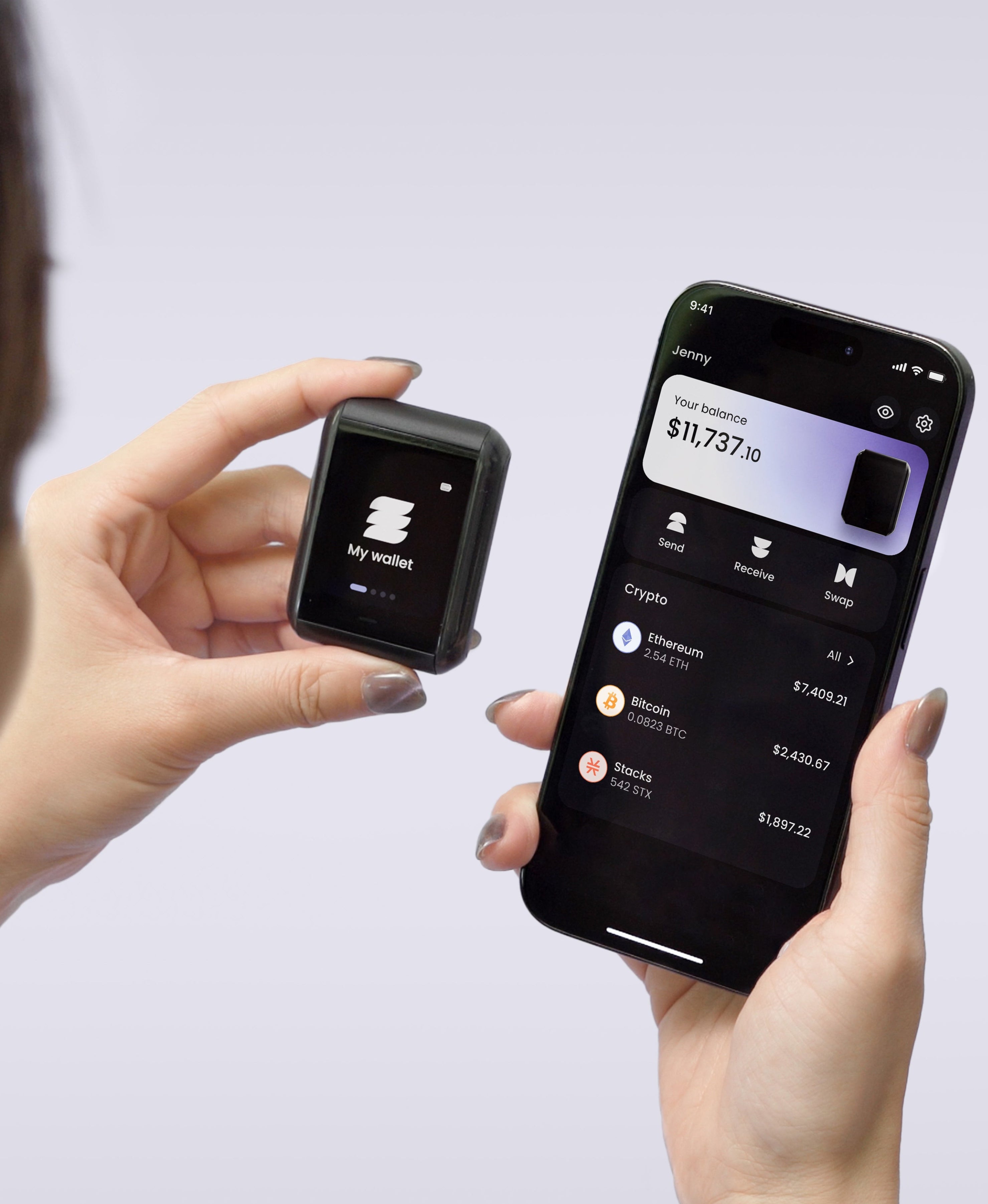
The Ryder One is $149.00 for the Starter Combo and $179.00 for the Super Safe Combo, which adds extra Recovery Tags. It measures 41 x 55 x 14.5 mm and weighs 38 grams, runs a 1.6-inch AMOLED touchscreen at 320 x 360, and wireless-charges over Qi using the charger included in the box. It's rated IP67 and won a Red Dot Product Design Award in 2026.
Keys are generated inside an EAL6+ certified Infineon SLC38 secure element and never leave the chip. The firmware was independently audited by Halborn, with the full report published rather than summarised. Communication runs over NFC and nothing else, so there's no Bluetooth radio and no wired data transfer, and the confirmation button is wired directly to the secure element so no software path can sign without a finger on it. Transactions render in readable detail before you approve them, and the passcode keypad shuffles its digits on every unlock so anyone watching over your shoulder learns nothing from your finger movements.
Best for: People holding Bitcoin, Ethereum, Solana and major ERC-20 or SPL tokens who want a wallet small enough to carry daily and a backup that doesn't live on paper.
Worth knowing: There's a 200 mAh battery to keep charged, and the supported asset list is narrower than a wallet chasing the long tail of altcoins.
Side by side
| Keystone 3 Pro | Ryder One | |
|---|---|---|
| Price | $149 (microSD sold separately) | $149.00 (Starter), $179.00 (Super Safe) |
| Air gap method | QR codes and microSD, power-only charging port | NFC only, no other radio |
| Screen | 4-inch touchscreen | 1.6" AMOLED touch, 320 x 360 |
| Unlock | Fingerprint sensor | Randomised passcode keypad |
| Key storage | Three security chips (ATECC608B, DS28S60, MAX32520) | EAL6+ Infineon SLC38, keys generated in-chip |
| Firmware transparency | Open source, audits published | Halborn audit published in full |
| Assets | 5,500+ across 200+ chains | Bitcoin, Ethereum, Solana, major ERC-20 and SPL tokens |
| Backup model | SLIP-39 Shamir shares, written down by you | TapSafe Recovery, shares held in objects you own |
| Seed phrase | Written at setup | Available on-device as a last resort, BIP-39 |
| Size | Bulkiest in class, four-inch body | 41 x 55 x 14.5 mm, 38 g |
The backup question, where the two designs part company
Both companies looked at the twelve-word card and decided it was the weak point, so it's worth being precise about what each one does instead, because the two answers sound similar and behave nothing alike.
Keystone's Shamir Backup splits your recovery material into shares under SLIP-39, and that's a stronger arrangement than one card in one drawer. The catch is what a share is. Each one arrives as another list of words that you have to write down, store somewhere sensible, and keep readable for as long as you hold crypto. Splitting one seed phrase into three means you now have three written secrets to protect instead of one, and most people who try it discover the storage problem multiplied rather than shrank.
TapSafe Recovery uses the same underlying maths, a custom implementation of Shamir's Secret Sharing, and puts the shares into things instead of words. Your Recovery Tag holds 50%, draws its power from the tap itself, and is IP69K rated so it survives water jets, dust, and temperature extremes. Your paired phone holds the other 50%, encrypted into your own iCloud or Google Drive rather than sitting on the handset, so losing the phone doesn't lose the share. Bring the tag and the phone together and the wallet comes back. Recovery Contacts are optional: people you pick, holding 25% each, seeing nothing about your wallet, set up in person with a tap.
Metal plates are the usual upgrade people reach for once paper starts to worry them, and stamped steel does survive a house fire in a way an index card won't. What it doesn't change is the shape of the risk, since your access still depends on one object staying intact and staying private. Splitting the secret across objects that each mean nothing alone is the part that removes the single point of failure, and it's the reason we built the recovery system before we finished the device.
The seed phrase doesn't disappear on either wallet, and we'd be suspicious of any company claiming it had. On the Ryder One it stays reachable on-device as a last resort and follows the BIP-39 standard, so your keys can walk to any other wallet whenever you want them to. What changes is that nothing in ordinary use makes you depend on it.
Which one should you buy
Buy the Keystone 3 Pro if the QR-only air gap is the feature you care about most, if your holdings run deep into altcoins that a focused wallet won't cover, or if a four-inch screen would make you check addresses you'd otherwise skim. It's a well-built device from a company that publishes its code, and for a certain kind of careful holder it's the obvious pick.
Buy the Ryder One if you want your keys generated inside certified silicon with an audit you can read end to end, if you'd rather carry something the size of a matchbox than something the size of a phone, and if the backup being distributed across objects rather than word lists sounds like the version you'd still trust in five years. Setup runs three taps and takes under a minute, which sounds like a small thing until you compare it to an evening spent writing SLIP-39 shares.
The summary we'd give a friend: Keystone wins on breadth and on the visible air gap, Ryder One wins on size, on certification, and on a backup that doesn't hand you more paper to protect. Either one beats leaving coins on an exchange, and that comparison is the one most people should be making first.
Ready for a backup with no single point of failure? Get your Ryder One.
Meta description: Keystone wallet vs Ryder One compared: price, air-gap method, secure chips, supported assets, and how each one handles backup when your seed has to work.


Share: